











The Courage to Feel Where True Connection and Leadership Begin
Leadership today requires more than strategy, technical expertise, or hitting performance metrics. In an era of rapid change, uncertainty, and widespread burnout, people are seeking leaders who are not only competent but also deeply human, able to genuinely connect with others. We seek leaders who can connect, empathize, and create environments where people feel seen, valued, and supported.
At the heart of this kind of leadership is emotional mastery. Emotions shape how we think, make decisions, and relate to others. Yet many organizations still operate as though emotions don’t belong at work. To lead humanistically, we must flip this script: becoming comfortable with our own emotions, understanding those of others, and inviting people to bring their whole selves to work. We examine why emotional fluency is crucial to effective leadership and provide practical steps for cultivating it.
Human Connection is a basic human requirment that is part of our DNA.
The DNA of Connection: We are Wired to Connect
Human beings are wired for connection. Neuroscience, psychology, and evolutionary biology all point to one truth: belonging is not optional; it is fundamental. Social neuroscientist Matthew Lieberman has shown that our need for connection is as critical to survival as food or shelter. Yet many organizations still operate as though people are machines, valued only for output, efficiency, and performance metrics.
This mechanistic view creates workplaces where emotions are suppressed, relationships are transactional, and leaders are expected to remain detached. But the truth is, we are not robots. We bring our whole selves, our hopes, fears, and feelings, into every meeting and decision. When leaders deny this reality, people disengage. When leaders embrace it, people thrive.
Humanistic leadership is about recognizing this DNA of connection and creating conditions where emotions are acknowledged, respected, and harnessed for collective success. To do so, leaders must first master their own emotional lives and then support others in navigating theirs.
Shifting from transactional to relational interactions
- Professional distance to true caring
- Self-interest to mutual interest
- What you get to what you give
- Stay in touch to keep informed
- Judge the results to evaluate the relationship
- Win the conflict to resolve it
- Agreement to acceptance
Why Emotions Matter in Leadership
For much of modern history, leadership has been viewed as a rational pursuit, centered on logic, strategy, and decision-making. Emotions were often seen as distractions, best left outside the boardroom. Yet decades of research across neuroscience, psychology, and organizational studies reveal the opposite: emotions are not obstacles to leadership effectiveness; they are its foundation. There are two reasons why emotions are so pervasive and important in leadership:
- Emotions are decision-making aids: clarity on one’s own emotions helps make the right choices.
- Emotions are the glue that holds social interactions together. Leadership is a social role, and understanding and lifting others’ emotions is a requirement for successfully inspiring others and creating optimal environments.
Emotions as decision-making aids
Neuroscientist Antonio Damasio demonstrated this in his groundbreaking work Descartes’ Error. Studying patients with brain injuries that impaired emotional processing, Damasio found that although these individuals could still reason logically, they struggled to make even the simplest decisions, such as what to eat for lunch. Without access to emotion, decision-making stalls. Emotions, in other words, are not the enemy of reason; they are the compass that gives our reasoning direction.
Emotions as the glue of social interactions
Gallup’s State of the Global Workplace report (August 2025) revealed that global engagement declined from 23% to 21%, resulting in organizations losing hundreds of billions in productivity. But the research also highlights a critical differentiator: people are far more likely to be engaged when they believe someone at work genuinely cares about them as a person. This single factor, feeling cared for, emerges as one of the strongest predictors of engagement across cultures and industries. Conversely, when managers themselves are disengaged, which Gallup found to be increasingly common (with a decline from 30% to 27% engagement among managers), teams often mirror that disconnection.
Similarly, Harvard professor Amy Edmondson’s research on psychological safety underscores that the highest-performing teams are not those that avoid mistakes, but those that feel safe enough to acknowledge them. When people feel safe to express concerns, share emotions, or admit uncertainties, teams innovate more, learn faster, and adapt better. Emotional safety, therefore, is not “soft,” it is a performance multiplier.
Taken together, these insights highlight a crucial truth: ignoring emotions undermines performance, while engaging with them authentically unlocks potential. Leaders who cultivate emotional awareness and connection are better decision-makers, build stronger teams, and foster healthier organizational cultures.
Your HEART is the gateway to your soul, The DOORWAY to your humanity, and gives you CAPACITY to fully experience life.
The Journey to Master Emotions
Developing the ability to work skillfully with emotions is not a one-time skill you pick up in a workshop; it is a journey. It requires patience, consistent reflection, and a willingness to stretch beyond what feels comfortable. There will be setbacks along the way, but the effort will ultimately pay off. Leaders who commit to this path find that emotional mastery not only strengthens their own decision-making and resilience but also enhances the trust, connection, and creativity of the people around them.
1. Becoming More Self-Aware of Our Own Feelings
Self-awareness is the foundation of emotional mastery. Leaders who are blind to their own emotions often act reactively, projecting frustration, stress, or anxiety onto others. By contrast, self-aware leaders can pause, reflect, and choose their response.
The mission is to recognize when we are facing fear, explore where it is coming from, acknowledge it, and move through the feeling until it leaves us.
This does not mean indulging every feeling. It means being honest with us about what we feel and why, so that we can lead with clarity instead of confusion.
- Notice Your Micro-Reactions – Pay attention to subtle physical cues, such as clenched jaws, tapping feet, or tightened shoulders. These often reveal emotions before you’ve consciously named them.
- Practice Emotional Labeling- When you feel something, pause and give it a name. Research shows that simply labeling an emotion can reduce its intensity and increase clarity.
- Seek Behavioral Mirrors – Ask a trusted colleague or friend what emotions they see you express most often. Others can often spot patterns you miss in yourself.
2. Building an Emotional Needs Vocabulary
Many of us struggle to find the words to describe our emotional experiences accurately. We default to vague terms like “stressed” or “fine,” which obscure what’s really happening. A richer emotional vocabulary enables leaders to discern the nuances of their emotions and communicate them constructively.
For example: “stressed” could mean overwhelmed, uncertain, frustrated, or even excited. Each requires a different response. Expanding our vocabulary helps us meet both our own needs and those of others more effectively. Tools like Plutchik’s Wheel of Emotions and Marshall Rosenberg’s Feelings Inventory are great starting points.
- Use tools like Plutchik’s Wheel of Emotions or Rosenberg’s Feelings Inventory.
- Distinguish between surface emotions (anger) and underlying needs (respect, clarity, fairness).
- Encourage precise language in team conversations.
3. Understanding the Needs and Emotions of Others
Humanistic leadership is not only about self-awareness but also about attunement to others. Emotions are rarely random; they signal underlying needs. Joy often reflects needs being met—such as belonging, recognition, and autonomy—while frustration, sadness, or fear often point to unmet ones.
When those needs go unaddressed, disharmony emerges. Fears trigger defensiveness, unmet needs for respect or clarity spark resentment, and communication begins to break down. Over time, this leads to stagnation, disengagement, or conflict.
Understanding others’ needs allows leaders to decode what people may not yet recognize or feel comfortable expressing. Many avoid naming their deeper needs out of fear or lack of awareness. By listening beneath the surface, leaders can help unlock another’s emotional world—making the unspoken visible.
This kind of empathy isn’t soft; it’s practical. By identifying and addressing needs, leaders transform hidden tensions into trust, connection, and healthier collaboration.
Research in the Harvard Business Review confirms that empathetic listening is correlated with higher engagement and loyalty.
- Ask open-ended questions: “What’s been most challenging for you about this?”
- Mirror back what you hear: “It sounds like you’re feeling anxious because of the uncertainty.”
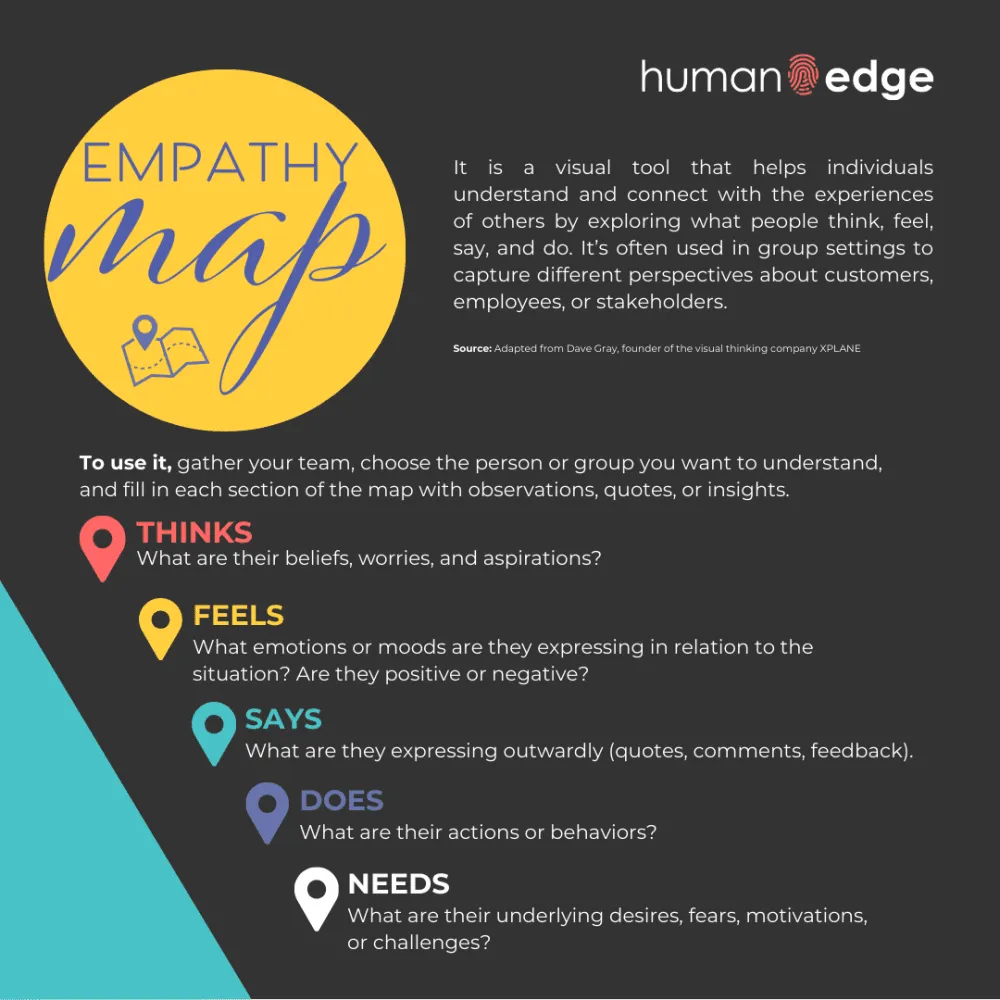
- Use empathy maps in group settings to explore what people think, feel, say, and need.
4. Getting Comfortable with Messy Emotions
Workplaces often reward positivity while discouraging the expression of more difficult feelings, such as grief, anger, or fear. Yet, these emotions are part of life, and they inevitably manifest in work contexts.
Leaders who avoid messy emotions risk creating cultures of silence, where unspoken frustrations or hurts erode morale. Leaders who embrace them, however, normalize authenticity. They demonstrate that emotions are not threats to productivity but signals that can guide healthier decisions and relationships.
- Open meetings with short emotional check-ins or “temperature checks.”
- Set ground rules for emotional conversations: no fixing, no judging, just listening.
- Share your own experiences appropriately to model vulnerability.
5. Expanding Our Emotional Range
Most people operate within a narrow emotional range, experiencing happiness, sadness, anger, and stress. But human beings are capable of a far wider spectrum: awe, tenderness, gratitude, melancholy, joy, hope, envy, relief, and more.
Psychologist Lisa Feldman Barrett calls this “emotional granularity.” Research shows that people who can differentiate their emotions more precisely are better at regulating them and less likely to become overwhelmed. For leaders, a broader emotional range enables more nuanced communication and fosters deeper connections with others.
- Pause when you feel “bad” or “stressed” and ask, “What specifically am I feeling?”
- Use art, music, or literature to explore emotions outside your daily range.
- Introduce emotion wheels in workshops to expand team vocabulary.
6. Naming What People Are Really Feeling
One of the most courageous acts of leadership is naming the unspoken. Emotions don’t disappear when they are ignored; they linger under the surface, shaping behavior and decision-making.
When a leader says, “I sense there’s frustration in the room. Should we talk about it?” they bring hidden dynamics into the open. This act of naming creates space for dialogue, reduces tension, and signals that emotions are not taboo. It’s not about being a therapist, it’s about being human.
- Voice what you sense in the room: “I’m noticing some hesitation—does that resonate?”
- Balance task and emotional levels by asking, “We’ve aligned on the plan, but how do people feel about it?”
- Always check for accuracy rather than assuming your interpretation is correct.
Bringing Our Whole Selves to Work
We live in a time when machines can think, but they cannot feel. What sets human leaders apart is not their efficiency but their humanity. Mastering emotions does not mean being ruled by them; it means becoming fluent in the language of human experience, our own and others’.
When leaders cultivate self-awareness, build emotional vocabulary, empathize with others, embrace messy emotions, expand their range, and courageously name what is present, they create workplaces that reflect our DNA of connection. These are environments where people feel seen, heard, and valued.
Humanistic leadership is not soft. It is strong, demanding, and deeply necessary. It is how we bring our whole selves to work and invite others to do the same. And it is how we will lead, not just with our heads, but with our hearts.


