











In today’s world of constant pressure, complexity, and acceleration, leaders often look outward for answers, strategy, structure, technology. But the most enduring leadership advantage is built inward. A consistent spiritual practice, whether through meditation, reflection, prayer, or mindfulness, is not just a personal choice. It is increasingly a leadership capability grounded in science.
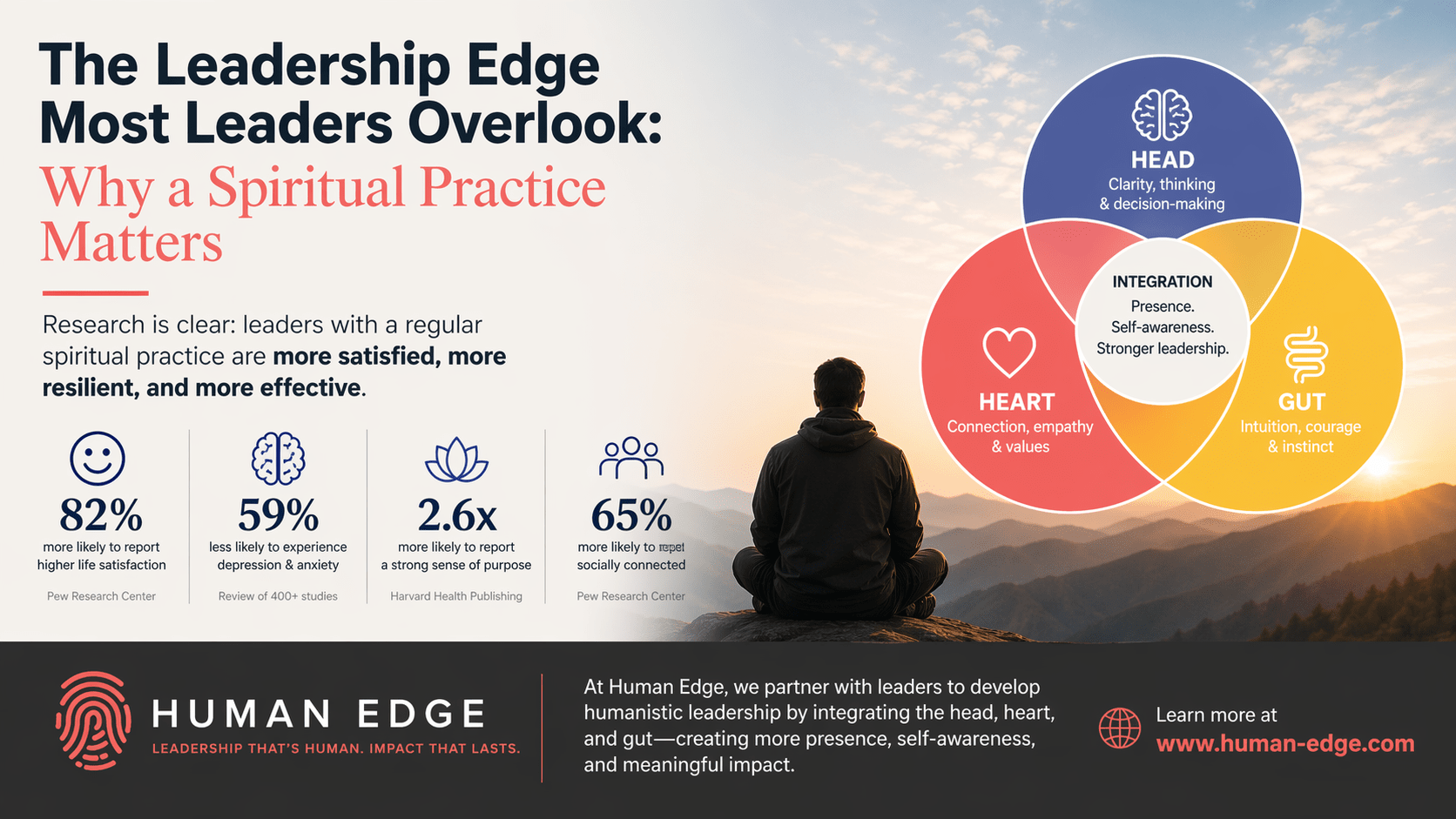
The Research Is Clear: Spiritual Practice Elevates Well-Being
A growing body of research shows a strong connection between spiritual practice and overall life satisfaction:
- People who engage regularly in spiritual or religious practices are significantly more likely to report being “very happy” compared to those who do not.
- Large-scale reviews of hundreds of studies show that higher spiritual engagement is consistently linked to greater life satisfaction, better mental health, and lower rates of depression and anxiety.
- Global data from Pew Research Center shows that individuals actively engaged in spiritual communities are happier and more socially connected than those who are not.
Even more compelling, research suggests the relationship is not superficial, it is systemic. Spiritual engagement influences emotional regulation, resilience, and meaning-making, all of which are foundational to human performance.
For me personally having a regular spiritual practice keeps my heart open and a willingess to accept my self and others more readily. At times, it feels indulgent to mediatate when I have so much going on but in reality I find it grounds me and gives me the sustenance to move forward.
Dwelling in the present moment, in the face of everything that would call us out of it, is our highest spiritual discipline.
It Builds the Inner System Leaders Rely On
Studies on mindfulness and contemplative practices show that regular practice:
- Reduces stress and anxiety
- Improves emotional regulation
- Enhances overall well-being and resilience
In one quantitative study, individuals who engaged in spiritual practices reported stronger emotional balance, resilience, and a deeper sense of purpose in life.
This matters for leadership. Because leadership is not tested when things are easy. It is tested under pressure. And under pressure, leaders don’t rise to their intentions. They fall back on their internal state.
To stay present in everyday life, it helps to be deeply rooted within yourself; otherwise, the mind, which has incredible momentum, will drag you along like a wild river.
Why This Translates Directly Into Leadership Effectiveness
A spiritual practice strengthens three capabilities that define effective leadership:
1. Clarity under pressure Spiritual practices train the mind to pause, observe, and respond, rather than react. This is the difference between reactive leadership and intentional leadership.
2. Emotional mastery Leaders who regulate their internal state create psychological safety. Research shows that emotional balance and resilience are directly enhanced through spiritual engagement.
3. Sense of purpose and meaning Spirituality helps individuals connect to something beyond themselves. That connection fuels meaning, and meaning fuels motivation, persistence, and inspiration.
4. Self-Acceptance Leaders become more self-accepting and compassionate and this leaves room for human-centered leadership which drives engagement and committment. In the end people want to be seen and valued.
And this is where leadership shifts from transactional to transformational.
The Hidden Multiplier: Satisfaction Fuels Performance
One of the most overlooked insights in leadership is this:
Leaders who are more fulfilled internally lead more effectively externally.
Research consistently shows that individuals with spiritual practices experience:
- Higher life satisfaction
- Greater happiness
- Stronger coping mechanisms
- Increased resilience in adversity
This is not just about feeling better. It’s about functioning better.
When leaders are grounded, they:
- Make better decisions
- Navigate ambiguity more effectively
- Build stronger relationships
- Sustain energy over time
A Practical Reframe for Leaders
A spiritual practice does not require religion. It requires intention and consistency.
It can look like:
- 10 minutes of daily reflection
- Mindfulness or meditation
- Journaling to process thoughts and emotions
- Quiet time to reconnect with purpose
- Prayer
- Joining a spiritual community where you grow together
The form matters less than the discipline. Because over time, the practice builds something far more powerful than a habit. It builds inner leadership.
Final Thought
In a world obsessed with external performance, the leaders who stand out are those who have done the internal work.
Not because it sounds good. But because the data is clear.
Spiritual practice is not a “nice to have.” It is a performance advantage, a resilience engine, and ultimately, a leadership differentiator.
And in a world that is only becoming more complex, that inner edge may be the most important one you develop.
Where This Becomes Real: Human Edge
At Human Edge, this is exactly the work we do with leaders.
We help leaders move beyond performance alone into humanistic leadership, a values-driven approach grounded in trust, empathy, and human development. Research shows that humanistic leadership centers on dignity, self-awareness, and helping people reach their full potential, while fostering meaning and connection at work .
Our focus is on integrating the head, heart, and gut:
- Head → clarity, thinking, and decision-making
- Heart → connection, empathy, and values
- Gut → intuition, courage, and instinct
When these are aligned, leaders show up with greater presence, self-awareness, and impact.
Through assessment, development, and coaching, we help leaders strengthen this inner system—so they don’t just perform better, they lead differently.
Because in the end, leadership is not just about what you do. It’s about who you are when it matters most.


