










From “Who is ready now?” to “What evidence do we trust for the leaders we need next?”
The old promise of leadership assessment was objectivity. The new expectation is integration: better evidence, clearer decisions, inclusive experience, faster development follow-through, and enough human judgement to make the data trustworthy.

The question has changed
For years, leadership assessment sat quietly inside selection, succession, or development. It was useful, sometimes respected, often fragmented. Now it is being pulled into a more strategic conversation. In client discussions, HR leaders are asking less, “Which instrument should we use?” and more, “What kind of leadership evidence will help us make braver, fairer, more future-ready decisions?” That shift matters. It suggests assessment is no longer a diagnostic event. It is becoming part of the operating system for leadership.
The market is growing because confidence is falling
Gartner’s Market Guide for Leadership Assessments, published on 29 June 2026, makes the tension clear: only 21% of HR leaders were confident in the strength of their leadership bench in 2025, down from 30% the year before. Gartner also reports that just 43% of CHROs were confident that HR could deliver on succession-management objectives over the next 12 to 18 months.
The surprising part isn’t that organizations worry about leadership readiness. The real surprise is how often they still rely on fragmented, internally managed assessment practices for the decisions where failure is most costly. In my experience, this is where many organizations fall short. Most lack a clearly thought-through assessment strategy. Assessments are often used selectively, such as when hiring senior leaders or running leadership development programs, rather than as part of an integrated approach to understanding leadership potential, readiness, and development needs.
As a result, leaders can become frustrated. They may complete similar assessments across different programs, receive familiar feedback, and walk away with little new insight. Instead of building a richer picture of leadership capability over time, assessment becomes repetitive, disconnected, and underused.
What we hear from clients
Three themes keep surfacing. First, leaders are being asked to do harder work: lead through AI disruption, ambiguity, cost pressure, and exhausted teams. Second, the leadership pipeline feels thinner than the org chart suggests; names exist, but readiness is less clear. Third, HR is tired of assessment results that create insight but no movement. A beautiful report that does not change a promotion decision, accelerate a successor, or reshape a development plan is increasingly hard to defend.
Gartner’s view: from tools to strategy
Gartner describes a market moving toward holistic solutions across the talent life cycle, with organizations seeking to consolidate disjointed legacy tools and reduce vendor sprawl. Gartner’s recommendation is explicit: audit current leadership assessments, build an intentional strategy tied to business priorities, avoid defaulting to incumbents, and evaluate vendors on legitimacy, customization, support, analytics, user experience, pricing, responsible AI, privacy and integration.
This is an important distinction: Gartner is not simply saying “buy more assessment.” It is saying:
Assessment needs governance, evidence and postassessment accountability.
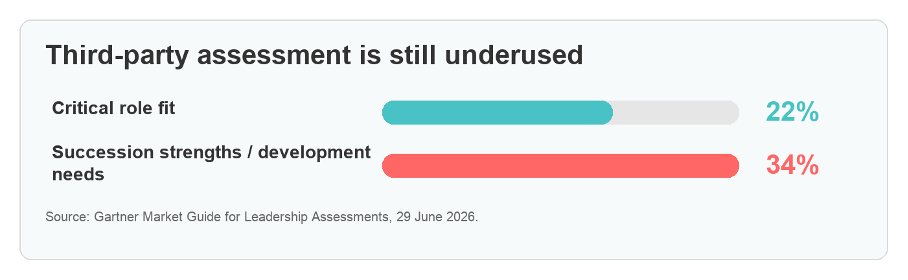
Gartner-derived data point from the Market Guide.
Leadership assessment is becoming a trust mechanism
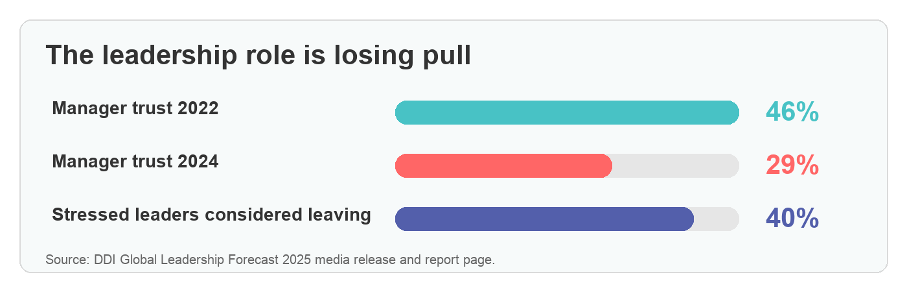
Outside Gartner, the trust story is equally sharp. DDI’s Global Leadership Forecast 2025, based on 10,796 leaders and 2,014 organizations, reports that trust in immediate managers fell from 46% to 29% between 2022 and 2024. DDI also reports that 40% of stressed leaders have considered leaving leadership roles to improve wellbeing. For HR, the implication is provocative: assessment is not only about identifying who can perform. It is also about whether the organization can create credible leadership journeys that people still want to join.
This is where CORE™ Leadership adds an important lens. Our assessment looks at human performance: how leaders manage their energy, sustain effectiveness, and recognize when pressure is becoming unsustainable. It can help identify when a leader may be moving toward burnout, creating an opportunity to intervene before they hit the wall. In one case, I was giving feedback to a Country Manager whose human performance results suggested he was heading toward serious depletion. The conversation gave him language for what was happening and a practical way forward. He chose to take a month away to rebalance, then returned with renewed focus, greater rigor and a clearer plan for sustaining himself. This is the power of integrated assessments.
The future-ready leader is not only more digital
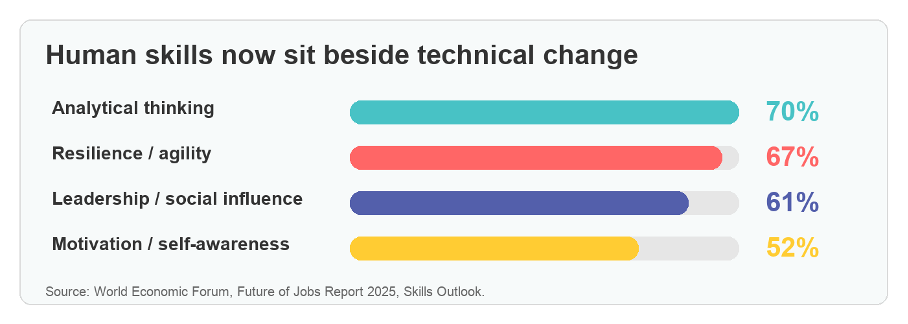
The World Economic Forum’s Future of Jobs Report 2025 points to a clear shift. The skills leaders need most are not only technical. They are also deeply human. Employers identify analytical thinking as essential for seven in ten companies. But other capabilities sit close behind: resilience, agility, leadership influence, motivation, self-awareness, curiosity, lifelong learning and talent management. These ten critical competencies can be grouped into four major categories.
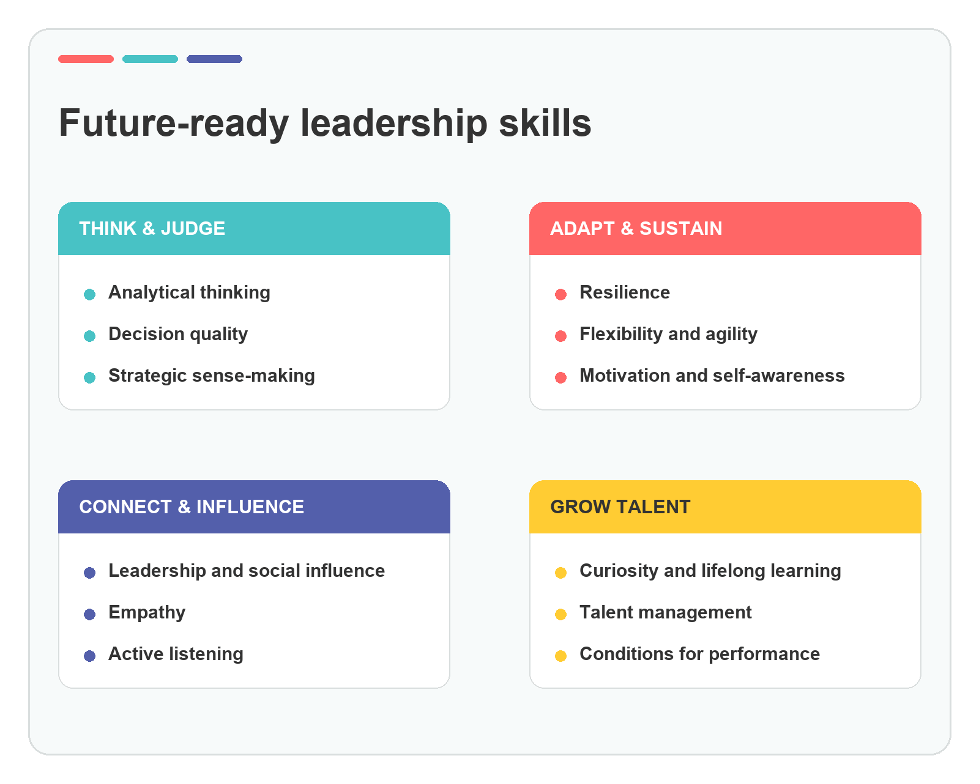
Seen together, these skills tell a bigger story. Future-ready leadership is not one capability. It is a connected set of behaviors. Leaders need to think and judge well. They need to adapt and sustain their energy. They need to connect and influence others. And they need to grow talent by creating the conditions where people can perform.
This is the important insight for assessment:
Technical change is raising the premium on human capability.
It is no longer enough to assess leaders against static competency checklists. Organizations need to understand how leaders learn, decide, connect, adapt and enable others over time. That is where leadership assessment becomes more powerful: not as a snapshot of what someone knows today, but as evidence of how they will lead through what comes next.
The AI paradox
Gartner notes that AI use in leadership assessment is expanding across adaptive simulations, AI chat interviews, automated scoring, proctoring, adverse-impact analysis, personalized reports, learning journeys and AI coaching. Yet Gartner also cautions that much application has been cosmetic so far, with greater uptake in outputs because development use cases carry lower regulatory risk. Outside Gartner, SIOP’s guidance on AI-based assessments follows a similar principle:
AI-based tools used for hiring and promotion should meet the same scrutiny as traditional employment tests, including evidence of prediction, consistency, fairness, and audit documentation.
“Fast” is not the same as defensible
This is where HR needs to be deliberately skeptical. AI can make assessment faster and more scalable. It can also make poor construct design look modern. The OECD’s 2025 work on algorithmic management, drawing on more than 6,000 firms across six countries, finds that such tools are already common and can improve perceived decision quality, while also raising concerns about unclear accountability, difficult-to-follow logic and worker wellbeing. The EU AI Act similarly treats AI systems used in recruitment and worker management as high-risk where they affect career prospects, rights and livelihoods.
The insight is uncomfortable: the more assessment influences careers, the more transparency and human oversight become part of product quality.
Inclusion is no longer an accommodation layer
Gartner highlights neuro-inclusive design as a rising market expectation: reducing ambiguous phrasing, limiting forced-choice formats, training assessors to interpret results through a neuro-inclusive lens, improving accessibility features, and checking for differential item functioning and disparate impact. This reframes fairness. Inclusion is not something added after an assessment is built. It is a design criterion from the start. In client language, this often sounds like:
We need evidence, but we cannot afford evidence that quietly excludes the very leadership diversity we are trying to build.
What this means for Human Edge CORE
This is the context in which Human Edge CORE belongs. CORE is best positioned not as another assessment product, but as an integrated leadership offering that responds to the market shift: assessment, interpretation, coaching, development planning, and leadership conversation in one connected experience. The value is not the test alone.
It is the disciplined movement from evidence to insight, from insight to readiness, and from readiness to stronger leadership decisions.
The CORE response to the shift
Gartner’s research points to the need for assessment that is more integrated across the talent lifecycle. CORE connects selection, succession, development, and coaching around a shared picture of leadership potential and capability.
DDI’s trust data highlights the need for leaders who build confidence, meaning and growth. CORE turns assessment into a developmental conversation, not just a judgment event.
The World Economic Forum’s skills data shows that future leadership will depend on human and adaptive capabilities. CORE helps surface the patterns behind judgement, resilience, influence and learning agility.
AI risk adds another requirement: humans must still interpret evidence. CORE keeps technology useful without allowing it to replace accountable human decision-making.
The practical questions HR should now ask
What leadership outcomes matter most in the next 18 months? Which decisions require stronger evidence than manager nomination or past performance? Where are current tools fragmented across regions, levels or vendors? Which assessments are valid, inclusive, culturally relevant and legally defensible? What happens after results are delivered? Who owns the development plan, and how will progress be measured? These are not procurement questions dressed up as strategy. They are strategy questions that procurement will eventually need to support.
The new promise
Leadership assessment is being rethought because leadership itself is being redefined. The next generation of assessment will need to be
- objective without being reductionist,
- scalable without becoming impersonal,
- AI-enabled without becoming opaque, and
- rigorous without losing sight of the human being behind the score.
The organizations that move first will not simply assess leaders better. They will build a better leadership system: clearer about potential, more honest about risk, more inclusive in how evidence is gathered, and more intentional about turning assessment into growth.
That is the real opportunity for HR:
Not to find another instrument, but to create a more intelligent way of seeing leadership.


