












Sarah had been one of the strongest performers in the business. She knew the organization, had earned senior leaders’ trust, and had consistently delivered results. When she was promoted into an executive role, everyone expected her to succeed.
Six months later, she was struggling. The decisions were bigger, the stakeholders more complex, and the behaviors that had made her successful before were no longer enough. Yet the organization treated the promotion as proof she was ready, rather than the start of a transition that needed active support.
Sarah had not suddenly become a poor leader. The context had changed, but the support around her had not.
This is the challenge behind leadership transitions. DDI’s 2021 Leadership Transitions research found that HR considered 35% of internally promoted executives to be failures. For external hires, that figure rose to 47%. The question is not simply whether organizations are choosing the wrong leaders. It is whether they are doing enough to help capable leaders succeed once the role changes.
These are HR’s perceptions of the outcome, not an objective performance measurement—an internal promotion that avoids conflict can be perceived as successful even without strong results, while an external hire who pushes necessary change can be perceived as a failure simply for causing friction. Even accounting for that, the figures are hard to ignore.
What they do not tell us is whether the original selection decision was wrong, whether the transition itself was inadequately supported, or both. A capable leader who appeared well matched at the point of selection can still struggle when the evidence used to select them is never translated into support for the role they are stepping into.
Selecting the right leader is not the finish line. It is the starting line for a different piece of work—one many organizations quietly skip.
Two different challenges, not one failure pattern
DDI’s analysis suggests that internal and external transitions may struggle for different reasons. Treat this as a hypothesis to explore, not a proven mechanism.
External hires may need more help understanding networks, culture, and informal power—the parts of an organization no assessment can fully capture in advance. Their challenge may lie in translating existing capability into an unfamiliar context.
Internal promotions may face a different challenge: relinquishing approaches that worked at a smaller scale and finding the confidence to challenge an organization they already know. The risk is an unexamined gap between what earned the promotion and what the larger role requires.
In either case, useful assessment evidence may already exist. It is just not always carried forward and interpreted against what the new role specifically requires.
The “unfinished yes”
We have written before about decisions that go wrong not because the wrong person was chosen, but because a sound choice was never followed through. That is one pattern worth examining here.
Assessment evidence at the point of decision usually says more than “hire” or “do not hire.” It might say something like: this person has strong strategic judgment and a tendency to tighten control when the pressure is on. Or: this person builds trust quickly and struggles to make an unpopular call when the room disagrees.
Too often, the second half of that sentence is acknowledged in the interview debrief and then forgotten. An assessment may flag a potential risk, but the person still starts the role without the support to manage it. The pattern was not hidden. What was missed was how much more likely it was to surface under greater pressure, in a new environment, or with bigger responsibilities. That can happen even with an internal hire.
What assessment data should keep doing
Used well, assessment evidence becomes part of the transition architecture. Competency data can inform the leader’s early mandate. Motivational drivers can shape how responsibilities and support are positioned. Traits can highlight where adapting to new stakeholders may require greater conscious effort. Human Performance can inform the pace and sustainability of the transition. Potential derailers can identify the triggers and guardrails worth discussing in advance.
It is also important to understand what success requires at different levels of leadership. Too often, leaders do not make these expectations explicit or build them into hiring and promotion decisions. That is why assessment tools should do more than evaluate current performance. They should also help predict a leader’s potential to succeed at the next level.
The point is not to turn every finding into an action. It is to use the most relevant evidence to help the leader create value sooner and more sustainably. That means asking the data to do three jobs, not one.
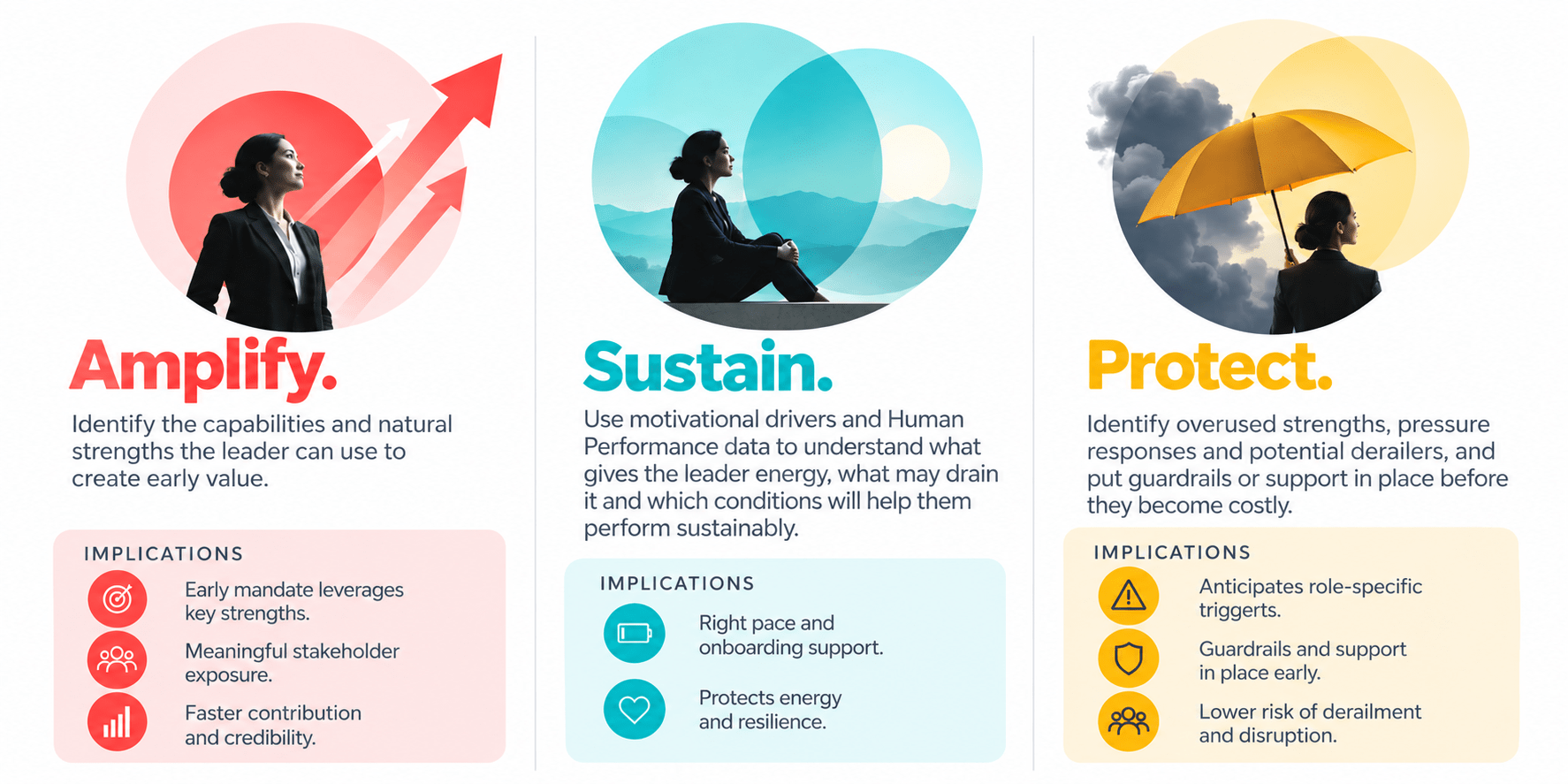
Turning assessment data into valuable action for transitions
Amplify. Identify the capabilities and natural strengths the leader can use to create early value. If someone was selected partly because of their strategic thinking, their initial mandate should give them meaningful opportunities to apply it—not bury them entirely in operational firefighting. Assessment data can help shape early priorities, stakeholder exposure, and the contribution the organization asks the leader to make first.
Sustain. Use motivational drivers and Human Performance data to understand what gives the leader energy, what may drain it, and which conditions will help them perform sustainably. A transition can place heavy demands on attention, relationships and resilience. Knowing how the leader is currently resourced can inform the pace of onboarding, the support around them and where the organization should protect capacity rather than simply add pressure.
Protect. Identify overused strengths, pressure responses and potential derailers. These are not general predictions of failure; they are patterns that may become less effective under particular conditions. The useful question is not “does this person have a derailer?” It is: “Which demands of this role are most likely to trigger that pattern, and what guardrails or support can be put in place before it becomes costly?”
All three jobs matter. A transition plan built only around strengths may ignore capacity and risk. One focused only on risk management wastes the reasons the person was appointed in the first place.
One transition, three things being managed at once
Take Daniel, a leader promoted for strong strategic judgment and a proven ability to deliver under pressure. On paper, he looks well suited to the bigger role.
His assessment also shows that he is energized by complex problems and meaningful autonomy. This gives a clear signal about how he can add value quickly: give him ownership of an important cross-functional priority, connect him with the right stakeholders, and create enough space for him to set direction rather than fill his calendar with operational meetings.
Suppose his Human Performance results also suggest that his mental resources are holding up well, while his physical recovery is already under pressure. That does not disqualify him from the role. It tells the organization something useful about the pace of the transition: adding an overloaded operational remit and an aggressive stakeholder agenda may prevent his strongest capabilities from becoming visible.
Daniel’s profile also suggests a tendency, under sustained pressure, to centralize decisions and pull back from delegating. In his previous, smaller role, that pattern barely mattered because he could still see everything himself. In the new role, where the scope has tripled, the same instinct that once looked like thoroughness could become a bottleneck for the whole function.
None of this makes it the wrong appointment. It makes it a specific one. The transition plan should give the leader a strategic priority to apply their strengths, protect enough capacity to sustain performance, and establish clear delegation expectations, decision rights, and coaching support before thoroughness becomes control. Used that way, the data does more than warn the organization about what might go wrong. It helps create the conditions for the leader to succeed.
Five questions worth asking before day one
- What value is this leader expected to create in the first 6–12 months, and which strengths could help them create it sooner?
- What motivates this leader, and which conditions will help them bring their best contribution to the role?
- What does their current Human Performance suggest about the pace, workload, and support needed during the transition?
- Which potential risk could surface under this role’s pressures, and what guardrails would help manage it?
- What should be visible at 90 days if the leader and the transition around them are on track?
None of these questions is answered by assessment evidence alone. They can be informed by it, alongside what the role demands, what stakeholders expect and what is learned as the transition unfolds. The assessment provides a starting hypothesis, not a finished answer.
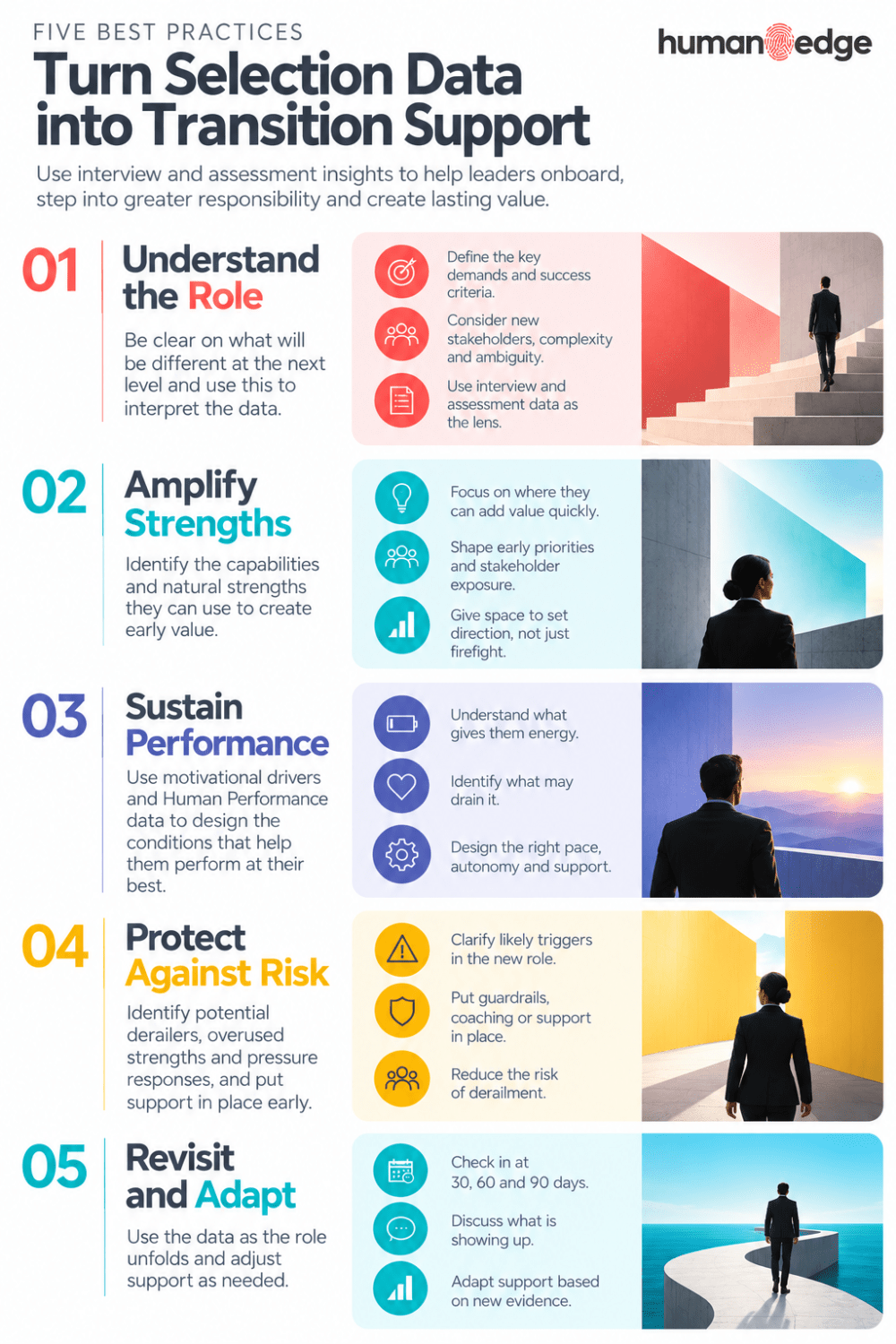
Closing the loop
This is the thinking behind CORE™ Leadership at Human Edge: traits, motivational drivers, reported competencies, Human Performance and derailers, brought together in one Leadership Power Model. [2] CORE™ Leadership also includes an algorithm designed to predict which leaders are more likely to succeed at senior leadership levels. Together, these dimensions can clarify where a leader can create early value, which conditions may sustain that contribution, which patterns could limit effectiveness under pressure, and how well their profile aligns with the demands of greater leadership scope and complexity.
As a self-report assessment, CORE™ Leadership’s findings are best treated as hypotheses to explore alongside role demands, observed behavior, and stakeholder feedback, not as fixed predictions of how someone will perform.
Its purpose does not end at the hiring decision. The same evidence that informs selection should carry directly into onboarding, coaching priorities, and the support and guardrails needed in the first six months, not as a second process starting from a blank page, but as a continuation of the same picture.
Whether the appointment is internal or external, transition support should help the leader translate capability into the new context and put guardrails in place for the risks this specific role is likely to intensify—not wait to see whether they surface.
A sound decision can still be undermined by everything that fails to happen next.
Research sources
1. Development Dimensions International (2021). Leadership Transitions Report, Global Leadership Forecast series.
2. Human Edge (2026). CORE™ Leadership.


