










The capabilities that drove leadership success in the past aren’t disappearing. But AI is changing which capabilities create the most value – and what organizations should be looking for.
Your leadership assessment may be doing exactly what it was designed to do.
That may be the problem.
If it was built around the leaders who succeeded five or ten years ago, it may be identifying people for a leadership model that is already changing.
Organizations have invested heavily in improving the science of leadership assessment: stronger psychometrics, better benchmarking, more sophisticated reports and richer data. But beneath all of that sits an assumption we rarely examine closely:
Will the capabilities that predicted success yesterday predict success tomorrow?
The test may be accurate. The target may have moved.
Most leadership assessments start with a sensible premise. Study successful leaders, identify the qualities associated with their performance, and use that evidence to inform selection, succession, and development.
The hidden assumption is that future success will look enough like past success.
That assumption becomes less reliable when the work itself changes. AI is not simply adding another tool to the workplace. It redistributes tasks, compresses career ladders, and changes where human contribution creates value.
The risk is subtle. An assessment can remain technically robust while the success profile used to interpret it becomes less strategically relevant.
Reliable is not the same as relevant.
Established instruments are not the problem
Many of the assessment instruments that became fixtures of corporate talent management were originally developed in the 1980s and 1990s, when the operating context for leadership looked very different.
The Hogan Personality Inventory, for example, was developed in the 1980s, grounded in socioanalytic theory and the Five-Factor Model. Hogan describes it as backed by more than four decades of validated research. The Occupational Personality Questionnaire (OPQ) also emerged in this period, with the original OPQ developed in 1984 and later versions and scoring approaches continuing to evolve. [1][2]
That history does not mean established instruments are obsolete. Age does not invalidate good science. Personality does not stop mattering because generative AI arrives, and mature instruments have been revalidated, renormed, and updated over time.
An instrument can offer a credible picture of personality, motives or behavioral tendencies. It cannot decide which combination of those qualities an organization will need from its leaders next. That judgment sits in the success profile, the way different evidence is weighted, and the conclusions decision-makers draw from it.
In other words, the issue is not necessarily the assessment.
It is the definition of leadership success underneath it.
Gartner’s 2026 Market Guide for Leadership Assessments points toward a more holistic assessment strategy. One that brings together multiple sources of evidence across the talent life cycle, reduces reliance on fragmented tools, and connects assessment more directly to business priorities and talent decisions.
The leadership premium is moving
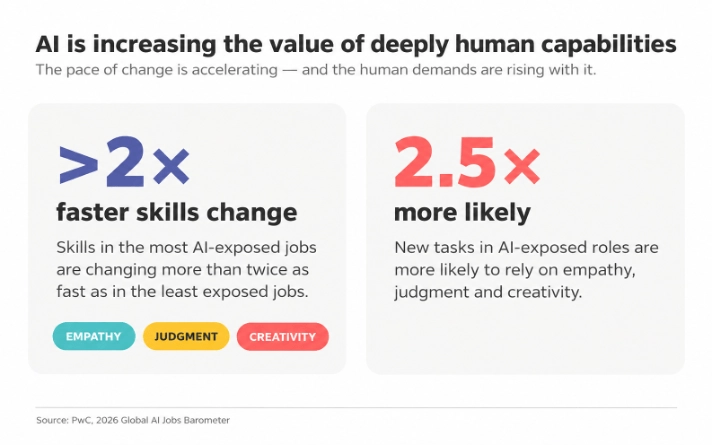
PwC’s 2026 Global AI Jobs Barometer, based on more than one billion job advertisements, found that the skills required in the most AI-exposed jobs are changing more than twice as fast as in the least exposed jobs. New tasks appearing in AI-exposed roles are 2.5 times more likely to depend on human-intensive capabilities such as empathy, judgment and creativity. [3]
The shift is already reaching the beginning of the leadership pipeline. AI-exposed junior roles are seven times more likely to demand traditionally senior capabilities such as leadership and strategic thinking. Judgment, initiative and complex decision-making are being expected earlier, not later. [3]
The World Economic Forum’s Future of Jobs Report 2025 points in the same direction. Analytical thinking remains important, but resilience, flexibility and agility, leadership and social influence, creative thinking, self-awareness, empathy, curiosity and lifelong learning all sit high on employers’ agendas. Leadership and social influence recorded a particularly sharp increase in importance compared with the 2023 report. [4]
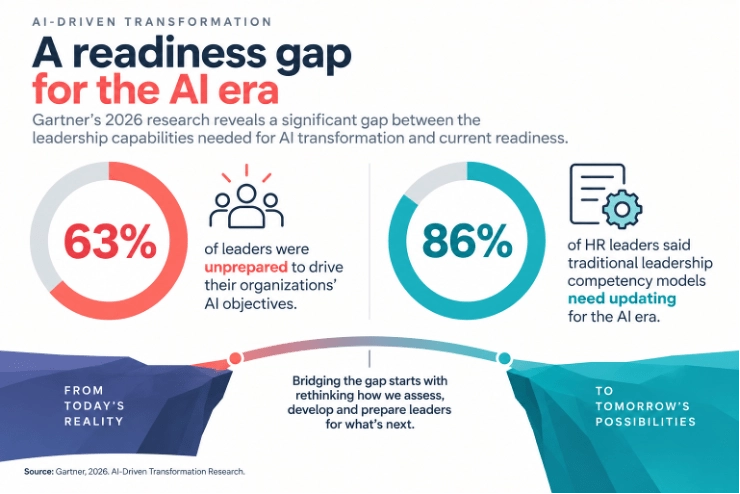
Gartner’s 2026 research on AI-driven transformation goes further. It reports that 63% of leaders were unprepared to drive their organizations’ AI objectives, while 86% of HR leaders said traditional leadership competency models need updating for the AI era.
Gartner identifies seven capabilities: strategic goal shielding, integrated decision-making, narrative direction, curiosity cultivation, cultural harmonization, exponential influence, and active communication. [5]
Some of the language is new. Many of the underlying human capabilities are not. What is changing is where they create value, how early they are needed, and how leaders must deploy them.
How yesterday becomes tomorrow’s specification
Most organizations lack a coherent assessment strategy. Instead, organizations often introduce assessments to solve an immediate need — hiring for a role, identifying leadership potential, supporting succession, or guiding development. Over time, these individual decisions accumulate, and outdated assumptions about what predicts success can become embedded in familiar tools and practices without deliberate review.
We benchmark against the leaders we already have
Current high performers provide useful evidence. But they also reflect the past success models, career paths and leadership norms that enabled them to succeed. If today’s incumbents define tomorrow’s potential, familiar styles of confidence, communication and presence can be mistaken for universal evidence of leadership capability.
The organization may then reproduce what it already recognizes rather than identify what it will need.
We treat experience as a proxy for future readiness
Experience still matters. But when tasks and roles are changing quickly, it becomes a less reliable substitute for learning agility, curiosity, and judgment.
A leader may excel in a role that rewards deep expertise, established relationships, and a known operating model. That does not automatically tell us how they will respond when the context changes or whether they can revise a strongly held view when their experience is no longer enough.
Equally, someone with less conventional experience may possess strong foundations for a role that does not yet fully exist.
We reward what is easiest to see
Polished communication, speed of analysis, and confident answers are highly visible. The capabilities that gain value are often harder to observe:
- Asking a better question
- Resisting an attractive distraction
- Integrating competing forms of evidence
- Changing one’s mind
- Enabling others to exercise judgment.
If the success profile hasn’t changed, the assessment process can keep rewarding familiar signals while missing the behavior the future context requires.
Future-facing assessment requires three layers
Updating a success profile should not mean throwing out established evidence and replacing it with a fashionable list of “AI-era competencies”. That would simply create a newer static model.
A more future-facing assessment strategy needs to examine three connected layers:
1. Enduring foundations. The traits, motives, and capacities that shape how someone thinks, relates, learns, and responds under pressure.
2. Capability in context. How those foundations translate into action amid ambiguity, competing stakeholder needs, and AI-supported decisions.
3. Capacity to develop. How the leader responds to feedback, learns from mistakes, revises assumptions and expands their repertoire over time.
This is where Human Intelligence becomes practical. Critical thinking, judgment, creativity, emotional intelligence, intuition, and wisdom should not simply appear as labels in a competency model. They should become visible in the quality of a leader’s questions, decisions, relationships and learning.
The question is no longer only, “What can this leader do today?” It is also,
How will they think, adapt, connect, and grow when the context changes?
From assessment to a more dynamic definition of leadership
At Human Edge, this is why CORE Leadership does not reduce leadership effectiveness to a single competency score. With Inner Power at its center, the Leadership Power Model connects reported competencies with the traits and motivational drivers beneath them. It examines how leaders work with others, what they build, how they make an impact, what they see, and how they excel.
CORE Leadership also considers the purpose, mental, physical, and emotional foundations of sustained Human Performance, alongside the derailers that may emerge under strain.
The objective is not to predict tomorrow by reproducing yesterday. It is to create a more coherent picture of what shapes a leader’s effectiveness, what may compromise it under pressure, and where development can create the greatest leverage as the context evolves.
The harder problem to spot is not an obviously poor assessment. It is a polished, reliable, and familiar process that continues to reward a version of leadership the organization no longer needs.
Before asking, “Which leadership assessment should we use?”, ask the more important question:
“Are we still assessing against the right definition of success?”
At Human Edge, we work with leaders to explore what it means to lead thoughtfully in an AI era — including how to use AI responsibly and ethically while strengthening the distinctly human capabilities technology cannot replace. Through our CORE™ assessments and leadership development work, we help leaders build greater self-awareness and develop the human intelligence needed to exercise judgment, navigate complexity, and lead others through change.
Research sources
Hogan Assessments. Hogan Personality Inventory (HPI): official product and history page. Link
Matthews, G. & Stanton, N. (1994). “Item and scale factor analyses of the Occupational Personality Questionnaire,” Personality and Individual Differences, 16(5), 733–743. Link
PwC (2026). Global AI Jobs Barometer: Two futures for jobs in an AI era. Link
World Economic Forum (2025). The Future of Jobs Report 2025, Skills Outlook. Link
Gartner (2026). 7 Leadership Capabilities Essential for AI-Driven Transformation, G00845534, 2 June 2026. Link


