










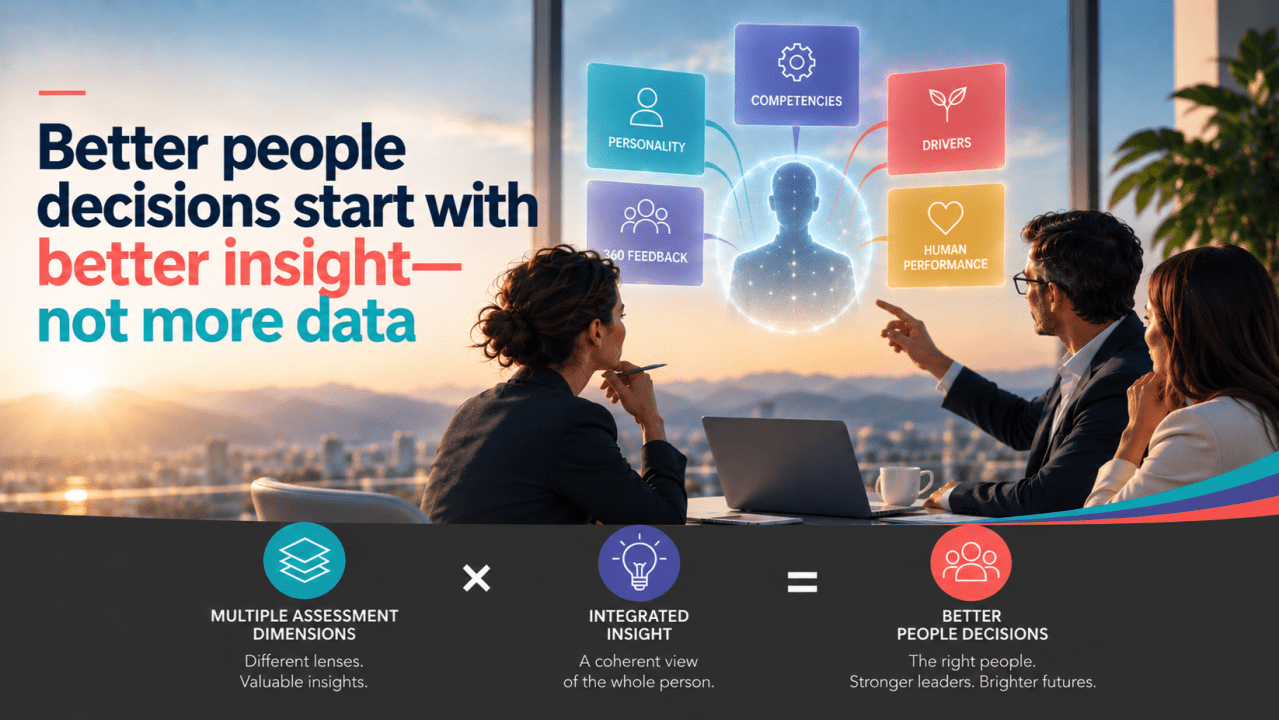
Multiple assessments can give us a richer picture of a leader. But unless the evidence ties to a clear people decision – such as hiring, promotion, or talent acceleration – it can simply create more information without improving the decision.
It is entirely possible to know more about a leader and still not know what people decision to make.
Imagine a succession discussion about a senior leader. The organization has personality data, competency scores, colleague feedback, and a detailed development report. Everyone has read the evidence. Yet half the room sees a strong successor, while the other half sees too much risk or can’t see this person rising to the top.
The issue is not too little data. It is too much disconnected data – and no coherent view of what it all means.
This challenge arises when organizations add tools because the decision matters and they want a fuller picture. Each assessment may contribute something useful. But if the findings remain in separate reports, built around different models and interpreted by different people, the decision-maker is left to do the integration.
That is a demanding task, and the volume of information can create an impression of rigor without clarifying the reasoning. In our fast-paced world, leaders want clear, data-driven recommendations that lead to better people decisions.
More evidence can create less clarity
In the previous article, we explored why leadership cannot be understood through a single lens. Traits, motivations, capabilities, pressure responses, Human Performance, and the experience of others each reveal a different part of the picture.
The natural response is to gather more data. But more evidence does not automatically lead to a better decision. It only adds value when each source contributes something relevant and the findings are brought together to show how they connect.
Without that integration, more data can create more noise rather than more clarity. Different tools may measure similar qualities using different language. Findings may appear to contradict one another, with no clear way to reconcile them. A single striking score can dominate the discussion even when it has little relevance to the role or decision at hand. Decision-makers can also gravitate toward the report that confirms what they already believe.
The challenge, then, is not collecting more evidence. It is turning multiple sources of evidence into one coherent view of the person, and using that view to make a better people decision.
Five professionally produced reports can still produce five competing versions of the same leader.
The CIPD describes high-quality, evidence-based decisions as those grounded in critically appraised evidence from multiple sources. Those sources may include scientific research, organizational data, professional expertise and the perspectives of relevant stakeholders. [2] Collecting the sources is only the first step. You must also examine their relevance, quality, and meaning.
Leadership assessment requires the same discipline. The question is not how much information has been collected.
It is whether that information improves the conclusion.
Start with the People decision
Not all people decisions are asking the same question, so they should not rely on the same evidence. If you are hiring, you need to know whether someone has the skills and leadership qualities to perform the role and thrive within the organization’s culture and context.
If you are identifying or accelerating high-potential talent, the question shifts: do they have the learning agility to master unfamiliar challenges and grow into increasingly complex roles?
If someone is moving into their first leadership role, you may care more about their propensity to lead others, emotional intelligence, and ability to build trust and relationships.
Research reinforces these distinctions: structured selection methods strongly predict job performance, learning agility is strongly associated with leadership potential and performance, and meta-analytic research links emotional intelligence to leadership and team effectiveness.
Evidence for People Decisions
Different people decisions require different evidence. The question is not simply what the assessment tells us, but whether the evidence is relevant to the decision we are trying to make.
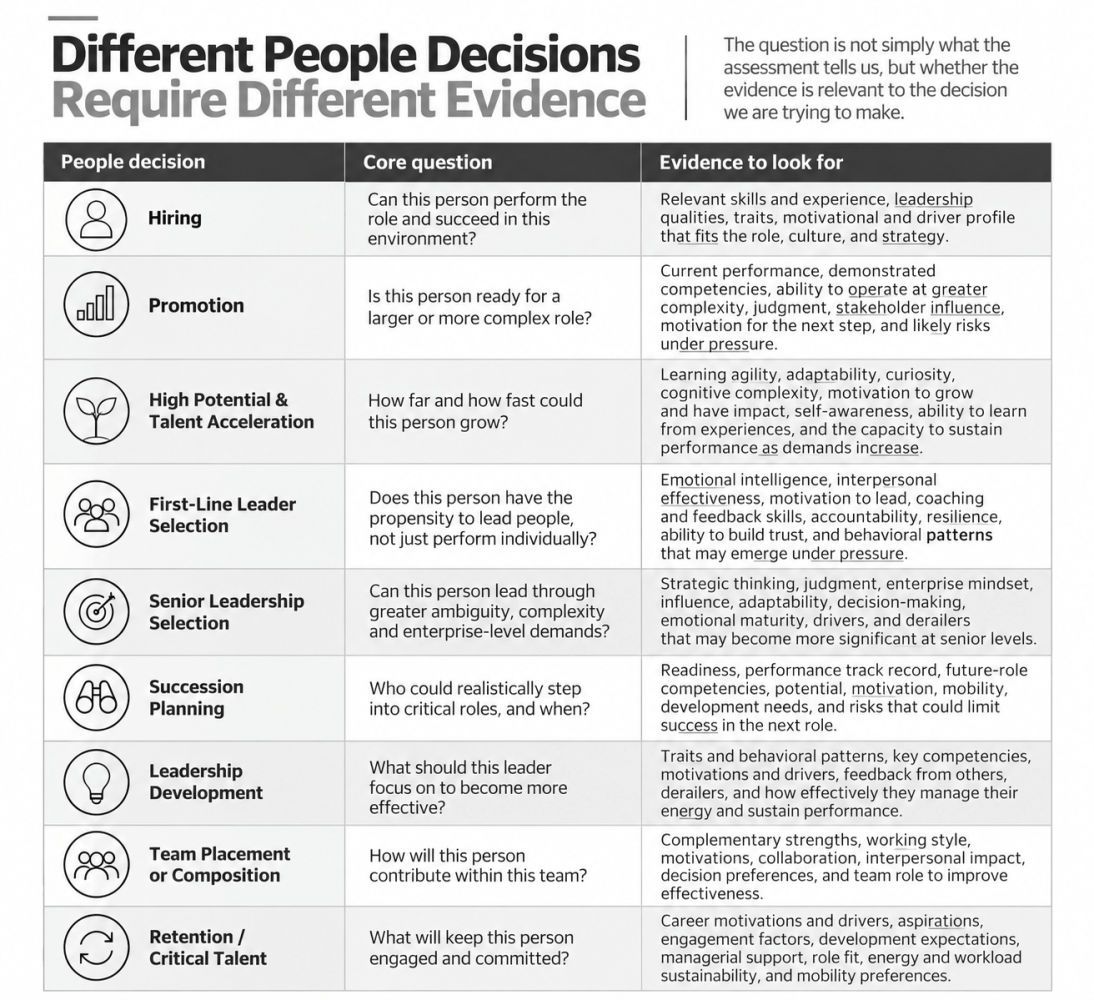
The decision should determine the questions you ask and the evidence you collect—not the assessment tools you happen to have available.
Integration is not aggregation
Putting several assessment reports into the same folder is aggregation. So is creating a dashboard that displays every score in one place.
Integration requires interpretation based on the core question.
It starts with a shared definition of success: what this role will demand, within this organization, in the context it expects to face. You can then examine the evidence in relation to that question.
- Which findings tell the full picture?
- Which apparent contradictions reveal something important about context or effort?
- Which evidence is most relevant to the decision?
- What remains uncertain?
Integration does not mean forcing every result to agree. Nor does it mean combining everything into one definitive score. Both approaches can remove the very nuance that makes multiple perspectives useful.
Consider the succession candidate from the opening. Their assessments indicate strong strategic judgment, ambition, and confidence in making difficult decisions. Their track record supports that picture. Viewed separately, each result strengthens the case for promotion.
The wider evidence adds important context. Feedback from colleagues suggests that the leader involves others less when deadlines tighten. Their results also indicate that independence can become control under strain, while their current Human Performance (energy management) profile points to depleted emotional and physical resources.
These findings do not cancel the evidence of strength. They help explain the conditions under which that strength may become less reliable.
The decision is no longer framed as a broad question,
“Is this a strong leader?” It becomes more useful and specific:
Under what conditions could this leader succeed at greater scale, and what would need to be addressed first?
The organization may still decide to promote them. But it can do so with a clearer view of the support, expectations and development needed to make success more likely.
The decision changes what the evidence means
Assessment does not produce insight independently of its purpose. The same finding may carry different significance depending on the decision being made.
In selection, the question is whether a candidate has the foundations and capability to perform in a particular role and environment. In succession, the organization needs to distinguish current performance from readiness for greater scale or complexity. In development, the priority is not necessarily the lowest score, but the change that could most improve effectiveness. In team composition, an individual quality needs to be understood in relation to what is already present around them.
Potential is always potential for something.
A leader who succeeds through deep expertise and personal control may be highly effective in their current remit. That same pattern may become a constraint in a role that requires them to lead through other leaders. Someone who appears less polished today may nevertheless have the curiosity, learning agility and relational capacity needed for a role whose demands are still emerging.
Neither conclusion can be reached responsibly from one score. But neither requires every available piece of data. It requires the right evidence, interpreted against the right question.
This is also why uncertainty should remain visible. Good integration does not manufacture confidence where the evidence is incomplete. It identifies what is known, what is inferred and what still needs to be tested through interviews, simulations, observed behavior, references or a stretch assignment.
That makes the reasoning behind the decision clearer—and therefore easier to challenge, explain and revisit.
From five results to one decision
Gartner’s 2026 Market Guide for Leadership Assessments states: “Many organizations use leadership assessments in an effort to make more accurate and objective decisions about leadership selection and development.” [1] Achieving that aim depends on more than choosing valid instruments. It also depends on how they bring the evidence together.
At Human Edge, this thinking underpins CORE™ Leadership. The methodology brings together traits, motivational drivers, reported competencies, Human Performance and potential derailers within one Leadership Power Model. [3]
Its value does not come simply from having five dimensions. It comes from examining the relationships between them: what underpins a leader’s effectiveness, what gives them energy, what their performance may be costing them, and what could emerge under strain.
Because CORE™ Leadership is a self-report assessment, consider its findings alongside role demands and evidence such as interviews, observed behavior, and others’ experience. The result is a clearer, more transparent hypothesis about the person and what the evidence means for the decision—not a final verdict.
For the succession candidate, that might mean moving beyond a binary “ready” or “not ready” judgment. The evidence could suggest that the leader has the strategic capacity for the role, but that readiness depends on their ability to lead through others and restore the foundations sustaining their performance. That conclusion gives the organization a decision, a development focus and a way to test progress.
The measure of a good assessment is not only about how much it tells you about a leader. It is also about whether it helps you make a better decision.


