










A single assessment can reveal something important about a leader. The mistake is asking it to explain everything.
Consider Alex, a regional functional leader who has recently taken on a broader role with responsibility for several teams and a demanding transformation agenda. On the surface, Alex looks highly capable. The leadership assessment competency profile describes a leader who is decisive, action-oriented, and willing to take ownership when difficult calls need to be made.
But the other data adds important context. Alex’s personality assessment shows a naturally cautious style — someone who prefers to understand the risks, gather evidence, and feel confident before committing. The motivation data shows a very strong drive to achieve, deliver, and meet high standards. At the same time, the human-performance assessment (energy management) suggests Alex is operating close to depletion, with little capacity left to sustain the current pace.
Taken together, a very different picture emerges. Alex can make decisions quickly, but doing so may require considerably more internal effort than others see. A powerful achievement drive may be pushing Alex to override a natural need for reflection and continue performing despite declining energy. What initially looks like a simple strength, decisiveness, may therefore become harder to sustain under prolonged pressure.
The development question is no longer simply, “How decisive is Alex?” It becomes, “What is enabling Alex to perform this way, what is it costing, and what could eventually get in the way of continued success?”
None of these individual assessment findings are wrong. They may simply be showing different parts of the same person. It’s only when we put them together do they tell the whole story.
Limitations of Leadership Assessments
This is where a leadership assessment can become unnecessarily reductive. We take a complex human system and search for a score, type, or headline to explain it. The report may be sophisticated, but the question behind it is often surprisingly simple: is this person a strong leader or not?
Leadership does not work like that.
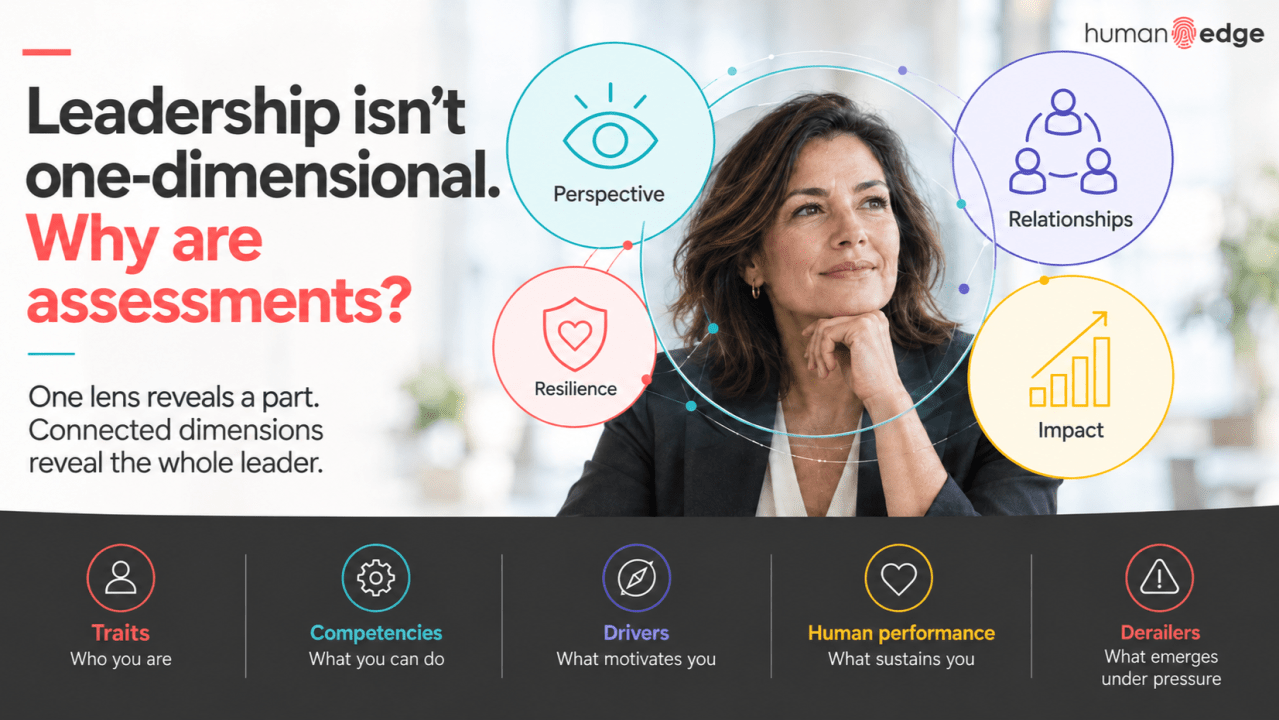
It emerges through the interaction between:
- Who someone is? (Personality Traits)
- What they can do? (Competencies)
- What drives them? (Drivers)
- How do others experience them?
- The context in which they are operating
- What happens when pressure rises? (Derailers)
If effectiveness is multidimensional, the evidence used to understand it needs to be multidimensional too.
One accurate lens can still be incomplete
In the previous two articles, we explored whether organizations are assessing against the right definition of success and which capabilities are becoming more valuable in the AI era. But even the right success profile cannot be understood through one lens alone.
Personality traits can provide useful evidence about a leader’s underlying tendencies. It can help us understand how they are likely to approach risk, relationships, learning, or ambiguity. But tendency is not destiny. Leaders adapt their behavior, compensate through experience and respond differently across situations.
A competency assessment asks a different question. It considers what someone believes they can do, or what they have demonstrated in a particular setting. That matters, but capability today does not fully explain motivation, sustainability, or what may happen when the context changes.
A 360-degree assessment adds others’ perspectives. It can reveal whether a leader’s intention matches their impact. Yet reputation is also contextual. A leader may be experienced differently by their manager, peers, and direct reports because each group sees different behavior and has different expectations.
These are examples from a much wider assessment ecosystem, not a single integrated model. None is inherently superior. Each answers a different question, and none provides a complete picture on its own.
The CIPD’s guidance on selection makes the same practical point: psychometric results should not be the sole basis for a decision, and stronger processes draw on several methods, supporting interviews with evidence such as psychometrics or task simulations. [2]
Multiple lenses are not meant to compensate for poor assessment. It is to avoid placing more interpretive weight on one valid piece of evidence than it can reasonably carry.
Different lenses answer different questions
The clearest way to understand an integrated assessment is not as a larger test, but as a set of connected questions.
What is this leader likely to do naturally? Personality Traits help reveal the tendencies that shape how someone thinks, relates, and responds. They provide useful foundations, but do not tell us how flexibly those tendencies are used.
What can this leader currently demonstrate? Competencies indicate how leadership capability is expressed. Depending on the method, the evidence may reflect self-perception, observed behavior, or the experience of others.
Why will they choose to use that capability? Drivers help explain what gives a leader energy, meaning, and motivation. Two people may display the same behavior while being propelled by very different needs.
What happens when their strengths are stretched too far? Derailers show how an otherwise useful quality may become counterproductive under strain. Decisiveness can become impulsivity. Confidence can crowd out curiosity. Independence can become distance.
Can they sustain their effectiveness? Human performance adds another question: whether the leader has the purpose, mental focus, physical resilience, and emotional balance to keep performing without gradually exhausting the system that performance depends on.
Each lens changes how you interpret the others. High ambition means something different when paired with strong resilience than when paired with depleted energy. Confidence looks different when others experience it as clarity than when they experience it as dominance. Curiosity expressed in a report matters less if the leader’s team has learned that challenging them is unsafe.
The value is not in collecting more labels. It is in understanding the relationships between them.
The apparent contradictions may be the insight
When assessment results do not align neatly, organizations often treat the inconsistency as a problem to resolve. Which score is correct? Which source should we trust?
Sometimes that is the wrong question.
A leader may report strong coaching capability while their team experiences little space to think for themselves. That discrepancy does not automatically mean the leader lacks honesty, or the team lacks perspective. The leader may understand coaching intellectually but revert to solving when deadlines tighten. They may coach some people but not others. Or their intention may simply not be landing the way they think it is.
Likewise, someone may show a low natural preference for visibility while being highly effective in senior stakeholder situations. The integrated picture is not “introverted, therefore lacks influence.” Influence may be a learned capability they can deploy well, but at a higher energy cost. That creates a different development conversation from teaching them how to present.
This is why disagreement between lenses can be more useful than perfect alignment. It helps locate the conditions under which effectiveness strengthens, becomes effortful, or begins to break down.
The CIPD’s wider guidance on evidence-based decision-making is instructive here. It argues that no single source of evidence is sufficient and that both conflicting and corroborating evidence need to be balanced. [3] Integration does not eliminate ambiguity. It gives us a more disciplined way to examine it.
Pressure reveals what a static score can miss
Leadership assessment often captures someone at a relatively stable moment. Leadership itself is rarely experienced that way.
The person who delegates effectively when the business is performing well may tighten control during a crisis. The thoughtful decision-maker may rush when exhausted. The collaborative leader may become overly accommodating when conflict threatens an important relationship.
These shifts are not peripheral to leadership effectiveness. They often sit at the center of the greatest organizational consequences.
This is particularly relevant now. Leaders are operating across faster decision cycles, AI-enabled workflows, competing stakeholder expectations, and sustained uncertainty. The question is not only whether someone possesses a capability. It is whether they can continue accessing it when complexity and pressure increase.
A multidimensional view helps distinguish between a missing capability, an underused strength, a motivational tension, and a pressure response. Those distinctions matter because they lead to very different development choices. Training cannot solve depletion. More confidence will not correct overconfidence. A new competency model will not address a derailer that only becomes visible under strain.
Integration means seeing the person, not stacking the reports
Gartner’s 2026 Market Guide for Leadership Assessments notes that organisations use leadership assessments “in an effort to make more accurate and objective decisions about leadership selection and development.” [1] That goal becomes harder to achieve when evidence remains fragmented across tools, models and reports.
Five disconnected reports do not automatically create five times the insight. They can just create more pages, more terminology and more opportunities for decision-makers to select the result that confirms what they already believe.
Integrated insight requires a coherent model. The evidence needs to be organized around a shared definition of leadership effectiveness, interpreted in context and translated into a small number of meaningful hypotheses:
What consistently enables this leader’s effectiveness? Where does capability rely on effort or compensation? What changes under pressure? Which development investment could create the greatest leverage?
The aim is not to manufacture certainty. It is to make the reasoning behind the conclusion clearer.
Decades of selection research show that leadership potential cannot be understood through a single measure. Hogan’s research with management populations supports combining multiple, job-relevant sources of evidence: including personality, potential derailers, motives and values, performance information and other validated selection methods, to build a more complete picture of future leadership performance. Each source provides different information; relying too heavily on one dimension narrows the evidence available for an important talent decision. [4]
From five dimensions to one leadership picture
This is the thinking behind CORE™ Leadership at Human Edge. It is a 5-in-1 self-assessment that examines traits, drivers, reported competencies, Human Performance, and derailers within one Leadership Power Model. [4]
Inner Power sits at the center because self-awareness shapes how leaders use everything else. The model then connects those foundations to the outward demands of leadership: how people work with others, what they build, how they create impact, what they see, and how they excel.
The point is not that five dimensions produce a definitive answer about a human being. They do not. CORE™ Leadership remains a self-report measure, and its findings should be interpreted as evidence of the individual’s self-perception. Other perspectives, including 360-degree feedback and observed behavior, can add further context.
The integrated model enables a richer conversation about the patterns beneath performance. It can help distinguish between what a leader does, why they do it, what sustains it, and what may compromise it.
That is a far more useful starting point for development than a list of high and low scores.
Leadership will never be fully captured by an assessment. Nor should it be. The purpose of assessment is not to reduce a person to a profile, but to improve the quality of the questions we ask about their effectiveness, potential and development.
If leadership is shaped by the interaction of multiple dimensions, then the challenge is not to find the one assessment that sees everything.
It is to build a more intelligent way of seeing the whole person.
Research sources
- Gartner (2026). Market Guide for Leadership Assessments, 29 June 2026. Link
- CIPD (2024). Selection methods. Link
- CIPD (2025). Evidence-based HR: Make better decisions and step up your influence. Link
- Human Edge (2026). CORE™ Leadership. Link
- Hogan Assessment Systems. High Potential Candidate Assessment Report: Technical Manual. Tulsa, OK: Hogan Assessment Systems. Link


