










We are spending enormous amounts of time preparing people for AI.
We are teaching employees how to prompt. Introducing new tools. Creating AI policies and governance. Building AI academies. Tracking adoption.
All this matters. But I wonder if we are focusing on the most visible disruption, while missing the more fundamental one.
What if AI itself isn’t the biggest change HR needs to prepare for?
What if the bigger change is what AI does to the role of the leader?
For decades, organizations have valued leaders for what they know, the decisions they make, the answers they provide, and their ability to direct others’ work.
AI is beginning to challenge each of those assumptions.
It can analyze more information than any individual leader. It can synthesize knowledge across disciplines, identify patterns, generate alternatives, challenge assumptions and increasingly support complex decisions.
In other words, many of the capabilities that historically gave leaders authority are becoming more widely available.
And that raises a much more interesting question:
If intelligence becomes abundant, what becomes scarce?
I believe the answer is human intelligence.
Not intelligence in the traditional sense of IQ or expertise, but the deeply human capabilities that allow us to make sense of complexity and turn intelligence into wise action.

Property of Human Edge Managment, All rights reserved
These capabilities don’t become less important as AI improves. They become more important. The leader’s role is shifting
The future leader will not necessarily be the person in the room with the most knowledge.
Increasingly, leaders will need to determine:
- What questions should we be asking?
- Which AI-generated insights should we trust, and which should we challenge?
- Where should human judgment override optimization?
- How do we make decisions when the data is incomplete, contradictory, or ethically complex?
- How do we create meaning and direction when people are experiencing unprecedented change?
And perhaps most importantly:
How do we use AI to strengthen human capability rather than gradually replace it?
That last question deserves much more attention.
There is an understandable temptation to use AI wherever it can make work faster. But productivity cannot be the only measure of successful AI adoption.
If AI consistently does the thinking, drafting, analysis, problem solving and decision preparation for us, we also need to ask what happens to the capabilities people are no longer exercising. Efficiency today cannot come at the expense of capability tomorrow.
This creates a challenge for HR
Technology is evolving extraordinarily quickly. But has our approach to leadership development evolved at the same pace?
Many organizations are still developing leaders around models created for a world in which information was scarce, expertise created advantage, and leaders were expected to provide answers.
That world is disappearing. The question for HR is therefore bigger than:
How do we prepare leaders to use AI?
What kind of leaders do we need when everyone has access to extraordinary intelligence?That requires us to rethink what we assess, what we develop, and ultimately what we reward.
- We may need to place less emphasis on knowing and more on discerning.
- Less on directing and more on creating the conditions for others to think, experiment, and grow.
- Less on individual expertise and more on combining human and artificial intelligence effectively.
- Less on having the answer and more on asking the question that changes the conversation.
And leadership development itself may need to change.
Instead of simply teaching leaders more frameworks, we need to give them opportunities to wrestle with ambiguity, challenge AI-generated recommendations, exercise judgment, navigate competing values, engage in difficult human conversations, and make decisions with no obvious right answer.
Because those are precisely the moments when human intelligence matters most.
HR has a choice
We can treat AI primarily as a technology transformation and focus on adoption. Or we can recognize it as a human transformation—one that is fundamentally changing what organizations need from their leaders.
The organizations that succeed will not simply be those with the most advanced AI. They will be the organizations that understand how to combine AI’s extraordinary capabilities with the distinctly human capabilities technology cannot replace.
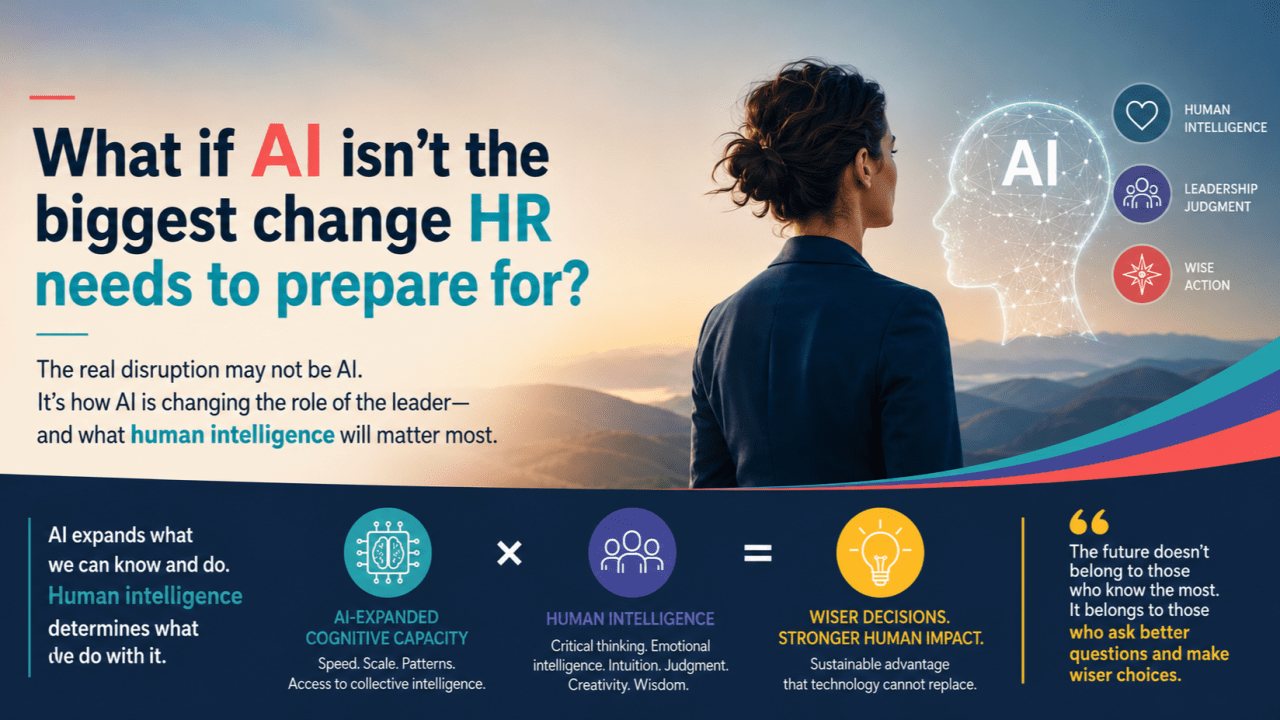
The equation for competitive advantage is changing. When knowledge was scarce and expertise concentrated, knowing more created advantage. AI is rapidly making knowledge abundant and expanding our cognitive capacity through speed, scale, pattern recognition and access to collective intelligence. This shifts the source of advantage from simply what we know to how wisely we use what is known. The new equation combines AI-expanded cognitive capacity × Human Intelligence — our critical thinking, emotional intelligence, intuition, judgment, creativity and wisdom. The multiplier matters: AI can dramatically expand what is possible, but it is our human intelligence that determines the value we create from it.

So perhaps the most important question for HR isn’t:
“How quickly are our leaders adopting AI?”
It is: “Are we developing the kind of leaders an AI-enabled organization will actually need?”
Questions for HR
If AI is changing what organizations need from leaders, perhaps we need to ask:
- What will great leadership look like when knowledge and intelligence are available to everyone?
- Which distinctly human capabilities will matter most, and how do we deliberately develop them?
- How does leadership development need to change when having the answers is less important than knowing what to question, how to judge, and when to act?
- How do we use AI to expand human capability without unintentionally weakening the very capabilities leaders will need most?
If we were designing leadership development from scratch for an AI-enabled world, what would we do differently? The real disruption may not be AI
AI will keep getting faster, smarter, and more capable. The question is whether our leaders, and the way we develop them, will evolve just as quickly.
As knowledge becomes abundant, knowing more will no longer be enough to differentiate great leaders. Advantage will increasingly come from what leaders do with that intelligence: the questions they ask, the judgments they make, the possibilities they imagine, the trust they create, and the wisdom they bring to decisions that technology cannot make for us.
This is the new equation: AI expands what we can know and do. Human intelligence determines what we do with it.
For HR, this requires more than adding AI skills to existing leadership programs. It means reconsidering what great leadership looks like, what we assess, what we develop, and what experiences we create to prepare leaders for a fundamentally different world of work. Perhaps that is the disruption we should be preparing for.
Not simply a new generation of AI—but a new generation of leadership.


