











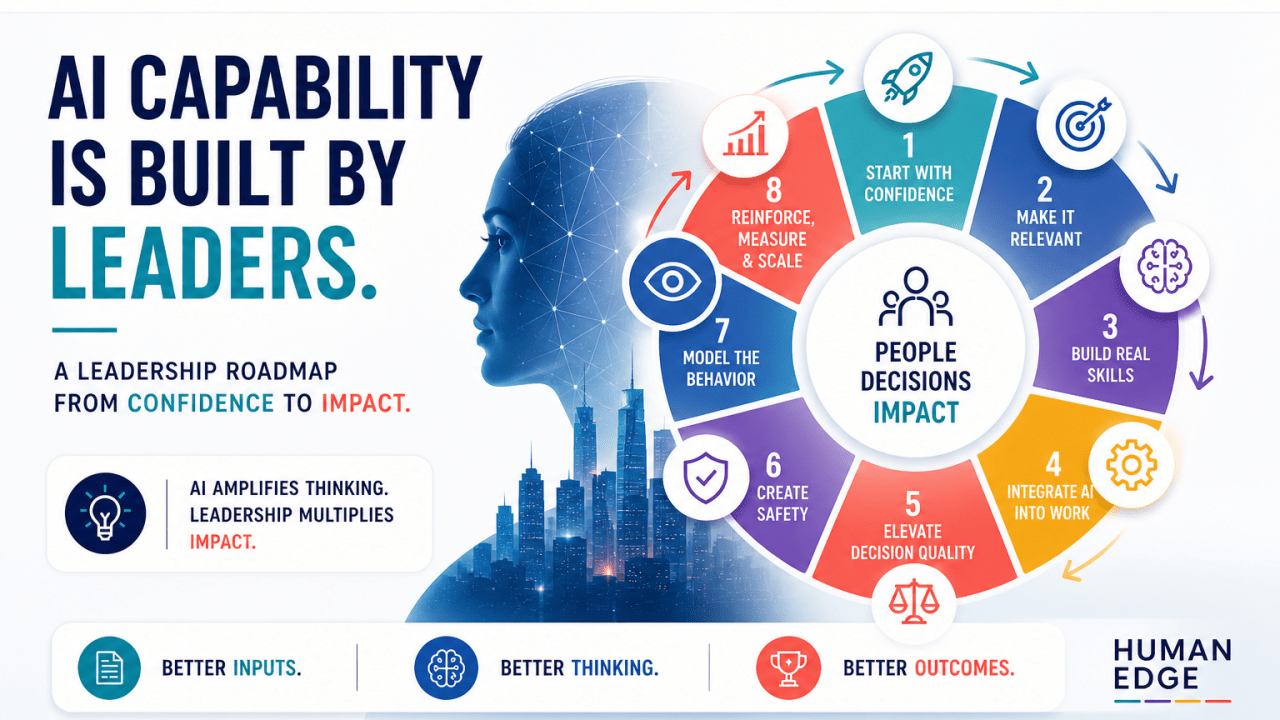
Most organizations are investing heavily in AI. Training programs are rolling out. Tools are being deployed. Strategies are being defined.
And still, adoption is uneven. Impact is inconsistent. In many cases, AI is being used at the surface level, if at all.
This is not a technology problem. It is a leadership problem.
Most organizations are trying to build AI capabilities from the wrong place. They begin with strategy, or training, or tools. But they skip the one thing people actually need first. Confidence.
The Real Barrier Is Not Resistance, It Is Capability Under Pressure
There is a common assumption that employees resist AI. In reality,y most people are curious and even motivated. But when it comes to using AI in their actual work, something different happens.
They hesitate.
Not because they do not see the potential, but because they do not yet feel capable. They are unsure where to start, how to use it effectively, and whether the output is actually good enough to rely on. So they default back to what they know.
In addition, some people are really afraid that AI will take away their job,s and until leaders address this fear, people will not get onboard.
Change is emotional and we need to address people’s fear of using new technologies
This is where most AI transformations stall. Not at the level of strategy, but at the level of daily behavior.
Behavior does not change through instruction. It changes through experience.
The Shift Leaders Must Make
If AI is to move from experimentation to real impact, leaders need to rethink how capabilities are built. It does not happen in one step. It builds in stages.
Confidence. I can use this Relevance. This matters to my work Capability. I can apply this well. This improves outcomes
Employees are already feeling overwhelmed with the amount of work they need to do. It’s important to pause, take a breath, and give them space to experiment without pressure.
When employees become curious about AI and how it can enable them to do their role more effectively, they will lean in and learn.
Most organizations start with capability. High-performing organizations start with confidence.
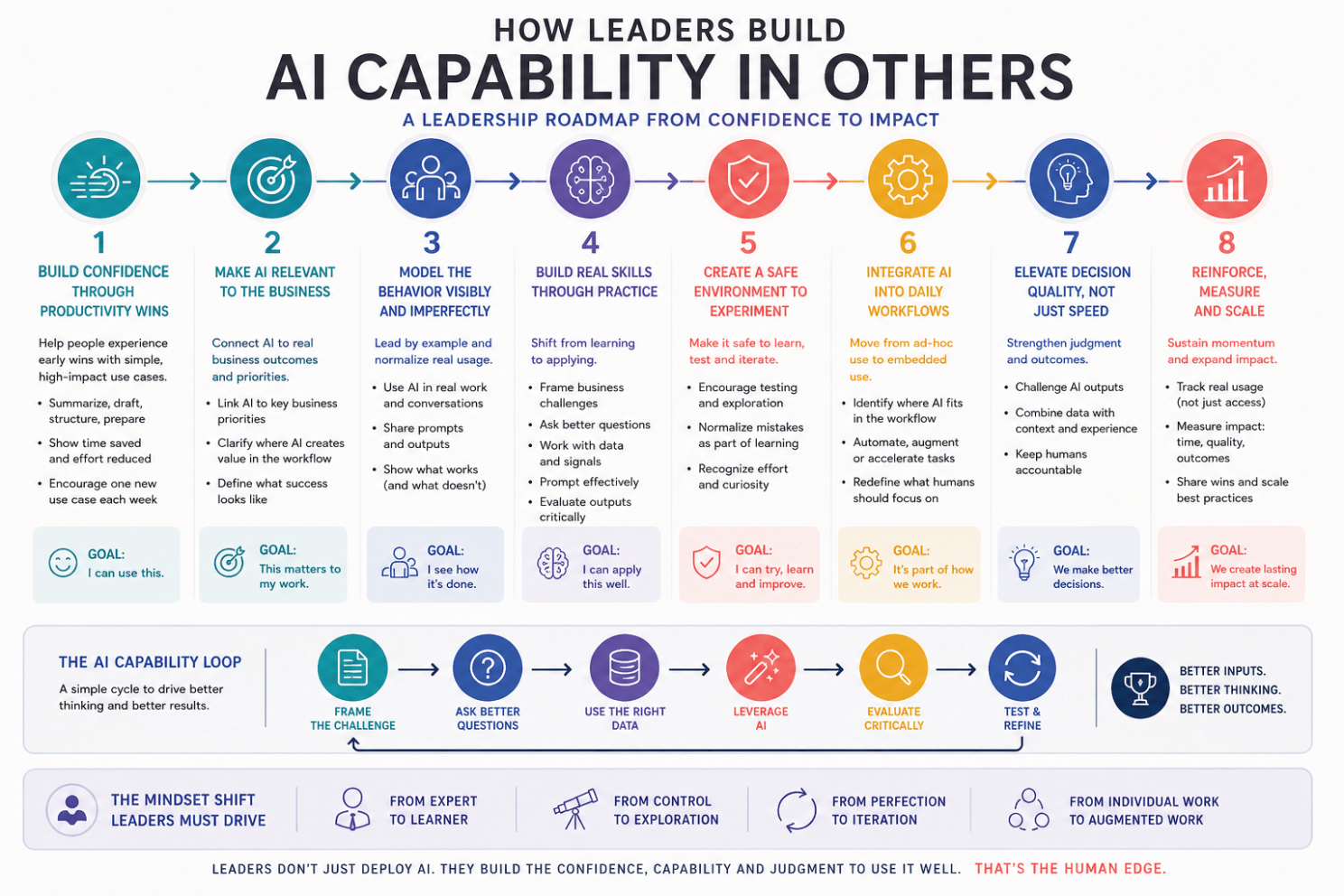
1. Start with confidence, not complexity
Before asking teams to think strategically about AI, leaders need to help them experience immediate value. This is where momentum begins.
Focus on simple and frequent use cases that reduce effort and save time.
- Summarizing documents and reports
- Drafting emails or first versions of presentations
- Structuring thinking before meetings
- Preparing talking points or questions
Start small and build up to more complex work.
These are not advanced applications. That is exactly why they work. They remove friction and create a sense of progress very quickly.
Leaders play a critical role here. They need to make the value visible and tangible.
- Demonstrate a few personal use cases in real time
- Show the difference in effort or time saved
- Encourage teams to adopt one practical use case each week
People do not adopt AI because they understand it. They adopt it because it helps them today.
2. Make AI Relevant To The Business
Once confidence begins to build, relevance must follow. AI cannot remain a general productivity tool. It needs to connect to real business outcomes.
Leaders must translate AI into the context of their function and priorities. Where can it improve decision speed? Where can it increase the quality of insight? Where can it remove bottlenecks?
- Link AI to a small number of critical business priorities
- Clarify where it should create value in the workflow
- Define what success looks like in practical terms
When this connection is missing, usage remains shallow. When it is clear, AI becomes a business lever rather than a tool.
3. Model The Behavior Visibly And Imperfectly
One of the fastest ways to accelerate adoption is through visible leadership behavior. People learn by observing how work gets done. Speak often about AI and showcase your own successes and failures.
Leaders need to use AI in real situations and make that usage transparent. Not polished demonstrations, but real applications.
- Use AI to prepare for meetings or structure thinking
- Generate options before making decisions
- Share prompts and outputs openly
It is equally important to show what does not work. This removes intimidation and makes learning accessible.
People do not learn from training decks. They learn from seeing others apply new behaviors in context.
4. Build Real Skills Through Practice
Training alone does not build capability. Application does. Teams need opportunities to work with AI on real challenges. If you really want people to practice, then ask them to come to you with AI failures. Where they tried to use it, and it didn’t work. This will further promote curiosity and psychological safety.
This requires developing a new set of skills that go beyond using tools.
- Framing business challenges clearly
- Asking precise and relevant questions
- Identifying meaningful data and signals
- Prompting effectively
- Evaluating outputs critically
A simple loop can guide this process. Frame the challenge. Ask the right questions. Identify the data. Use AI to explore options. Evaluate the output. Test and refine.
- Run short working sessions using real business problems
- Focus on thinking quality rather than tool features
- Encourage iteration rather than one-time answers
AI does not replace thinking. It exposes the quality of it.
5. Create A Safe Environment To Experiment
Even when people have the skills, they often hold back. They are unsure what is acceptable and do not want to get it wrong.
Without psychological safety, usage remains limited and cautious.
Leaders need to actively create an environment where experimentation is expected.
- Encourage testing and exploration
- Normalize mistakes as part of learning
- Recognize effort and curiosity
When people feel safe, they move beyond basic use and begin to build real capability.
6. Integrate AI Into Daily Workflows
This is where many organizations lose momentum. AI becomes something people use occasionally rather than consistently.
To scale impact, AI needs to be embedded into how work actually happens.
- Identify where AI fits into existing processes
- Clarify which tasks should be supported or automated
- Redefine what humans should focus on instead
- Discuss the outputs of AI and emphasize that decision-making still lies in the hands of humans
Leaders need to remove friction and make usage expected, not optional. Adoption happens when AI is part of the workflow, not outside of it.
7. Elevate Decision Quality Not Just Speed
AI can accelerate work, but speed alone is not the goal. The real opportunity is improving the quality of decisions.
Leaders need to help teams balance data with judgment. AI outputs should be challenged, interpreted, and refined.
- Ask what might be missing in the output
- Compare AI insights with experience and context
- Reinforce human accountability in final decisions
AI amplifies thinking. Strong thinking becomes stronger. Weak thinking becomes risk.
8. Reinforce Measure And Scale
Without reinforcement, early progress fades. Without measurement, impact remains unclear.
Leaders need to make capability visible and trackable.
- Monitor actual usage rather than access
- Measure time saved and improvements in quality
- Share success stories and practical examples
Scaling AI is not about rolling out more tools. It is about making success visible and repeatable.
The Leadership Shift Behind All Of This
This is not just a capability shift. It is a leadership shift.
Leaders are no longer just decision makers. They are capability builders. They shape how people work, learn, and adapt in real time.
This requires a different posture.

The shift is subtle, but the impact is significant. Leaders are no longer telling people what to do. They are showing them how to work differently.
The Human Edge Of AI
AI transformation will not fail because of technology. It will fail if leaders do not change how people experience work.
At its core, this is about confidence, behavior, and judgment under pressure. It is about how people think, act, and decide when new tools are in their hands.
This is where the real advantage is built. Not in the technology itself, but in the people using it.
Final Thought
AI does not create high performance. It reveals it.
The organizations that succeed will not be the ones with the most advanced technology. They will be the ones whose leaders know how to build confidence, capability, and judgment at scale.


