









What if the most important question in leadership assessment is no longer simply, “Who will perform?” but “What uniquely human capabilities will matter when AI can perform more of the work?”
That question is becoming increasingly difficult for organizations to ignore.
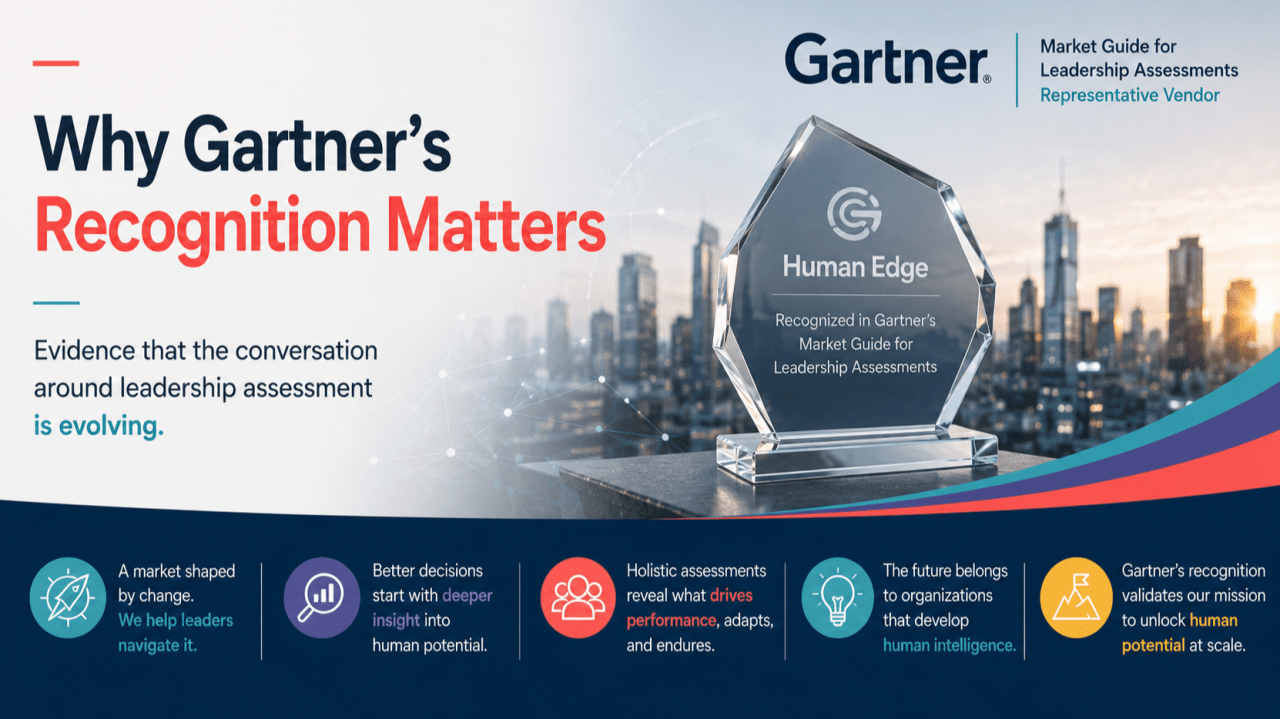
Human Edge was recently included in Gartner’s Market Guide for Leadership Assessments as a representative vendor in the leadership assessment market. We are, of course, proud to be included alongside some of the most established names in the field. But for me, the report’s significance goes well beyond recognition of Human Edge.
What matters is what Gartner’s research tells us about how profoundly the leadership assessment conversation is changing.
Gartner describes a market being reshaped by declining confidence in leadership pipelines, rapidly changing leadership requirements, rising demand for objective, data-driven talent decisions, advances in AI, and a shift away from fragmented assessment tools toward more holistic solutions.
This is not simply an evolution of assessment technology. It reflects a much bigger question organizations are beginning to confront:
What should we be assessing leaders for in a world being transformed by AI?
We Have a Leadership Pipeline Problem
The starting point is uncomfortable.
According to Gartner, only 21% of HR leaders were confident in the strength of their leadership bench in 2025, down from 30% the previous year. Yet third-party assessments remain relatively underused for some of the decisions where objectivity may matter most. Gartner reports that only 22% of organizations use third-party assessments to identify the best fit for critical leadership roles, while only 34% use them to identify the strengths and development needs of people in their succession pipeline.
Leadership capabilities are shifting
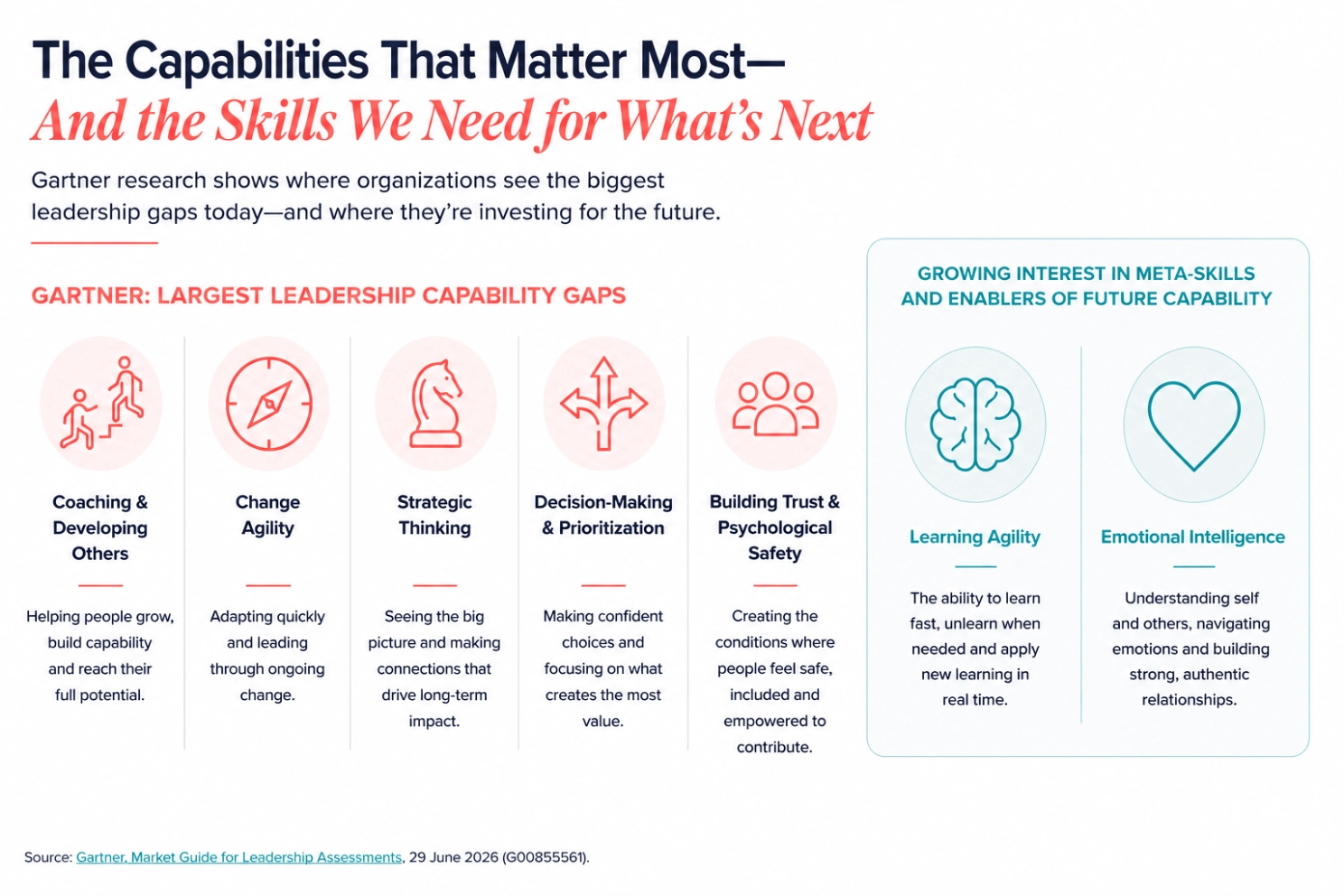
Gartner identifies some of the largest current leadership capability gaps as coaching and developing others, change agility, strategic thinking, decision-making and prioritization, and building trust and psychological safety. The report also points to growing interest in assessing “meta-skills” and the enablers of future capability, including learning agility and emotional intelligence.
That distinction is important. Organizations have traditionally assessed leaders largely by looking backward: What have they achieved? Which competencies have they demonstrated? How closely does their experience resemble the job we need them to do?
But when roles, strategies and even entire industries are changing quickly, past experience becomes a less reliable proxy for future effectiveness.
We increasingly need to understand the human system underneath performance.
How does someone think? How quickly can they adapt? What drives them? How do they respond when pressure increases? Can they challenge their own assumptions? Can they connect with others? Can they exercise judgment when there is no obvious right answer? These questions have been central to the philosophy behind our CORE Suite from the beginning.
From Fragmented Assessments to a More Holistic View of the Human Being
One of the most significant trends Gartner identifies is the movement toward holistic assessment solutions.
Organizations are increasingly moving away from multiple disconnected legacy tools and toward integrated approaches spanning selection, succession and development. Gartner argues this can create a more coherent source of talent insight across the employee life cycle, rather than leaving organizations with separate personality tests, competency assessments, 360s, and development tools that tell different stories.
This resonates deeply with how we have approached CORE.
A human being cannot be adequately understood through a personality score alone. Nor can demonstrated competency tell us everything about potential.
Performance emerges through the interaction of multiple dimensions.
Our CORE philosophy therefore looks at traits, competencies, motivational drivers and derailers together. We can then add perspectives such as 360-degree feedback and team dynamics to understand not only someone’s internal tendencies but how their leadership is experienced by others.
Why does this matter?
Because two leaders can demonstrate the same behavior for entirely different reasons. One may naturally possess the underlying attributes that make the behavior sustainable. Another may have learned to compensate effectively through experience. Both may perform well today, but they may respond very differently when complexity, uncertainty, or pressure increases.
Assessment therefore needs to move beyond describing people. It needs to help us understand how and why they are likely to perform, adapt and develop.
And Then AI Changes the Question Again
This is where the conversation becomes even more interesting.
The World Economic Forum’s Future of Jobs Report 2025 found that employers expect 39% of workers’ key skills to change by 2030. While AI and big data lead the fastest-growing technology skills, employers continue to place enormous importance on deeply human capabilities. Analytical thinking remains the number one core skill, while resilience and agility, leadership and social influence, creative thinking, motivation and self-awareness, empathy and active listening, and curiosity and lifelong learning all rank highly.
This reinforces something we have been arguing for some time: the more capable Artificial Intelligence becomes, the more important Human Intelligence becomes.Not because humans need to compete with machines. Quite the opposite.
We need to get better at the capabilities that let us use machines intelligently.
Human Intelligence Is Becoming a Business Capability
We think about Human Intelligence through six interconnected capabilities: critical thinking, judgment, creativity, emotional intelligence, intuition, and wisdom.
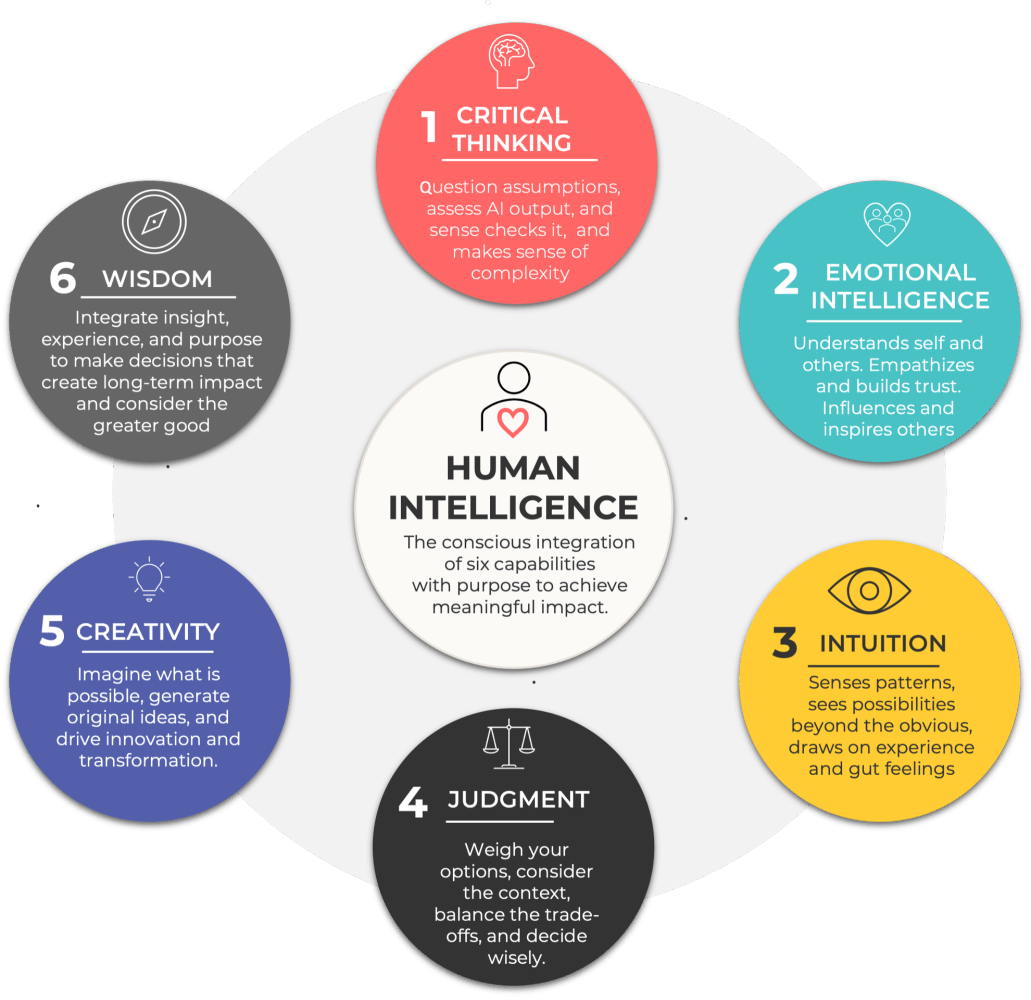
Source: Human Edge Management AG, All rights reserved
These capabilities have always mattered to leadership. What is changing is the context in which they operate. When information was scarce, having access to knowledge created advantage. When information becomes almost limitless, the ability to determine what deserves our attention and what is credible becomes more valuable.
When analysis took days, analytical capacity was a constraint. When AI can generate an analysis in seconds, the differentiator shifts toward judgment. When producing ideas required significant effort, idea generation itself created value. When AI can produce 50 ideas instantly, humans must become better at recognizing which idea is novel, relevant, and worth pursuing.
And when AI can simulate empathy convincingly, genuine human understanding, trust, courage and wisdom do not become irrelevant. They become more consequential.
Research on human-AI collaboration already shows why this matters.
A 2024 Nature Human Behaviour meta-analysis examined 106 experiments and 370 effect sizes comparing humans alone, AI alone and humans working with AI. Human-AI combinations generally improved on humans working alone—but, importantly, they did not, on average, outperform the better of the human or AI working independently. The researchers also found performance losses in many decision tasks.
That finding challenges one of the simplest assumptions behind AI adoption: putting a human and an AI together does not automatically create better intelligence.
The quality of the human matters. Their ability to question, evaluate, discern, integrate and decide matters.
There Is Also a Risk of Human Intelligence Atrophy
Perhaps the more provocative question is whether some of the capabilities we will need most could weaken if we fail to use AI thoughtfully.
Microsoft Research studied 319 knowledge workers and collected 936 examples of how they used generative AI in their work. The researchers found that higher confidence in AI was associated with less critical-thinking activity, while greater confidence in one’s own ability was associated with more critical thinking. They also observed that critical thinking itself shifts when AI is involved, from producing information toward verifying, integrating, and overseeing AI-generated output.
This should matter enormously to those of us working in talent and leadership development. It means our challenge is no longer simply to measure whether leaders possess particular capabilities. We may increasingly need to understand whether those capabilities are being strengthened or weakened by how people work with AI.
So How Do We Assess Human Intelligence Today?
We are not starting from zero. Many components of Human Intelligence can already be understood through rigorous assessment.
Gartner’s Market Guide itself describes an increasingly diverse assessment ecosystem that includes personality questionnaires, cognitive assessments, emotional intelligence measures, structured interviews, 360 feedback, simulations, situational judgment tests and assessment centers.
CORE today approaches this from several angles.
Traits help us understand the underlying tendencies influencing how someone thinks, responds, and relates. Competencies show how capability is translated into observable leadership behavior. Drivers help us understand the motivation and energy behind those behaviors. Derailers provide insight into what may happen when pressure increases. 360 feedback provides another critical lens: how others experience that leadership.
Together, these dimensions can already give us important insight into aspects of Human Intelligence such as emotional intelligence, adaptability, curiosity, relational capability, judgment, and the underlying conditions that make effective leadership more or less likely.
But I don’t believe this is where assessment ends. It is where the next generation begins.
The Future: Assessing Human Intelligence in Action
The next evolution of leadership assessment will need to move beyond asking only, “What characteristics does this person possess?” We will increasingly need to ask:
“How does this person think and behave when confronted with complexity, ambiguity and AI?”
That means assessment will become more contextual and dynamic. Rather than assessing judgment primarily through self-report, we can put leaders into complex simulations where the data are incomplete, AI offers a confident recommendation, and competing stakeholder needs must be balanced.
Rather than simply measuring whether someone describes themselves as curious, we can observe whether they ask better questions, challenge an initial hypothesis, and actively search for disconfirming evidence.
Creativity can increasingly be assessed through how people combine ideas, extend what AI produces and recognize possibilities that were not initially obvious. Emotional intelligence can be evaluated not simply through preferences but through how leaders read and respond to complex interpersonal situations.
Even intuition and wisdom, arguably among the most difficult human capabilities to reduce to a score, may become better understood through patterns of judgment across multiple contexts and over time.
This is not about replacing psychometrics with AI.
In fact, Gartner makes an important observation: despite considerable attention around AI-enabled assessment, much of its application to date has been relatively superficial, improving efficiency and user experience without fundamentally changing underlying psychometric methodology. Gartner expects greater experimentation with adaptive simulations, AI interviews, performance prediction, automated scoring and personalized development, while also emphasizing the need for validity, explainability, bias safeguards and continued human oversight.
That is exactly the tension we need to get right.
Technology should deepen our understanding of humans, not simply make assessment faster. Assessment Must Lead to Development Another part of Gartner’s research, I believe, is just as important as measurement.
Go Beyond the Report
Gartner recommends building post-assessment development into the process from the outset, including debriefs, development planning, accountability and measurement of longer-term outcomes such as transition success, performance, successor promotion accuracy and leadership effectiveness. This reflects a principle that has always been important to us at Human Edge:
Insight without development has limited value.
Assessment is not meant to put people into boxes. It is to give individuals and organizations a better understanding of potential—and then provide people with the opportunity to expand it. As we enter the AI era, that development imperative becomes even greater. Organizations will need to deliberately strengthen the Human Intelligence that technology cannot simply provide for us.
Why Gartner’s Recognition Matters
This is ultimately why Gartner’s inclusion of Human Edge in its Market Guide matters to me. Yes, it is meaningful to see Human Edge listed among the representative vendors in a global market that includes many long-established assessment organizations. But the more important story is the market Gartner describes.
- A market moving from fragmented tools toward holistic insight.
- From relying primarily on past experience toward understanding future potential.
- From static assessment toward personalization and more contextual measurement.
- From assessment as an event toward assessment connected directly to development.
And increasingly, from asking whether someone possesses yesterday’s leadership competencies toward understanding whether they have the Human Intelligence required for tomorrow.
The irony of the AI era may be that better technology forces us to become far more sophisticated in how we understand humans. For decades, assessment has helped organizations answer:
Who is this person?
Then we began asking:
What could this person become?
The next question may be even more important:
What uniquely human capabilities will this person need to strengthen to thrive alongside increasingly intelligent machines?
That is where I believe the future of leadership assessment is heading. And that is why this recognition matters.


