










AI is not creating an entirely new species of leader. It is increasing the value of some deeply human capabilities – often faster than organizations are developing them.
The uncomfortable news is not that leaders suddenly need a completely new set of skills. It is that some of the capabilities organizations have discussed for years – judgment, curiosity, adaptability and influence – are becoming more important at the same time as the context makes them harder to exercise.
In our previous article, we argued that a leadership assessment can remain scientifically sound while the definition of success underneath it becomes outdated. That raises the next question:
If the target has moved, what should organizations be looking for now, and where are the most consequential gaps?
The capabilities are familiar. The demands are not.
Much of the debate about “future skills” creates a false choice between traditional leadership and an entirely new AI-era model. The reality is more nuanced.
Strategic thinking, judgment, curiosity, and influence are not new. What is changing is the environment and context in which leaders must deploy them.
AI can generate options in seconds, but that increases the need to decide which options deserve attention. It can accelerate analysis, but that raises the cost of acting quickly in the wrong direction. It can personalize communication at scale, but it cannot create trust, shared meaning or genuine commitment on a leader’s behalf.
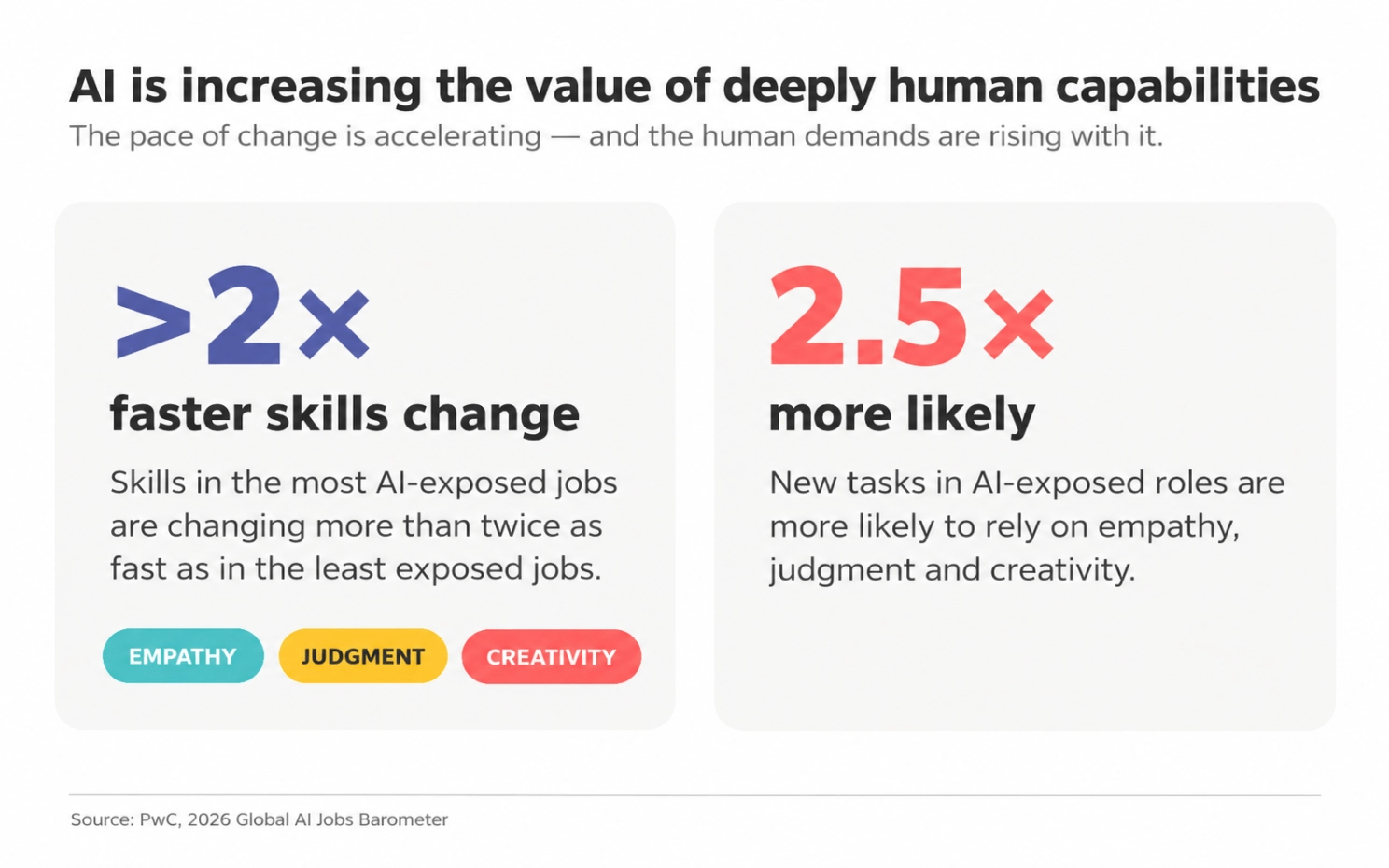
PwC’s 2026 Global AI Jobs Barometer makes the shift visible in the labor market. Skills in the most AI-exposed jobs are changing more than twice as fast as in the least exposed jobs, while new tasks in AI-exposed roles are 2.5 times more likely to rely on empathy, judgment and creativity. [1]
The World Economic Forum finds a similar pattern. Analytical thinking remains central, but resilience, flexibility and agility, leadership and social influence, creative thinking, self-awareness, empathy and curiosity all feature strongly among employers’ core or rising skills. [2]
Gartner translates this broader shift into seven capabilities for leaders navigating AI-driven transformation: strategic goal shielding, integrated decision-making, narrative direction, curiosity cultivation, cultural harmonization, exponential influence and active communication. [3]
Rather than treating these as another competency list, it is useful to examine what they require leaders to do differently.
1. Strategic thinking becomes strategic goal shielding
Leadership models have long rewarded the ability to identify opportunities. AI changes the volume of those opportunities. Leaders can now generate ideas, scenarios, experiments, and efficiency possibilities at extraordinary speed.
The challenge is no longer only seeing what could be done. It is protecting what matters from the lure of everything that is technically possible.
Gartner calls this strategic goal shielding: maintaining focus on critical business priorities while resisting exciting but nonessential AI-driven possibilities. [3]
This is more than prioritization. It requires leaders to understand the organization’s strategic intent well enough to make trade-offs when technology moves faster than planning cycles. It also demands the confidence to stop activity that looks innovative but does not create meaningful value.
The gap may not present as a lack of ideas. It may look like fragmented experimentation, overloaded teams, and a growing portfolio of pilots with no clear connection to the business strategy.
The assessment and development question, then, is whether leaders can protect strategic coherence as possibilities multiply.
2. Decision-making becomes integration, not simply speed
AI can make analysis extraordinarily fast. That does not automatically make decisions better.
Gartner describes decision-making as one of the biggest existing leadership capability gaps and argues that AI intensifies the challenge by shortening decision shelf lives and increasing technical, ethical, cybersecurity, and commercial complexity. [3]
Integrated decision-making requires leaders to hold several things together: what the technology makes possible, how the business works, the quality and limitations of the available evidence, the consequences for different stakeholders and the organization’s longer-term intent.
In the clients I work with, people push decision-making up because they don’t want to be accountable for the results. This will become even more prevalent as new technology emerges and the pace of change accelerates.
This is why judgment becomes more valuable, not less, as analysis becomes easier to produce. More options will be on the table, but which ones will move the needle?
PwC’s findings add another layer. AI-exposed junior roles are seven times more likely to demand traditionally senior capabilities such as leadership and strategic thinking. Organizations are therefore asking people to exercise complex judgment earlier in their careers, often before they have accumulated the experiences through which judgment was traditionally developed. [1]
That creates a development problem as much as an assessment problem. If AI removes some of the lower-risk work through which people learned, organizations must design new ways for that learning to happen.
The question is not whether leaders can decide quickly. It is whether they can recognize what must remain a human decision, interrogate AI-supported analysis, and integrate evidence that does not fit neatly into one model.
3. Curiosity becomes an operating capability
Curiosity is often treated as a desirable trait: useful, but difficult to translate into business performance. AI makes it operationally important.
When the skills required in AI-exposed work are changing more than twice as fast, leaders cannot rely only on what they already know. They must be willing to test assumptions, learn in public, and revise their view as the evidence changes. [1]
Gartner’s idea of curiosity cultivation goes beyond the leader’s personal appetite for learning. It includes creating conditions where teams feel trusted to experiment safely with AI-enabled improvements, rather than waiting for every workflow to be designed from the top. [3]
That distinction matters. A leader may describe themselves as open and curious while unintentionally punishing uncertainty, rewarding only polished answers or stepping in whenever an experiment becomes uncomfortable.
Curiosity becomes visible in behavior. Does the leader explore before concluding? Do they ask questions that expose the assumptions underneath an answer? Change their mind without treating it as a loss of authority? Create enough psychological safety for others to challenge an AI-generated recommendation?
4. Influence matters more when hierarchy matters less
AI transformation rarely succeeds through formal authority alone. It crosses functions, changes workflows, and redistributes expertise. Leaders must build commitment among people they do not directly manage, many of whom have different incentives, concerns, and levels of technical understanding.
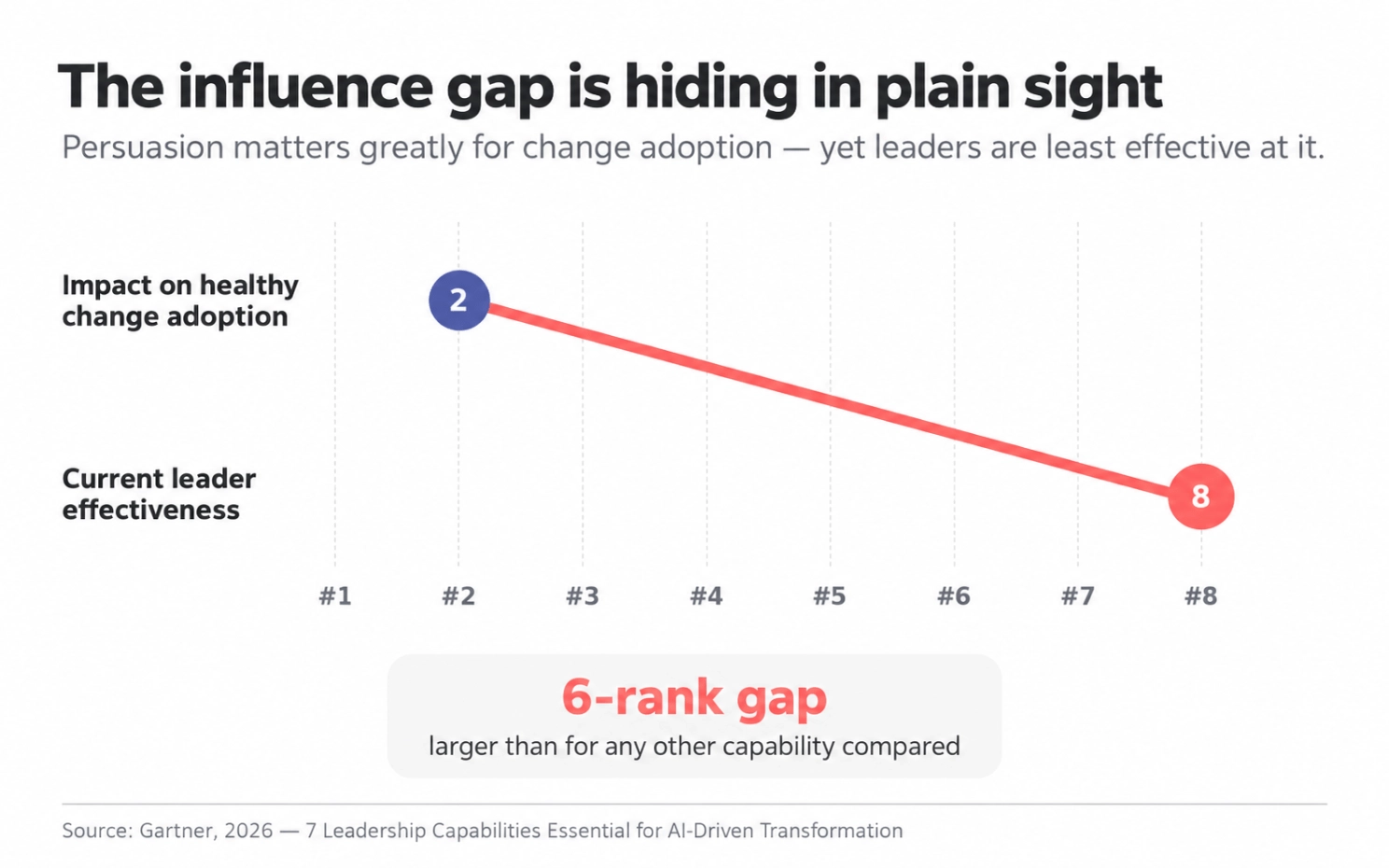
This makes Gartner’s findings on influence especially important. In its comparison of eight leadership capabilities, persuasion ranked second for its impact on healthy change adoption but eighth – last – for leaders’ current effectiveness. That six-rank difference was substantially larger than for any other capability. [3]
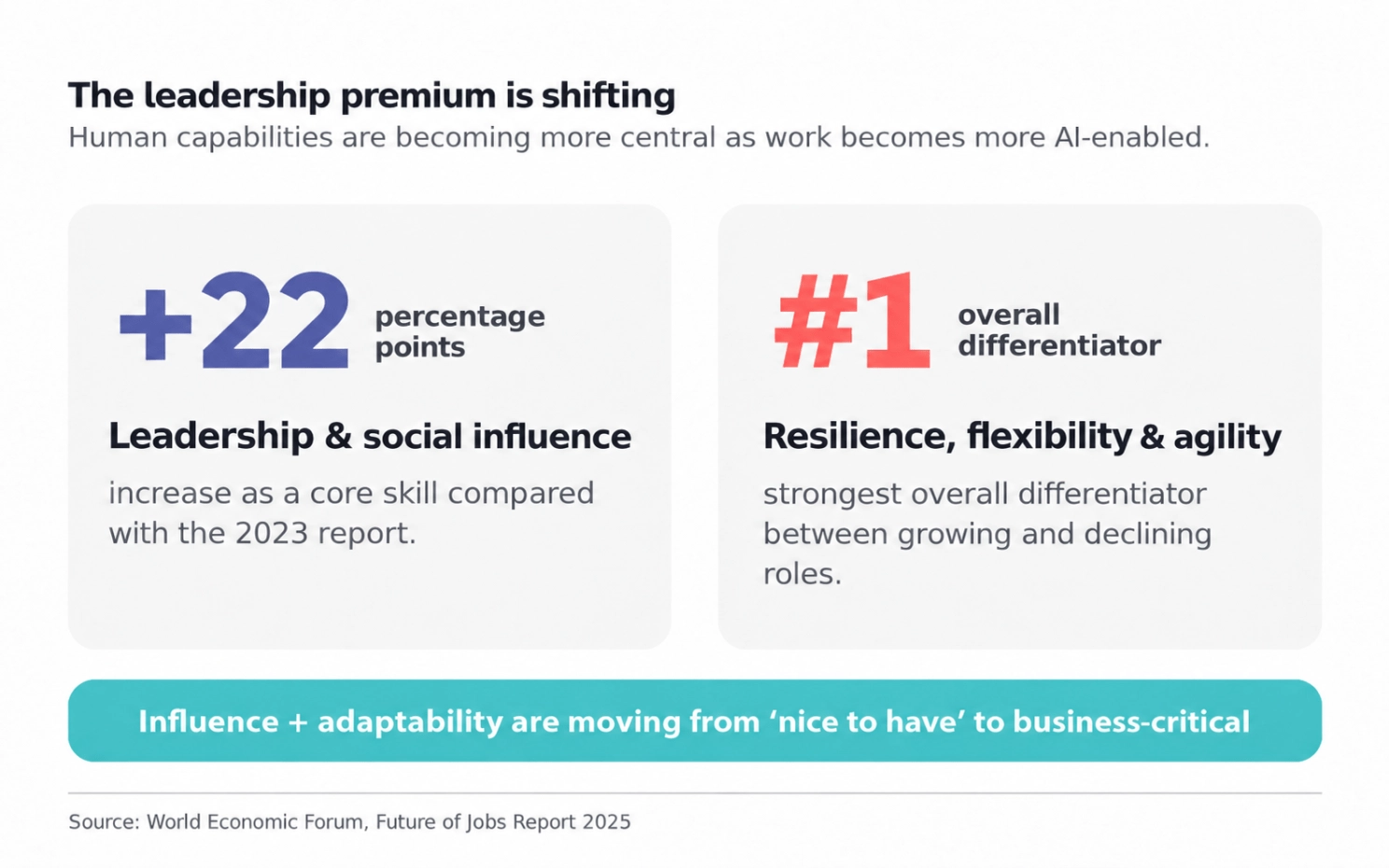
The World Economic Forum reports that leadership and social influence rose by 22 percentage points as a core skill compared with its 2023 report. It also identifies resilience, flexibility, and agility as the strongest overall differentiator between growing and declining roles. [2]
In this context, influence is not polished communication or relentless advocacy. It is the ability to understand different perspectives, create a credible narrative, adapt the message without diluting it, and help people see their role in the change.
Resilience matters here too. Influence during transformation involves resistance, ambiguity, and repeated course correction. Leaders need enough emotional steadiness to remain responsive rather than defensive.
The gap is not solved by adding four competencies
Organizations respond predictably to emerging skill requirements: update the competency framework, add new labels, and launch a program.
That may be necessary. It is not sufficient.
The World Economic Forum identifies skills gaps in the labor market as the primary barrier to business transformation, cited by 63% of employers. [2] Gartner’s research suggests that the capabilities with the greatest impact may also be among those where leaders are least effective. [3]

Closing those gaps requires organizations to connect four decisions:
Define. Translate broad capabilities into the behavior required by the organization’s strategy and operating context.
Assess. Use multiple forms of evidence to understand the foundations beneath the behavior, current capability in context, and capacity to develop.
Develop. Give leaders real decisions, trade-offs, and experiments through which judgment, curiosity, and influence can be practiced – not just discussed.
Reinforce. Examine whether incentives, governance, and senior role-modeling reward the new behavior or quietly pull leaders back toward speed, certainty, control, and short-term activity.
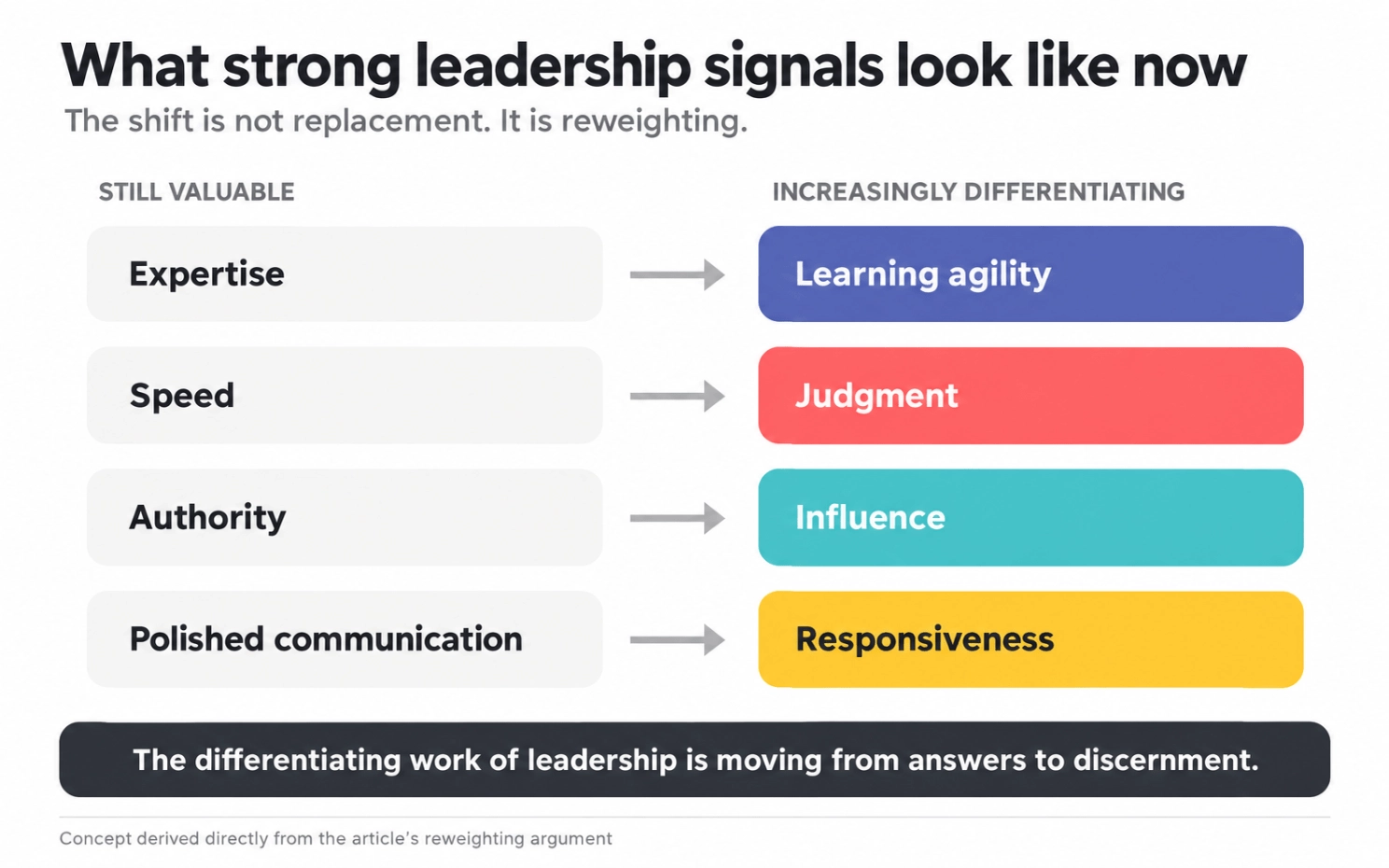
This also requires some reweighting. Expertise without learning agility, speed without judgment, authority without influence, and polished communication without responsiveness may still look impressive. They are increasingly incomplete signals of future leadership value.
The real shift is from answers to discernment
AI will continue to make information, analysis, and content easier to produce. The differentiating work of leadership moves elsewhere: deciding what deserves attention, recognizing what the data does not capture, creating the conditions for responsible experimentation and mobilizing people through uncertainty.
The organizations that respond well will not simply add “AI leadership” to an already crowded competency model. They will become more precise about where human capability creates value – and more deliberate about how those capabilities are assessed, developed and reinforced.
The future leader is not the person with the fastest answer.
It is the person who can determine which answer matters, what it may be missing, and how to help others act on it wisely.
At Human Edge, we work with leaders to explore what it means to lead thoughtfully in an AI era, including how to use AI responsibly and ethically while strengthening the distinctly human capabilities technology cannot replace. Through our CORE™ assessments and leadership development work, we help leaders build greater self-awareness and develop the human intelligence needed to exercise judgment, navigate complexity and lead others through change.
Research sources
- PwC (2026). Global AI Jobs Barometer: Two futures for jobs in an AI era. Link
- World Economic Forum (2025). The Future of Jobs Report 2025, Skills Outlook and Workforce Strategies.
- Gartner (2026). 7 Leadership Capabilities Essential for AI-Driven Transformation, G00845534, 2 June 2026. Link


