











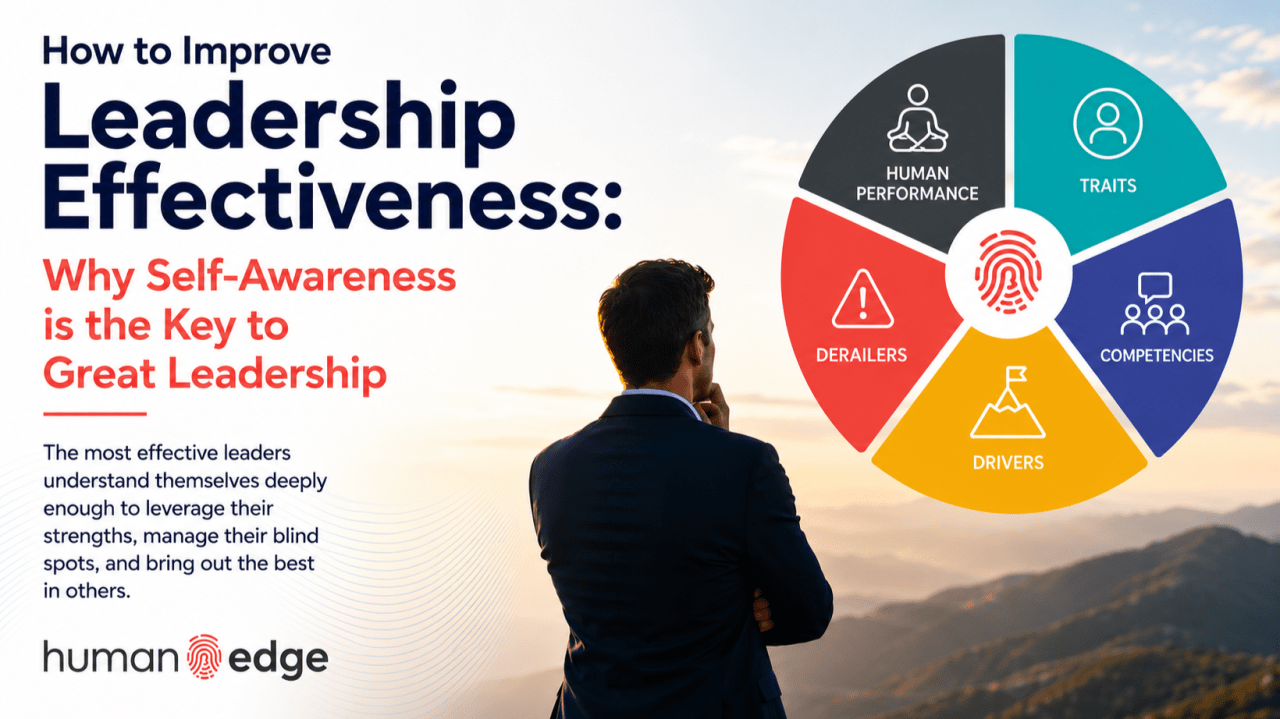
Leadership Effectiveness Starts Within
Leadership has never been more important or more challenging. Research from Gallup shows that managers account for at least 70% of the variance in employee engagement, making leadership one of the single biggest factors influencing team performance, retention, productivity, and culture. Yet despite organizations spending billions of dollars annually on leadership development, employee engagement remains stubbornly low in many organizations.
The challenge is not a lack of leadership training. The challenge is that many leaders are trying to improve their leadership without first understanding themselves.
Research by organizational psychologist Tasha Eurich revealed a striking leadership paradox: 95% of people believe they are self-aware, yet only 10–15% actually are. This means that most leaders may be operating with blind spots that affect their decision-making, communication, relationships, and overall effectiveness.
This matters because self-awareness has been linked to stronger relationships, better decision-making, greater emotional intelligence, improved adaptability, and higher leadership performance. Leaders who understand how they are perceived by others are better equipped to build trust, leverage their experts, navigate complexity, inspire engagement, and create high-performing teams.
At Human Edge, after working with thousands of leaders across industries and geographies, we have found that the most effective leaders are not necessarily the smartest, most experienced, or most technically capable. They are the leaders who understand themselves deeply enough to leverage their strengths, manage their blind spots, and continuously adapt their approach to the needs of their people and organization.
These leaders know who they are. They are grounded in their values, aware of their impact, and confident in what they bring to the table. Because they stand firmly in their own power, they do not feel the need to dominate conversations, seek validation, or be the smartest person in the room. Instead, they create space for others to contribute, grow, and shine. Their confidence comes not from proving themselves, but from knowing themselves. This self-awareness enables them to lead with humility, build trust, and unlock the full potential of those around them.
The path to leadership effectiveness does not begin with learning another leadership model. It begins with understanding yourself.
What Is Leadership Effectiveness?
Leadership effectiveness is the ability to consistently influence people and create conditions that enable individuals, teams, and organizations to achieve desired outcomes.
What Makes Leaders Effective Today?
Effective leaders do more than deliver results. They:
- Demonstrate strong business acumen
- Build trust and credibility
- Create psychological safety
- Inspire commitment and engagement
- Develop talent and future leaders
- Foster collaboration across boundaries
- Drive sustainable performance
However, in today’s environment, these capabilities alone are no longer enough. The most effective leaders have expanded their leadership toolkit to include three critical capabilities:
1. Leading Change
Change is no longer an occasional event—it is a constant reality. Effective leaders help people navigate uncertainty, adapt to new ways of working, and maintain momentum through transformation. They create clarity, build commitment, and help others move forward even when the path is unclear.
2. Thinking Beyond Their Function
Today’s challenges rarely fit neatly within organizational silos. Effective leaders think like enterprise leaders, balancing the needs of their team with the broader needs of the organization. They collaborate across boundaries, make decisions with a long-term perspective, and prioritize collective success over functional optimization.
3. Enabling Technology and AI Adoption
Technology is increasingly shaping how organizations compete, innovate, and create value. Effective leaders do not need to be technical experts, but they must understand how technology, data, and AI can improve performance and create new opportunities. More importantly, they help their teams embrace new technologies, develop new capabilities, and integrate them into everyday work.
The New Leadership Equation
The leaders who thrive in the future will not be those who excel in only one of these dimensions. They will be those who can integrate all three—delivering results today while preparing their people and organizations for tomorrow.

Research consistently demonstrates that leadership effectiveness directly impacts employee engagement, innovation, customer satisfaction, productivity, retention, and organizational performance.
Exceptional leadership comes from integrating the Head, Heart, and Gut. The Head provides clarity, logic, and execution, helping leaders analyze situations, solve problems, and turn ideas into action. The Heart creates connection, trust, and engagement, enabling leaders to build strong relationships and bring out the best in others. The Gut provides intuition, courage, and strategic insight, helping leaders navigate uncertainty, recognize emerging opportunities, and make difficult decisions when there is no clear answer. Leadership effectiveness is not about relying on one channel over another—it is about integrating all three in the right combination for the situation at hand. When leaders engage their Head, Heart, and Gut together, they make better decisions, inspire greater commitment, and create stronger business outcomes.
Leadership effectiveness is not about relying on one channel over another; it is about integrating all three in the right combination for the situation at hand.
The Self-Awareness Gap
One of the most important findings in leadership research is that self-awareness is surprisingly rare.
Most leaders believe they understand themselves well. However, self-perception and self-awareness are not the same thing.
Without self-awareness, leaders often:
- Overestimate their strengths
- Underestimate their weaknesses
- Misjudge how they are perceived by others
- Fail to recognize the unintended impact of their behavior
For example:
- A leader who sees themselves as decisive may be perceived as controlling.
- A leader who believes they are supportive may actually be avoiding difficult conversations.
- A leader who prides themselves on high standards may unknowingly create anxiety and perfectionism within their team.
These blind spots often become the hidden barriers that prevent leaders from reaching their full potential.
The most effective leaders are not those without weaknesses. They are the leaders who understand their weaknesses and actively manage them.
Why Self-Awareness Drives Better Leadership
Self-awareness serves as the foundation for nearly every leadership capability.
Better Decision-Making
Neuroscience research shows that effective decision-making requires integrating logic (Head), emotion (Heart), and intuition (Gut). Leaders who understand their own biases, assumptions, and emotional triggers are better equipped to make balanced decisions, particularly in complex or uncertain situations.
They are less reactive, more thoughtful, and better able to consider alternative perspectives.
Stronger Relationships
Trust is the currency of leadership.
Self-aware leaders understand how their communication style affects others. They recognize when to challenge, when to support, and when to listen. Because they understand themselves, they are better able to understand and adapt to others.
This creates stronger relationships and higher levels of trust.
Greater Adaptability
Today’s leaders operate in environments characterized by constant change and disruption.
Self-aware leaders are more likely to seek feedback, know when they need to rely on experts, learn from mistakes, and adapt their approach when circumstances change. Rather than becoming defensive, they view feedback as information that helps them improve.
Improved Team Performance
Research from organizations such as Gallup and studies by Amy Edmondson have consistently demonstrated that trust and psychological safety are critical drivers of team performance.
Leaders who understand their impact on others create environments where people feel safe contributing ideas, challenging assumptions, admitting mistakes, and taking intelligent risks.
The result is greater innovation, collaboration, and performance.
The Hidden Leadership Derailers
Another critical component of leadership effectiveness is understanding derailers.
Leadership derailers are behaviors that often emerge under pressure, stress, uncertainty, or fatigue. Ironically, many derailers originate from strengths that become overused.
Examples include:
- Excitability can result in emotional overreactions, causing others to perceive the leader as unpredictable or lacking composure.
- Skepticism can lead to questioning others’ intentions, making it difficult to build trust.
- Reservedness can be perceived as disengagement, distance, or a lack of empathy and care.
- Cautiousness can lead to excessive risk avoidance and slower decision-making.
- Gutsy can lead to frequent shifts in direction, creating confusion and instability.
- Liveliness can lead to dominating conversations and failing to create sufficient space for others to contribute.
- Nonconformity can lead to overlooking important stakeholder perspectives, organizational norms, or political realities.
- Arrogance can come across as believing one’s perspective is superior and dismissing others’ input.
- Meticulousness can lead to micromanaging details and limiting others’ autonomy.
- Agreeableness can make it difficult to challenge others, speak candidly, or address difficult issues directly.
For example, a highly driven leader may become overly demanding under pressure. A collaborative leader may struggle to make difficult decisions. A confident leader may stop listening to alternative viewpoints. These behaviors often explain why otherwise capable leaders struggle to maximize their effectiveness.
One of the biggest challenges with derailers is that they typically operate below conscious awareness. Leaders often do not recognize these behaviors in themselves until someone points them out or until their relationships, team performance, or business results begin to suffer. What makes derailers particularly difficult to manage is that they are often triggered automatically under pressure, uncertainty, fatigue, or stress.
Research by organizational psychologist Karen Horney, whose work laid the foundation for much of today’s derailer research, suggests that these behaviors are rooted in underlying fears and self-protective strategies that people develop over time. In response to perceived threats, people tend to move away from others, against others, or toward others in an effort to protect themselves. For example, a highly cautious leader may fear making mistakes, a skeptical leader may fear being taken advantage of, while an overly agreeable leader may fear rejection or conflict. Until leaders understand the fears and assumptions driving these behaviors, it is difficult to recognize and manage the triggers that bring them.
The impact of derailers on leadership effectiveness can be significant. Research from Hogan Assessments has found that leadership effectiveness declines substantially as derailers accumulate. Leaders with four or more pronounced derailers are significantly more likely to experience challenges with interpersonal relationships, team engagement, and overall leadership performance. This is why increasing self-awareness is so critical. When leaders understand their derailers, the situations that trigger them, and the underlying fears that fuel them, they can make more intentional choices about how they respond under pressure and ultimately become more effective leaders.
Why Assessments Accelerate Leadership Growth
Most leaders rely on experience alone to develop self-awareness. While experience is valuable, it is often slow and incomplete.
Leadership assessments provide an objective mirror that helps leaders see themselves more clearly.
A high-quality assessment helps leaders answer critical questions:
- What are my natural strengths?
- What motivates me?
- How do I respond under pressure?
- What leadership behaviors come naturally?
- What are my potential blind spots?
- How might others experience me?
- Which development areas will have the greatest impact?
Rather than relying on assumptions, leaders gain data-driven insights into the patterns that influence their effectiveness.
At Human Edge, we often describe assessments as a catalyst for self-discovery. They do not define a leader. They provide the insight needed to make intentional choices about how to lead more effectively.
The result is accelerated development, greater self-awareness, and stronger leadership performance.
The Human Edge Approach to Leadership Effectiveness
At Human Edge, we believe that sustainable leadership growth begins with self-awareness.
While many leadership programs focus primarily on skills and competencies, we recognize that behavior is shaped by multiple factors. To truly understand leadership effectiveness, leaders need insight into the underlying drivers of their behavior.
This is why our assessments examine leadership through four critical dimensions:

By examining leadership through these multiple lenses, leaders gain a more complete understanding of themselves.
Rather than receiving generic leadership advice, they receive targeted insights that help them leverage their strengths, address areas for development, and focus their efforts where they will have the greatest impact.
The Power of Feedback
Self-awareness cannot be developed through assessment data alone. It also requires feedback.
One of the challenges of leadership is that the higher individuals rise within organizations, the less likely people are to provide honest feedback. As a result, leaders can become increasingly disconnected from how they are perceived.
Research consistently shows that leaders who actively seek feedback are more effective than those who do not.
Effective leaders regularly ask:
- What am I doing well?
- What should I continue doing?
- What should I do differently?
- What impact am I having on others?
When assessment insights are combined with meaningful feedback, leaders gain a more complete and accurate understanding of themselves.
This combination creates the foundation for lasting growth.
Leadership Effectiveness Creates Better Teams
The impact of leadership effectiveness extends far beyond individual performance.
In Human Edge’s research involving teams across multiple organizations, we found that trust, inclusivity, team confidence, innovation, and shared leadership explained 58% of organizational citizenship behavior, the discretionary effort employees choose to give beyond their formal responsibilities.
In practical terms, effective leadership creates environments where people are more willing to contribute ideas, support colleagues, solve problems, and go above and beyond what is required.
These are the behaviors that fuel innovation, collaboration, customer satisfaction, and organizational success.
When leaders improve, teams improve. When teams improve, organizations thrive.
Leadership Development Is a Journey
One of the biggest misconceptions about leadership effectiveness is that it can be achieved through a single workshop or training program.
Leadership effectiveness is not an event. It is an ongoing process of learning, reflection, practice, feedback, and adaptation.
The most effective leaders develop habits that support continuous growth:
- Regular self-reflection
- Seeking feedback
- Understanding their impact on others
- Managing their derailers
- Building emotional intelligence
- Continuously learning and adapting
They recognize that leadership is not about perfection. It is about continuous improvement.
Final Thoughts
The future belongs to leaders who combine business expertise with deep self-awareness. Technical knowledge, strategic thinking, and operational excellence remain important. However, these capabilities alone are no longer enough. Organizations need leaders who can build trust, navigate complexity, develop talent, and create environments where people can thrive.
Research consistently points to self-awareness as the foundation upon which these capabilities are built. Yet self-awareness rarely develops by accident. It requires intentional reflection, meaningful feedback, and objective insight.
This is why assessments remain one of the most powerful tools available for leadership development. They help leaders uncover strengths they can leverage, identify blind spots they need to manage, and focus development efforts where they will generate the greatest return.
At Human Edge, we believe leadership effectiveness starts from the inside out. When leaders understand themselves more deeply, they make better decisions, build stronger relationships, create higher-performing teams, and ultimately deliver better business results.
Because leadership is not simply about managing others. It is about mastering yourself first.
At Human Edge, we help leaders understand the whole person behind the performance. Through research-backed assessments and development solutions, we uncover the traits, competencies, motivations, derailers, and performance factors that shape leadership effectiveness. The result is greater self-awareness, stronger leadership, and sustainable business success.


