









A collision is coming.
Most organizations can already feel the tension. AI is accelerating work faster than structures can adapt. Skills are becoming obsolete faster than job descriptions can be rewritten. Employees are moving toward fluid capability ecosystems while leadership models remain frozen in another era.
Organizations can no longer rely on rigid structures, static roles, or siloed expertise to keep pace with change. In a world where technology, AI, customer expectations, and business priorities evolve constantly, capability must become fluid. A fluid capability ecosystem connects people, skills, AI, learning, and opportunity dynamically across the organization, allowing talent to move where it creates the greatest impact. Rather than simply managing roles, leaders must orchestrate an adaptive ecosystem that continuously learns, evolves, and responds in real time.

And many organizations are about to discover something uncomfortable:
You cannot build a skills-based organization with leaders who still think in silos.
The Workforce Has Already Moved On
The shift is no longer emerging. It is happening now.
Organizations across industries are rapidly redesigning work around skills, adaptability, and the mobility of capabilities rather than static jobs and rigid hierarchies.
According to Deloitte, leading organizations are increasingly moving toward skills-based workforce models designed to create greater agility and internal talent fluidity. LinkedIn Talent Solutions reports that the pace of skill change is accelerating dramatically, while IBM Institute for Business Value identifies workforce adaptability as one of the defining business challenges of the decade.
Organizations understand the game has changed. Competitive advantage is no longer just:
- Headcount
- Expertise
- Experience
- Organizational size
It is the ability to continuously reconfigure human capability faster than disruption unfolds. And this is where the fracture begins. Because while the workforce is evolving dynamically…
Leadership behavior often is not.
Most Leadership Systems Were Built for Stability, Not Fluidity
For decades, leadership systems were built for a world that valued control, predictability, hierarchy, and specialized expertise. Leaders succeeded by managing stable structures, clear roles, and linear career paths. But the world of work has fundamentally changed.
Today, skills-based organizations move faster than traditional systems were designed for. Capabilities evolve constantly. AI is reshaping work in real time. Talent no longer stays neatly within functions or boundaries, and employees increasingly expect growth, mobility, and reinvention throughout their careers.
This shift requires a different kind of leadership. Leaders can no longer simply manage roles and processes. They must learn to orchestrate capability across people, teams, and systems in an environment defined by constant change.

And under pressure, this becomes far harder than most organizations expect. Because when uncertainty rises, leaders often revert to familiar patterns:
- Protecting resources
- Hoarding talent
- Narrow functional thinking
- Overcontrolling decision making
- Prioritizing immediate execution over long-term adaptability
The result?
Organizations attempt to build fluid systems atop rigid leadership behavior. And eventually, the contradiction becomes visible to everyone.
The Real Transformation Is Psychological
Most organizations think this transformation is operational. It is not. It is existential.
Because skills-based organizations fundamentally challenge how many leaders define value, authority, and identity.
Suddenly:
- Expertise becomes distributed
- Authority becomes less centralized
- Influence matters more than hierarchy
- Employees own more of their career mobility
- Learning speed becomes more valuable than historical knowledge
- Adaptability begins to outperform certainty
That changes the emotional architecture of leadership itself. And many leaders are not prepared for it. Not because they lack intelligence. Because they were trained to succeed in a different system. A system optimized for stability. Not perpetual reinvention.
Enterprise Leadership Is Becoming the Divider
This is why enterprise leadership is no longer optional. Organizations no longer need leaders who optimize only their own function. They need leaders who can think across systems, complexity, and capability ecosystems.
Research from McKinsey & Company continues to show that adaptable organizations outperform peers during disruption. But adaptability is not simply a cultural trait.
It is a leadership behavior under pressure. And this is where many leadership models still fall behind. Most leadership frameworks assess performance in relatively stable environments.
Far fewer assess:
- How leaders respond to ambiguity
- How they behave under pressure
- Whether they can shift perspectives quickly
- Whether they build adaptability in others
- Whether they lead beyond functional boundaries
- Whether they create enterprise-level capability
At Human Edge, this is exactly why enterprise thinking and adaptability sit at the center of the CORE™ Leadership Assessment Enterprise Leadership cluster. Because the future will not reward leaders who simply manage efficiently.
It will reward leaders who can continuously evolve capability across the enterprise while maintaining trust, clarity, and momentum under uncertainty.
The Most Dangerous Illusion
Many organizations believe they are transforming because they are implementing:
- AI tools
- Skills taxonomies
- Workforce analytics
- Internal talent marketplaces
- Capability frameworks
But infrastructure is not transformation. Leadership behavior is. And this is where the next divide is forming. Some organizations will use AI and skills models to unlock adaptability, innovation, and enterprise-wide reinvention.
Others will install the same systems…and unintentionally amplify rigidity.
Because technology cannot compensate for leadership models that no longer fit the environment they are trying to lead.
The Question Most Organizations Are Avoiding
Most executives are asking: “How do we become a skills-based organization?”
But the more dangerous question is still sitting underneath it.
What happens when the workforce evolves faster than leadership itself?
Because that is no longer a future problem. It is already happening.
What Organizations Must Do Next
Most organizations are still trying to solve a leadership problem with structural solutions. But skills-based organizations require something much deeper: A rewiring of how leaders think, adapt, and operate under pressure.
And this is where many organizations will either evolve… or stall. So, what actually needs to change?
Not through another leadership workshop. Not through abstract competency models. Not through inspirational slogans about agility.
But through measurable shifts in leadership behavior.
Here are three critical leadership shifts organizations must embrace for skills-based transformation to succeed.
1. Train Leaders to Think Like Enterprise Orchestrators, Not Functional Owners
Most leaders were rewarded for optimizing their own area and are measured on silo-based KPIs. But skills-based organizations require leaders who can optimize capability across the enterprise.
That means leaders must stop asking: “How do I protect my team?”
And start asking: “How do we mobilize capability where it creates the greatest enterprise value?”
This is a profound shift.
Organizations must intentionally develop:
- Enterprise thinking
- Systems thinking
- Cross-functional collaboration
- Shared accountability
- Talent mobility mindsets
Otherwise, the organization builds a fluid talent model built on territorial leadership behavior. And eventually, the system breaks under its own friction.
2. Develop Adaptability Under Pressure, Not Just Adaptability in Theory
Many organizations say they value adaptability. Far fewer train leaders to remain effective when certainty disappears.

At Human Edge, this is why measuring behavior under pressure matters so deeply. Because transformation does not reveal leadership theory. It reveals leadership patterns.
3. Shift Leadership Development from Knowledge Transfer to Capability Building
Many leadership programs still focus heavily on information. But information is no longer the competitive advantage. AI already has information. The future advantage is human capability.
Organizations must stop developing leaders as static experts and start developing them as capability multipliers.
That means leadership development must increasingly focus on:
- Building learning cultures
- Coaching adaptability in others
- Increasing psychological safety
- Strengthening enterprise collaboration
- Developing decision-making quality
- Creating reinvention capacity across teams
The best leaders in the next decade will not be the people with the most answers. They will be the leaders who can continuously expand the capability of the people around them. And that requires a very different development model than most organizations still use today.
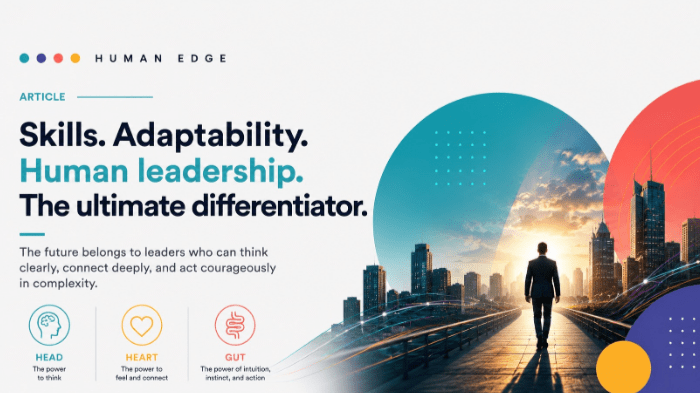
4. Develop Whole Human Leaders Who Can Integrate Head, Heart, and Gut
Most leadership development still overdevelops one capability:
The head.
- Analysis.
- Logic.
- Strategy.
- Problem solving.
- Execution.
But skills-based organizations and AI-accelerated environments demand far more than cognitive intelligence alone. When complexity rises, data overwhelm, and certainty disappear, leaders cannot rely solely on analytical thinking. They need integration.
At Human Edge, this is the foundation of Humanistic Leadership: The ability to integrate head, heart, and gut to lead with greater awareness, adaptability, courage, and human connection.

Research increasingly supports the idea that effective decision-making is not purely cognitive but involves emotional and intuitive processing as well. And this matters enormously in modern leadership environments.
Because leaders today are navigating:
- Constant ambiguity
- AI-driven disruption
- Emotional fatigue across teams
- Ethical complexity
- Rapid decision cycles
- Human resistance to change
- Information overload
In these environments:
- Head without heart creates intelligent but disconnected leadership
- Heart without gut creates empathy without decisive movement
- Gut without head creates impulsive leadership without reflection
The strongest leaders learn to integrate all three.
- They think clearly.
- Connect deeply.
- And act courageously.
This creates leaders who can:
- Make wiser decisions under uncertainty
- Build trust faster
- Navigate tension without overreacting
- Balance data with human impact
- Stay grounded under pressure
- Create psychological safety while still driving performance
- Lead transformation without losing humanity
In many ways, this may become the defining leadership capability of the AI era.
Because as technology becomes more intelligent, deeply human leadership becomes more valuable, not less. And organizations that develop leaders who can integrate analytical clarity, emotional intelligence, and intuitive judgment will have a significant advantage in environments where complexity is rising faster than logic alone can manage.
The Real Leadership Challenge Ahead
The shift to skills-based organizations is not merely a change in workforce strategy. It is changing the psychological contract of leadership itself. And the organizations that succeed will be the ones that realize this early:
The future will not belong to organizations with the most static expertise.
The future will belong to organizations whose leaders can continuously adapt, mobilize, and evolve human capability faster than the environment changes around them.
At Human Edge, we believe the future of leadership is not built solely on competency models, but on deeper human capability. Our integrated CORE™ assessments go beyond measuring knowledge or personality in isolation by combining traits, competencies, human performance patterns, drivers, and behavior under pressure into one multidimensional view of leadership effectiveness. Grounded in our Humanistic Leadership approach, we help organizations develop leaders who can integrate head, heart, and gut, think clearly, connect deeply, and act courageously in complexity. Because in a world increasingly shaped by AI and disruption, the organizations that thrive will be the ones that build deeply human leaders capable of adapting, mobilizing capability, and leading transformation without losing humanity.


