











He had the corner office, the title, and the team. He was also falling apart.
Marcus, a senior leader at a global pharmaceutical firm, had just delivered a record quarter. But on a Tuesday morning, sitting in his car in the parking garage, he couldn’t bring himself to open the door. Not because anything was wrong with the business. Everything was wrong with him. His sleep had collapsed. He’d stopped exercising months ago. His temper had become unpredictable, short, sharp flashes of frustration that left his team walking on eggshells. And beneath it all was a hollowness he couldn’t name: the feeling that he’d lost the thread of why any of this mattered.
Marcus wasn’t lazy. He wasn’t weak. He was a leader who had mastered strategy but neglected the most fundamental asset he had: his own energy.
His story is not rare. It’s becoming the rule.
The Silent Crisis Nobody Talks About
We’ve spent years talking about employee burnout. But there’s a quieter, more consequential crisis unfolding: the depletion of the people at the top.
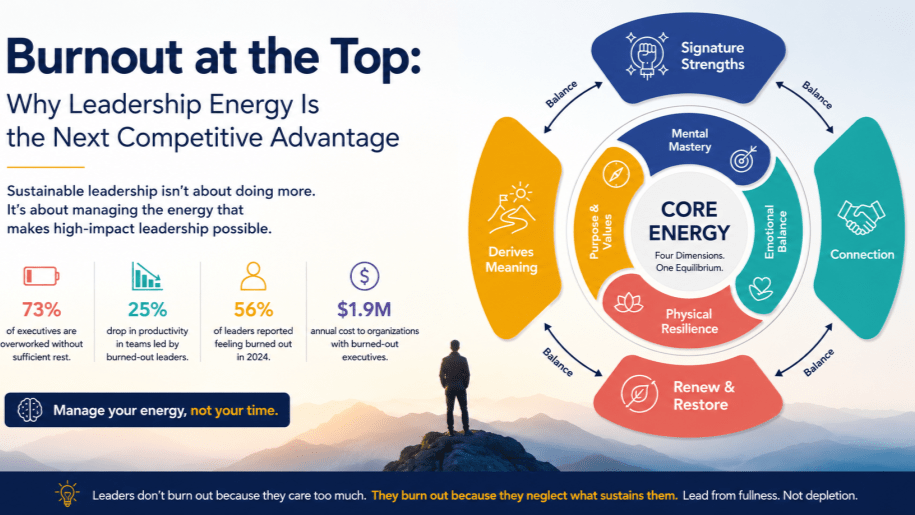
Research shows that 56% of leaders reported feeling burned out in 2024, a number that has been climbing year over year. Among middle managers, it’s 71%. At the C-level, 73% of executives admit they are overworked without sufficient rest. The consequences are measurable: organizations with burned-out executives incur an estimated $1.9 million in related costs annually, and teams led by depleted leaders experience a 25% drop in productivity and 28% lower engagement.
A 2026 Forbes analysis further elevated the issue: burnout has moved from an individual wellness concern to a board-level business risk. It can no longer be delegated to HR alone. It demands strategic attention from the top.
But here’s what most organizations get wrong: they treat burnout as a resilience problem, as if the leader simply needs to toughen up. They offer meditation apps, wellness stipends, or an occasional offsite. These interventions address symptoms while ignoring the root cause.
What if the real answer isn’t about being tougher? What if it’s about being more whole?
Two Forces Inside Every Leader
There is an ancient wisdom tradition that teaches something profound about what it means to be human. It says that every person carries two inner forces: a higher self that yearns for meaning, purpose, and connection, and a reactive self-driven by instinct, fear, and self-preservation.
The goal is not to destroy the reactive self. That would be impossible. The goal is to bring it under the governance of the contemplative self, to let awareness rather than impulse drive our actions.
We must learn to observe ourselves without judgment
This tradition also teaches that the mind has a natural authority over the heart. Not through brute force suppression, but through a deeper principle: as you think, so you feel. Emotions are described as “children of the mind.” If your mental life is dominated by scarcity and pressure, your emotional life will follow. If you never contemplate your purpose, you won’t feel connected to it. But when you intentionally fill your mind with expansive, purposeful thoughts, your emotional landscape transforms.
The ideal is not perfection. It is the “intermediate person” who still feels fear, frustration, and desire but who has developed the capacity to pause between stimulus and response, to observe what they feel without being hijacked by it. This person doesn’t suppress emotion. They govern it through awareness.
For leaders operating under relentless pressure, this is not abstract philosophy. It is a survival skill. And it maps directly onto a practical, modern framework for leadership energy.
The CORE Energy Model: A Framework for Leadership Equilibrium
At Human Edge, the approach to resilience begins with a powerful premise:
Manage your energy, not your time.
Human Edge’s CORE Energy model identifies four interconnected dimensions of energy that leaders must actively manage to sustain performance and avoid burnout. When all four are in balance, leaders return to a state of equilibrium, the ability to lead from a place of fullness rather than depletion. When even one dimension is neglected, the entire system starts to break down.

1. Mental Mastery: Governing the Inner Narrative
This is the practice of training the mind to rule the heart. Mental Mastery is about developing the self-awareness to notice your thought patterns and the discipline to redirect them. Leaders who cultivate mental mastery don’t just react to crises. They observe their own cognitive habits, challenge catastrophic thinking, and choose where to place their attention.
Research from the Center for Creative Leadership confirms that mindfulness and cognitive reappraisal, the ability to reframe stressful situations, are among the most evidence-backed practices for leadership resilience. Leaders trained in this capacity don’t experience less stress. They experience it differently, extracting learning rather than damage.
We need to learn that our mind is a tool, not the driver of our life
This is the ancient practice of deep contemplation applied to the modern boardroom. It is the conscious act of filling the mind with purposeful thought so that reactive emotions don’t rule the day.
2. Emotional Balance: Regulating, Not Suppressing
The intermediate person of the ancient wisdom tradition doesn’t pretend that difficult emotions don’t exist. They feel frustration, fear, and desire, but they don’t act from those places. They have developed an inner pause: the space between feeling and response.
For leaders, emotional regulation is not about putting on a brave face. It’s about developing the capacity to hold difficult emotions without being hijacked by them, and to model that capacity for their teams. It’s also about going beyond the emotion and realizing there is an unmet need that needs a voice.
Consider Marcus again. His anger in meetings wasn’t a character flaw. It was a signal, a symptom of an emotional system that had been running on empty for too long. When he began working with a coach using the CORE Energy framework, the first breakthrough wasn’t a strategy shift. It was learning to name what he was feeling in real time, and to ask himself: Is this emotion informing my decision, or driving it?
That single question changed everything.
Emotional regulation is one part of the equation. But an even deeper issue is that when life becomes too busy, we stop investing in our relationships. Over time, our sense of connection fades and, with it, our energy. Human connection is not a luxury. It is one of the primary ways we restore ourselves emotionally. When we invest in meaningful relationships, we refill our emotional tank, allowing us to take on more responsibility and pressure while still feeling grounded, connected, and whole.
3. Physical Resilience: The Foundation Everything Else Rests On
Here’s a truth most leadership programs ignore you cannot think clearly, regulate emotions, or sustain purpose if your body is running on empty.
Physical Resilience is the bedrock of the CORE model, and it includes four non-negotiable practices: leaving time for recovery, sleeping well, eating healthy, and exercising regularly.
The science is unequivocal. Research published in Neurology shows that cardiovascular fitness is directly associated with improved cognitive function and decision-making, with fit executives demonstrating 20% better decision-making performance. Physical activity reduces cortisol levels by up to 25% and improves emotional regulation during high-pressure situations.
A landmark study from the Icahn School of Medicine at Mount Sinai found that sleep quality and exercise were among the strongest predictors of resilience in frontline workers during the COVID-19 pandemic. And research published in the International Journal of Neuropsychopharmacology (2025) confirms that regular exercise builds resilience at a neurobiological level through enhanced neurogenesis, neuroplasticity, and reduced inflammatory response.
Yet when leaders are asked what they sacrifice first under pressure, the answer is almost always the same: sleep, exercise, and recovery time. This is the leadership equivalent of burning the foundation to heat the house. The outer dimensions of the CORE model, Renew & Restore and Connection, can’t function without this physical base.
4. Purpose & Values: The “Why” That Sustains the “How”
The ancient teaching tells us that the higher self yearns for connection to something greater. When that connection is alive, everything else flows. When it goes dormant, even success feels hollow.
Purpose & Values is the dimension of CORE Energy that answers the question: Why does this work matter to me? Leaders who are anchored in a clear sense of purpose demonstrate greater resilience under pressure, make more consistent decisions, and inspire deeper loyalty in their teams.
After the COVID pandemic, revenues and profits had recovered, but the leaders were still operating in survival mode, afraid to take risks and be vulnerable. They had lost touch with their why. The scarcity mindset had calcified into a culture of fear. It wasn’t until they reconnected with their deeper purpose that growth, real, sustainable growth, became possible again.
This is the outer ring of the CORE model in action: when Purpose & Values are alive, leaders derive meaning from their work. When they lean into their signature strengths and cultivate connections with others, the system reaches equilibrium. And when they prioritize renewal and restoration, the cycle becomes self-sustaining.
Five Practices to Reclaim Your Equilibrium
Understanding the CORE model is essential. But knowledge without action is just information. Here are five evidence-backed practices that leaders can begin today to manage their stress and return to equilibrium. Think of them as daily disciplines for governing your inner life with intention.
1. Build Micro-Recovery into Your Day
You don’t need a two-week vacation to reset. You need intentional 3 to 5-minute recovery breaks every 90 minutes. A landmark University of Cambridge study tracking 5,000 knowledge workers found that employees who practiced these brief, strategic pauses reported 37% lower stress levels and 28% higher productivity than those relying solely on lunch breaks or end-of-day relaxation.
The practice is simple: after every 90-minute work sprint, step away. Change your posture. Look out a window. Walk to the end of the hall. The key is rhythm: preventing stress from accumulating rather than trying to recover after it’s already overwhelmed you. As neuroscientists explain, the most effective recovery combines four elements: a cognitive switch (change tasks briefly), an emotional lift (something that brings a moment of lightness), a social micro-connection (a brief, genuine exchange), and a physical reset (movement or a posture change).
This is the modern application of an ancient principle: you cannot sustain the higher self’s clarity if you never give it space to breathe.
2. Practice Box Breathing Before High-Stakes Moments
Before your next board meeting, difficult conversation, or strategic decision, try this: Inhale for 4 seconds. Hold for 4 seconds. Exhale for 4 seconds. Hold for 4 seconds. Repeat three to five times.
This technique, known as box breathing, is used by Navy SEALs, elite athletes, and increasingly by executives for good reason. A meta-analysis published in Scientific Reports (Nature) found that breathwork interventions significantly reduced self-reported stress, anxiety, and depressive symptoms, with slow-paced breathing particularly effective in activating the parasympathetic nervous system and increasing heart rate variability, a key marker of emotional resilience.
What makes this so powerful for leaders is that it works in the moment. It is the physiological equivalent of the ancient teaching that the mind can govern the heart. One minute of regulated breathing can measurably lower cortisol levels and shift you from reactive mode to responsive mode. You don’t have to retreat to a meditation room. You can do it in your chair, in the elevator, or in the two minutes before you walk into the room.
3. Reflect for 15 Minutes a Day (Not About Strategy, About Meaning)
Research from Harvard Business School found that employees who spent just 15 minutes at the end of each day reflecting on lessons learned performed 23% better after 10 days than those who did not reflect. For leaders, the impact is even more pronounced.
But the key is what you journal about. Don’t write about your to-do list. Write about what surprised you, what frustrated you, and what failed. Research shows that reflections involving surprise, failure, and frustration are the most pivotal moments for learning and growth. Ask yourself: What did I feel today that I didn’t expect? What pattern am I noticing in how I react? What is this experience teaching me about my purpose?
This is the practice of making the unconscious conscious. The ancient wisdom tradition taught that emotions are “children of the mind,” that what you contemplate shapes what you feel. Journaling is the modern discipline of that contemplation. It transforms fleeting experience into lasting self-awareness.
4. Protect Your Sleep Like You Protect Your Calendar
Leaders routinely block time for strategy sessions, board meetings, and client dinners. Yet almost none of them protect their sleep with the same discipline. This is a critical error.
Research from the Icahn School of Medicine at Mount Sinai identified sleep quality as one of the strongest predictors of resilience. Studies show that even moderate sleep deprivation, getting six hours instead of seven or eight, reduces cognitive performance by 25%, impairs emotional regulation, and increases risk-taking in decision-making. Physical activity and nutrition amplify the effect: leaders who combine consistent sleep with regular exercise and healthy eating create a compounding resilience advantage at a neurobiological level.
The practical discipline: set a non-negotiable “shutdown time” each evening. Treat it like a meeting with your most important client, because in a very real sense, it is. Your body is the vessel through which every other dimension of CORE Energy flows.
5. Schedule One “Purpose Conversation” Per Week
Burnout is often less about workload and more about disconnection from meaning. One of the most powerful antidotes is deceptively simple: have one conversation per week that reconnects you to your purpose.
This might be a mentoring session where you invest in someone else’s growth. It might be a conversation with a colleague about why the work matters, not just what needs to get done. It might be 20 minutes with a coach exploring the question: Am I living my values this week, or just managing my calendar?
The CORE model’s outer ring shows that Connection and Derives Meaning are essential to equilibrium. These aren’t soft concepts. They are the relational and purposeful fuel that sustains everything else. Lisa Danels often describes how the post-pandemic leaders she worked with didn’t recover by working harder. They recovered by reconnecting with themselves, with their teams, and with their deeper why.
The ancient teaching says the higher self yearns to connect to something beyond itself. When that connection is alive, energy returns naturally. Purpose is not a luxury for leaders. It is the renewable energy source that makes all other effort sustainable.
Equilibrium Is the Competitive Advantage
The genius of the CORE Energy model, and the reason it resonates so deeply with ancient wisdom about the human soul, is that it treats the leader as a whole person, not a performance machine.
The intermediate person of the wisdom tradition doesn’t achieve mastery through perfection. They achieve it through awareness, practice, and the daily choice to govern their inner life with intention. They regulate their emotions not by denying them, but by creating the mental, physical, and purposeful conditions in which balance becomes possible.
That is exactly what the CORE model provides: a practical, evidence-based framework for leaders to manage their energy across all four dimensions, mental, emotional, physical, and purposeful, so that equilibrium is not a luxury but a discipline.
Companies with strong leadership see 13% higher profitability and a 65% increase in employee engagement. Conversely, 70% of employees would consider leaving their job due to poor leadership quality.
In an era defined by AI disruption, geopolitical uncertainty, and relentless change, the leaders who thrive won’t be the ones who simply endure the pressure. They’ll be the ones who manage their CORE Energy, who cultivate Mental Mastery, Emotional Balance, Physical Resilience, and Purpose & Values, and who choose every single day to lead from wholeness rather than depletion.
Marcus eventually made that choice. He started sleeping for seven hours. He walked every morning before his first call. He began journaling, not about strategy, but about meaning. He scheduled one conversation per week that had nothing to do with deliverables and everything to do with purpose. And slowly, his equilibrium returned. His team noticed before he did.
That's the real edge. Not a sharper strategy. A more whole leader.
Human Edge helps organizations build resilient, self-aware leaders through their CORE Energy model and humanistic leadership development. Learn more at human-edge.com.


