











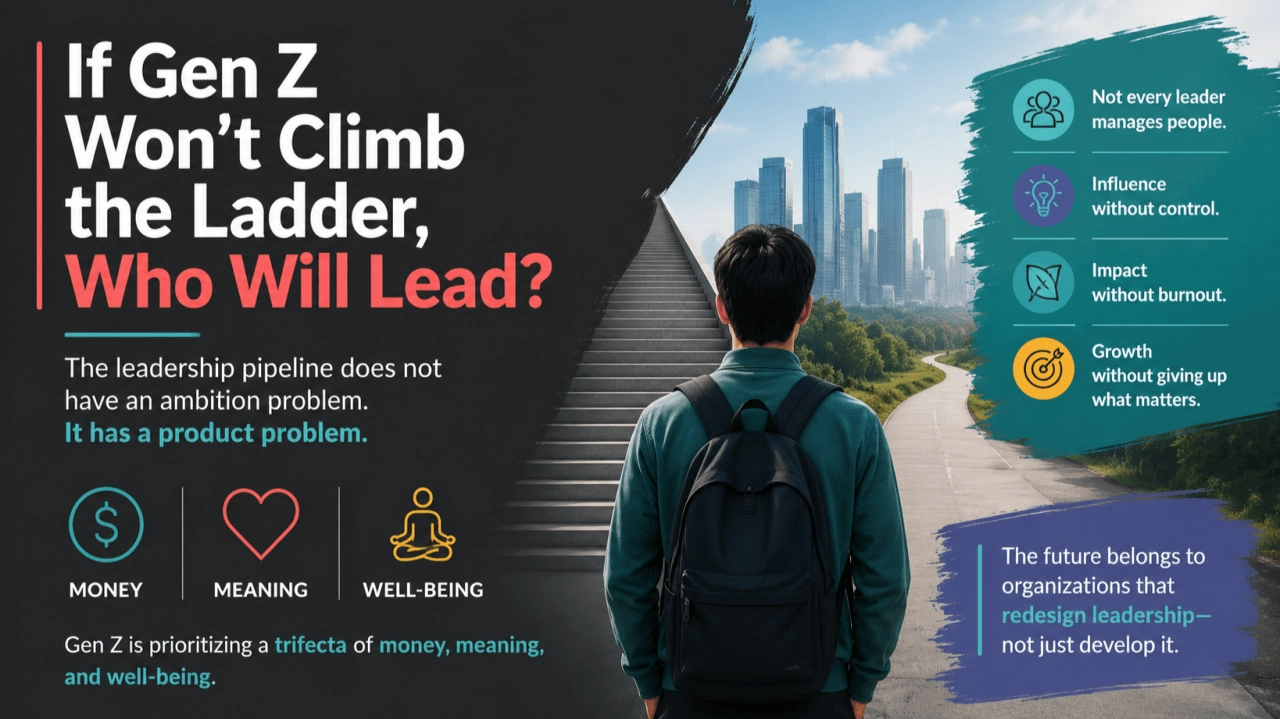
The leadership pipeline does not have an ambition problem. It has a product problem.
For decades, organizations built their leadership pipelines around a reassuring assumption: talented employees would eventually want what their managers had. Greater status. A larger title. More authority. A bigger team. A place higher in the hierarchy.
The bargain was straightforward. Perform well, demonstrate ambition, and earn the right to move upward. Leadership was presented as the natural destination of a successful career.
That bargain is breaking down.
Deloitte’s 2025 global survey of more than 23,000 Gen Z and millennial respondents found that only 6% of Gen Z considered reaching a leadership position their primary career goal. Yet the same research found that Gen Z remains deeply interested in growth, learning, and career development. Their decisions increasingly revolve around what Deloitte calls a trifecta of money, meaning, and well-being.
The provocative conclusion is not that Gen Z lacks ambition. It is that many young employees no longer see a leadership position as evidence of ambition.
They may want to grow without managing people. They may want to influence without controlling. They may want responsibility without surrendering their health. They may want to make a difference without inheriting a calendar filled with meetings, escalations, and administrative work.
This creates an uncomfortable question for leaders and HR: if the next generation does not want the leadership roles we have created, who will lead the organization in ten years?
But perhaps that is the wrong question.
The better question is: What have we made leadership look like, and why would an intelligent young employee want it?
Gen Z is watching what leadership costs
Junior employees do not form their impressions of leadership from competency models, career websites or purpose statements. They form them by watching their managers.
They see managers caught between senior leaders demanding more and teams needing greater support. They see calendars with no white space, relentless organizational change, and accountability without corresponding authority. Leaders are expected to deliver performance with smaller teams and fewer resources while managing well-being, implementing new technologies, resolving conflict, retaining talent, building inclusion, and absorbing pressure from every direction. At the same time, they rarely relinquish their individual contributor responsibilities. They must still provide thought leadership, lead strategic initiatives, and produce significant deliverables of their own. The result is not simply a bigger job, but two demanding jobs compressed into one increasingly unsustainable role.
Then organizations ask:
Why don’t young people want to become managers?
DDI’s 2025 research, based on 10,796 leaders across more than 50 countries, suggests that Gen Z may be making a rational assessment. 71% of leaders reported a significant increase in stress after assuming their current role. Among those experiencing increased stress, 40% had considered leaving leadership to improve their well-being. Only 30% believed they had enough time to complete their work to the standard expected. The sense of purpose reported by frontline leaders had also declined.
This is the leadership role junior employees can see.
From their perspective, promotion may mean more accountability but less control over one’s time; more emotional labor but fewer opportunities to do the work one enjoys; and responsibility for team wellbeing while sacrificing one’s own.
If this is what leadership visibly demands, prioritizing wellbeing is not evidence of fragility. It is evidence of pattern recognition.
Organizations sometimes describe the resulting reluctance as “conscious unbossing,” as though younger employees have suddenly developed an aversion to responsibility. But what if they are not rejecting responsibility? What if they are rejecting the assumption that responsibility must be accompanied by chronic overload?
The future leadership crisis will not be caused simply by Gen Z refusing to step up. It will be caused by organizations refusing to redesign what stepping up means.
Growth is still highly attractive, but management is not automatically growth
The evidence does not support the stereotype of an unambitious generation.
Gallup found that 43% of Gen Z employees considered accelerated professional or career development very important when choosing a new job; a substantially higher figure than among older age groups. However, work-life balance and well-being, compensation, and security were prioritized more widely.
Gen Z wants progression. The mistake is assuming that progression must culminate in managing other people.
For many organizations, the career architecture still communicates a twentieth-century message: expertise gets you noticed, but management gets you rewarded. The individual contributor path eventually narrows while the leadership path opens into greater compensation, influence, and prestige. Employees are told that both paths matter, but the organization’s titles, pay structures, and decision rights often reveal otherwise.
Gen Z is challenging that contradiction.
Young talent may want harder problems, broader exposure, new skills, greater autonomy, and meaningful influence. None of those desires necessarily translates into wanting direct reports. When “leadership” is presented primarily as people administration, performance management, and organizational firefighting, an expert career can appear more developmental and more impactful.
HR should therefore stop treating a low appetite for conventional management as a low appetite for growth. These are not the same thing.
The leadership pipeline will become stronger when organizations allow employees to experience leadership before asking them to accept a management job, and when leadership is defined as mobilizing people around meaningful outcomes, not merely occupying a position in the hierarchy.
McClelland’s theory tells us what has changed
David McClelland’s work on motivation offers a useful way to understand this transition. His framework identified three learned needs: achievement, affiliation, and power.
The need for achievement is the desire to master difficult tasks, meet demanding standards, and improve performance. It explains why development, challenge, and learning remain powerful attractions for Gen Z. But achievement motivation alone does not necessarily produce people leaders. Highly achievement-motivated employees may prefer work where they can personally control quality and see a direct connection between their effort and the result. Management can frustrate that need because success becomes dependent on enabling others rather than personally delivering the answer.
The need for affiliation is the desire to establish and maintain positive relationships. Traditional interpretations sometimes treated strong affiliation as a leadership liability because leaders must make unpopular decisions. Yet contemporary leadership depends increasingly on trust, empathy, collaboration, and the ability to hold diverse teams together. Affiliation is not sufficient to create leadership motivation, but its constructive form shapes the kind of leadership many younger employees respect.
The need for power is the most important for the leadership pipeline, and the most frequently misunderstood.
Power is often interpreted as the desire to control people, acquire status, or rise through a hierarchy. But McClelland distinguished between personalized and socialized power.
Personalized power is exercised primarily for the individual: status, recognition, control, dominance, and the symbols of importance. Socialized power is exercised to influence collective outcomes, strengthen the organization, develop other people, and advance a purpose beyond oneself.
This distinction changes the conversation.
Gen Z may be less attracted to the traditional packaging of power, title, hierarchy, and authority, without being less attracted to influence. Many may be motivated by the possibility of changing something, creating a better outcome, amplifying unheard voices, developing others, or bringing a worthwhile idea to life.
They are not necessarily saying, “I do not want power.” They may be saying,
I do not want power over people. I want the power to make something better.
Research on contemporary leadership motives increasingly makes a similar distinction. A 2025 study of adolescents and emerging adults differentiated dominance motivation, gaining power through authority, control, or fear, from prestige motivation, in which influence is earned through trust, expertise, respect, and consensus. Prestige motivation was associated with empathy and agreeableness, while dominance motivation was more closely associated with narcissism and maladaptive social dominance.
This does not prove that every member of Gen Z is more prosocial than previous generations. In fact, large-scale research cautions against attributing workplace differences automatically to generational membership. Age, career stage, and historical conditions often explain more than generational labels do. Ravid, Costanza, and Romero, 2024, Schröder, 2024
But it does show that organizations have been measuring and marketing the wrong form of power.
The old pipeline asked, “Who wants to move up?”
The future pipeline must ask, “Who wants to create positive influence, and what conditions would make leadership the best vehicle for doing so?”
Purpose can activate leadership motivation, but purpose theatre will repel it
Deloitte found that 89% of Gen Z respondents considered purpose important to job satisfaction and well-being. That sounds like an obvious opportunity: connect leadership with purpose, and the pipeline problem is solved.
It is not that simple.
Purpose is not a slogan, an employer-brand campaign, or a carefully produced video featuring the chief executive. Purpose becomes motivational when employees can see a credible relationship between their effort, their influence, and an outcome that matters.
A leadership role activates socialized power when it allows a person to answer four questions positively:
- How can I make a meaningful difference?
- Will I have enough authority to affect the outcome for which I am accountable?
- How can I help other people grow or succeed?
- How can I do this without destroying my own well-being?
If the answer to the first question is an inspiring “yes,” but the answer to the other three is “no,” purpose will not pull people into leadership. It will feel manipulative.
Purpose without agency is theatre. Purpose without resources is exploitation. Purpose without boundaries is simply a more emotionally compelling route to burnout.
This is why HR cannot solve the pipeline problem through messaging alone. If the leadership role remains structurally unhealthy, wrapping it in purpose may temporarily attract idealistic employees, but it will also accelerate disillusionment.
The organization must redesign the job before it redesigns the story.
Leadership identity is built before the promotion
Many succession systems still look for employees who already appear leader-like. They search for confidence, visibility, executive presence, and an openly expressed desire to advance. This approach risks repeatedly selecting people who are comfortable claiming authority while overlooking those motivated to create influence.
Leadership identity research offers a different perspective.
A 2025 systematic review of nearly 200 papers concluded that internalizing “leader” as part of one’s identity influences motivation, how people interpret leadership situations, and how they build relationships. Leader identity is not simply discovered through an assessment. It develops through experience, reflection, relationships, and social recognition. Hammond, Thrasher, and Vogelgesang Lester, 2025
This matters because many young employees may reject the identity of “manager” even as they already behave as leaders.
They convene people around a problem. They mentor a new colleague. They challenge an inefficient process. They create psychological safety in a project team. They translate complex information so others can act. They influence without formal authority.
If an organization only validates leadership after promotion, these employees may never recognize leadership as part of who they are.
The pipeline should therefore begin with small, authentic experiences of influence: leading a project, facilitating a decision, mentoring, representing employee voices, owning a client outcome, coordinating across functions, or improving a system. These experiences allow people to test leadership without immediately inheriting the full burden of management.
Crucially, someone else must name what happened: “You brought people together. You influenced the outcome. You helped others perform. That was leadership.”
Leadership identity grows partly through this social validation. People are more likely to imagine themselves leading when respected others can already see leadership in them.
Stop selling the position. Start revealing the impact.
A recent development in motivation-to-lead research captures this idea directly. The emerging concept of prosocial motivation to lead describes the desire to lead because leadership offers an opportunity to benefit others and make a positive difference.
Its items include ideas such as wanting to take the lead after seeing one’s positive influence, helping others through leadership, and using a leadership position to benefit the group. Initial validation found that this motivation was associated with leadership aspiration and contributed to the prediction of perceived leadership effectiveness. The scale is new and requires further validation, but it captures something that conventional leadership assessments often miss.
This is the motive organizations should learn to activate.
Instead of saying, “This role is the next step in your career,” say:
- “You will be able to shape how this team works.”
- “You will have the authority to remove obstacles that frustrate people.”
- “You will help six talented employees grow.”
- “You will influence decisions that affect our customers.”
- “You will be accountable for an outcome that matters—and you will have the resources to deliver it.”
That is a fundamentally different leadership proposition. It activates achievement through challenge, affiliation through human connection, and socialized power through positive influence.
It also treats well-being as a condition of sustainable leadership, not a competing sign of insufficient commitment.
HR must redesign the pipeline around five choices
- Separate growth from hierarchy. Build credible expert and enterprise-contributor paths with status, compensation, and influence comparable to management. Leadership should be chosen because someone wants to mobilize others, not because it is the only route to advancement.
- Assess socialized influence, not appetite for status. Look for people energized by improving collective outcomes, developing colleagues, taking responsible ownership, and influencing across boundaries. Do not confuse self-promotion with leadership motivation.
- Create leadership experiments before leadership appointments. Give emerging talent bound opportunities to lead projects, communities, client work, and change initiatives. Provide coaching and reflection so that these experiences contribute to leader-identity formation.
- Repair the frontline management role. Audit spans of control, meeting load, administrative work, decision rights, and access to support. If frontline leadership offers accountability without authority, no purpose statement will make it attractive for long.
- Make wellbeing evidence of leadership maturity. Sustainable leaders establish boundaries, manage energy, distribute responsibility and create conditions in which others can perform. Treating exhaustion as proof of commitment selects the wrong role models and advertises an unhealthy future to the pipeline.
Who will lead the future?
Gen Z’s hesitation may ultimately be a gift.
It is forcing organizations to confront a leadership model that many existing leaders already find unsustainable. The old pipeline was powered by the promise of advancement. The future pipeline must be powered by the possibility of contribution.
The next generation of leaders may not be the people most eager for authority. They may be the people most determined to use influence responsibly. They may not dream of becoming the boss. They may care deeply about improving a system, helping a team succeed or solving a problem that matters.
HR’s task is not to convince them to sacrifice well-being for a title. It is to show them that leadership can expand their contribution without consuming their life, and then to ensure the reality matches the promise.
If only 6% of Gen Z identify a leadership position as their primary goal, the answer is not to make the corporate ladder shinier.
It is to build a different invitation.
Do not ask young talent to climb for the sake of being higher.
Invite them to lead because, from there, they can move something that matters.
At Human Edge, this is where our work in leadership and potential begins. We help organizations look beyond who appears ready for the next title to understand what truly activates a person’s potential to lead. That means identifying not only capability, but also motivation: the purpose people want to serve, the influence they want to create, and the conditions they need to thrive. By combining human insight with evidence, we help organizations build leadership pipelines that recognize different expressions of ambition and develop leadership identity through meaningful experience. The future will not be secured by persuading Gen Z to accept the old leadership bargain. It will depend on unlocking their human potential and creating forms of leadership they can believe in, and sustain.


