










And Why It Quietly Shapes Everything
There is a moment many leaders know well, even if they rarely talk about it openly. The meeting ends. Everyone leaves the room. The conversation moves on.
But internally, something remains unfinished.
- A comment they should have challenged.
- Feedback they avoided giving.
- Frustration they swallowed.
- Emotion they suppressed so they could appear composed.
And hours later, sometimes days later, the conversation is still replaying in their mind.
Most people assume leadership pressure comes from workload, complexity, or difficult decisions. But often, the heaviest pressure leaders carry comes from unresolved emotional tension.
The conversation left unfinished. The truth left unsaid. The emotion left unprocessed.
And what makes this dangerous is that unresolved emotional tension rarely stays contained. It quietly begins shaping behavior underneath the surface.
Leadership Is Happening Internally Long Before It Shows Up Externally
Many leadership challenges are not caused by a lack of intelligence, strategy, or capability. Often, they are driven by emotional reactions leaders themselves may not fully understand yet. When pressure rises or something feels threatening externally, old emotional patterns can quietly emerge beneath the surface. A fear of losing control. A fear of not being enough. A fear of being exposed, dismissed, or unsafe. These reactions are deeply human, not signs of weakness.
For example:
- A leader who micromanages may not simply struggle with delegation. They may be trying to get it perfect where internally they feel anxious, vulnerable, or afraid of failure.
- A leader who avoids difficult conversations may not lack communication skills. They may fear rejection, conflict, or damaging relationships.
- A leader who dominates discussions may not simply be highly driven. They may unconsciously use certainty and control to manage anxiety.
Under pressure, leaders do not simply apply skills. They react from emotional conditioning.
And most organizations spend far more time developing visible leadership behaviors than helping leaders understand the emotional systems driving those behaviors underneath.
This is why two leaders can attend the same leadership program and respond completely differently under stress.
- One becomes grounded and reflective. The other becomes reactive and defensive.
- One creates trust and openness. The other unintentionally creates fear and silence.
The difference is often emotional awareness.
The Emotional Energy Teams Feel But Rarely Name
Here is the uncomfortable truth many leaders underestimate.
Teams may not always understand what is happening emotionally inside a leader, but they absolutely feel the effects of it.
People notice impatience. They notice tension. They notice emotional unpredictability. They notice when challenge feels unsafe. They notice when leaders stop listening and start protecting themselves emotionally.
And slowly, teams begin adapting around those emotional patterns.
A team learns whether honesty is safe. Whether disagreement is welcomed. Whether vulnerability is punished indirectly. Whether leaders truly want openness or only comfort. This is why emotional mastery is not a soft leadership concept. It shapes culture.
Because unresolved emotional patterns eventually become organizational patterns.
- Avoided tension becomes passive resistance.
- Avoided accountability becomes confusion.
- Avoided conflict becomes politics.
- Avoided emotional awareness becomes burnout, defensiveness, and silence.
Most organizational dysfunction is emotional before it becomes operational.
Why So Many High Performers Become Emotionally Disconnected
Many successful leaders learned early in life that achievement creates value. Competence creates safety. Performance creates recognition. Control creates certainty.
Over time, many become exceptionally skilled at functioning while becoming increasingly disconnected from what is happening emotionally underneath the surface.
Not intentionally. But gradually.
They learn how to push through stress instead of processing it. How to suppress emotion instead of understanding it. How to stay productive instead of reflective. And eventually, this creates a dangerous illusion. Externally, they appear highly capable. Internally, unresolved emotional pressure quietly builds.
Patience shortens. Defensiveness increases. Listening weakens. Control intensifies. Emotional exhaustion grows beneath constant performance. And eventually, leadership shifts from intentional influence toward emotional self protection.
The Leadership Habit Nobody Talks About
Many leaders stay constantly busy because busyness protects them from reflection.
- Achievement becomes distraction.
- Productivity becomes emotional avoidance.
As long as leaders remain moving, solving, fixing, and performing, they rarely have to fully confront what is happening internally. But unresolved emotional patterns do not disappear through achievement. They simply travel upward into bigger roles, larger teams, and more pressure.
This is why highly successful leaders can still become emotionally reactive, disconnected, controlling, or exhausted.
The issue is rarely intelligence. It is unexamined emotional patterns operating automatically under stress. And this is where the real leadership work begins.
Emotional Mastery Is Not Suppression
One of the greatest myths about emotionally strong leaders is that they do not experience fear, frustration, insecurity, self doubt, or emotional triggers. They do.
The difference is that emotionally grounded leaders recognize these emotions without becoming fully controlled by them. Emotional mastery is not becoming emotionless. It is becoming conscious.
The strongest leaders are not those who never feel emotionally activated. They are the leaders who notice what is happening internally early enough to choose their response intentionally.
- A leader can feel fear without collapsing into avoidance.
- A leader can feel frustration without becoming destructive.
- A leader can feel uncertainty without compensating through control.
That space between emotion and reaction is where mature leadership begins.
And yet, most leaders move too quickly to ever access that space. The First Step Toward Emotional Mastery
- The first shift is not fixing yourself.
- It is observing yourself honestly without judgement
Most leaders spend enormous energy analyzing external business problems while spending very little time examining their internal reactions. Start noticing patterns.
What situations create defensiveness? What conversations trigger anxiety? When do you emotionally withdraw? When do you seek certainty, validation, or control? When does pressure change the way you lead?
Do not rush to judge the reaction. Observe it first.
Awareness interrupts emotional automation.
Without awareness, leaders repeat the same emotional patterns for years while believing the problem exists entirely outside themselves.
Learn to Pause Before Reacting
One of the most powerful emotional mastery habits is learning to pause. Pressure creates urgency. Emotional reactivity accelerates behavior. Leaders often react before fully understanding what they are actually feeling internally.
Emotionally mature leaders slow the moment down.
Not externally in dramatic ways. Internally. They pause before sending the emotionally charged email. Pause before escalating conflict. Pause before becoming defensive. Pause before making emotionally driven decisions. Even a short pause creates psychological space between emotion and behavior.
And inside that space, reflection becomes possible.
Ask yourself: What am I actually feeling right now? What fear or need may be driving this reaction? Am I responding intentionally or emotionally protecting myself?
These questions create clarity that dramatically improves leadership quality over time.
Build the Capacity to Stay Present Inside Discomfort
Many emotional reactions are actually attempts to escape discomfort.
Leaders interrupt because silence feels uncomfortable. They avoid feedback because tension feels threatening. They become controlling because uncertainty activates anxiety.
Emotional mastery requires increasing the ability to remain grounded inside discomfort without immediately reacting to escape it. This does not mean suppressing emotion.
It means building emotional tolerance.
Some of the strongest leaders are not the loudest or most dominant people in the room. They are the leaders who can remain emotionally steady while pressure rises around them.
Reflection Is Where Self Leadership Begins
Emotional mastery rarely develops accidentally. Leaders need intentional moments of reflection that reconnect them with themselves beneath constant external stimulation.
Simple reflective questions create enormous awareness over time:
- Where did I react emotionally today?
- What triggered me? What did I avoid? Where was I most grounded?
- What emotional pattern keeps repeating?
Without reflection, emotional patterns remain unconscious.
And unconscious emotional patterns eventually shape leadership behavior whether leaders intend them to or not.
The Conversation Most Leaders Never Finish
Perhaps this is the deeper conversation many leaders quietly carry throughout their careers. Not whether they are capable enough. But whether they are aware enough.
Aware enough to recognize when fear is driving control. Aware enough to recognize when insecurity is shaping leadership behavior. Aware enough to notice when exhaustion is becoming emotional volatility. Aware enough to pause before unresolved emotional patterns begin shaping the culture around them.
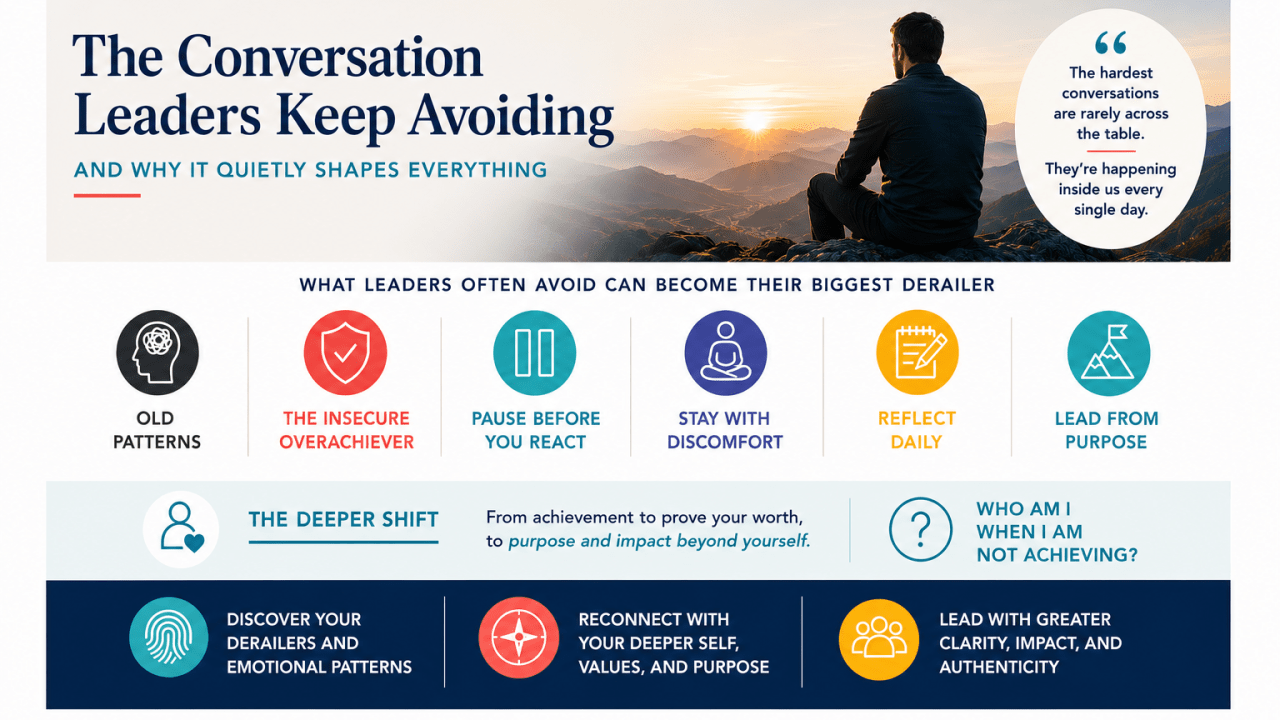
Because underneath many high performing leaders is an archetype few people talk about openly: the insecure overachiever.
The leader who achieves relentlessly, not only from ambition, but from a deeper need to prove their worth. The leader who keeps performing, delivering, solving, producing, and succeeding because somewhere underneath the surface lives a quiet question they are afraid others might discover:
Am I really good enough?
So externally, they build success. They collect achievements. They become indispensable. They stay in motion. But internally, the doubt often lingers. Not because they are weak. Not because they lack capability. But because achievement became tied to identity.
Over time, accomplishment stops feeling like expression and starts feeling like protection. And this is where many leaders become trapped. Because no amount of achievement fully resolves an internal belief that worth must constantly be earned.
The pressure becomes endless.
If I achieve more, maybe I will finally feel enough. If I succeed again, maybe the doubt will quiet down. If I keep performing, maybe nobody will see the insecurity underneath.
But eventually, leadership asks a deeper question.
Who are you when you are not achieving?
Who are you without the title, the performance, the validation, or the constant proving? This is often the real turning point in emotional mastery.
The shift from achievement as self worth toward purpose and impact beyond oneself.
From proving… to contributing. From validation… to meaning. From performance… to presence.
Because leadership was never only about managing others. It has always been about learning how to lead ourselves first.
And maybe the reason this conversation stays with leaders long after meetings end is because deep down, they already know the answer. The hardest leadership conversations are rarely happening across the table.
They are happening internally, inside ourselves, every single day.
At Human Edge, this is the deeper work we help leaders explore. Through our CORE™ Leadership assessment, leaders gain insight not only into their strengths and capabilities, but also into the derailers, emotional patterns, and stress reactions that quietly shape behavior under pressure. We help leaders build the self awareness to recognize what drives them, what triggers them, and how their internal world impacts the people around them. But beyond performance, we also help leaders reconnect with something many lose along the way — themselves. Their deeper values. Their humanity. Their purpose beyond achievement. Because sustainable leadership is not built only through external success. It is built through the courage to understand and lead ourselves more consciously.


