









The rise of the superworker is already underway. Not in some distant future shaped by speculative technology, but here, now, quietly redefining what it means to contribute, perform, and lead. The signals are everywhere. Roles are expanding. Expectations are compressing. And the gap between those who can operate at this new level and those who cannot is widening faster than most organizations are willing to admit.
What makes this moment different is not just the speed of change. It is the nature of the change. Which raises a provocative question that leaders are starting to ask, often quietly.
Is this the biggest shift in the workplace in our history?
There is a strong case that it is.
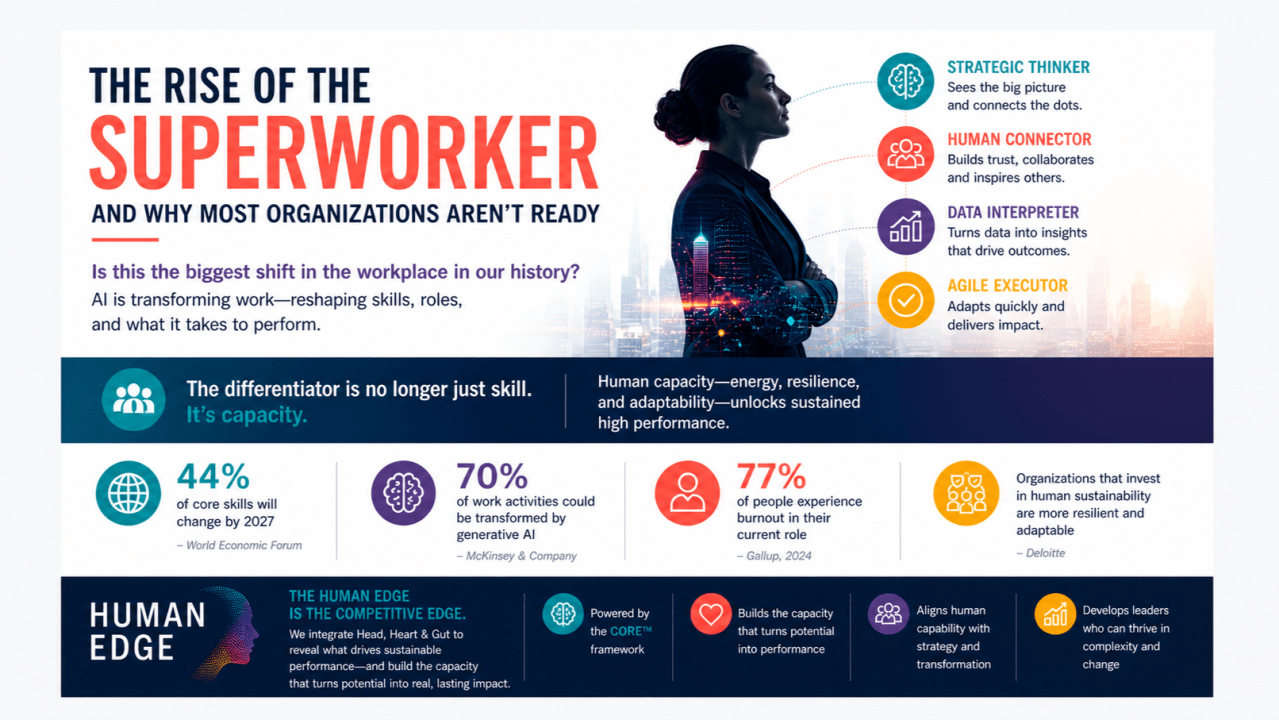
According to the World Economic Forum, nearly half of all core skills are expected to change within just a few years. Not evolve. Change. At the same time, McKinsey & Company estimates that up to 70 percent of work activities could be transformed by generative AI, accelerating a transition that would normally take decades into a much shorter window. Historically, even major shifts like the Industrial Revolution or the rise of the internet unfolded over generations. This shift is unfolding within careers.
And it is not just technological. It is human.
The rise of the superworker is not about doing more work faster. It is about a fundamental redefinition of performance itself.
The rise of the superworker
A superworker is not defined by output volume or long hours. They are defined by integration. They combine capabilities that used to sit in separate roles and functions. They think strategically and execute operationally. They use data, but they apply judgment. They collaborate with AI while staying anchored in the human context.
This is not a niche profile. It is becoming the new expectation for high performance.
Research from Microsoft on AI-enabled work highlights that employees are increasingly expected to manage more complex, cross-functional responsibilities, supported by AI tools that amplify both speed and expectations. The result is not simplification. It is compression. More decisions. Faster cycles. Higher stakes.
And this is where most organizations start to struggle. They respond by asking a logical but incomplete question.
What skills do we need now?
Why the skills conversation is not enough
It sounds like the right question. It drives learning agendas. It aligns with capability frameworks. It gives leaders something tangible to act on.
But it misses the real constraint. Because the challenge is not just skill. It is capacity.
Capacity is what determines whether someone can apply their skills under pressure, in ambiguity, and over time. It is energy. It is resilience. It is adaptability. It is the ability to stay clear when priorities collide and demands escalate.
Two people can have the same skills and deliver entirely different outcomes based on their capacity. This is where the current approach starts to break down.
Organizations are investing heavily in upskilling. Digital learning platforms are expanding. AI literacy programs are scaling. On paper, capability is increasing.
In reality, people are overwhelmed.
Data from Gallup shows that global stress levels remain at record highs, while engagement continues to lag. Burnout is no longer an exception. It is becoming a baseline condition in many environments.
The paradox is clear. As tools become more powerful, the human system required to use them effectively is becoming more strained.
The real differentiator is human capacity
This is the shift most organizations are not yet ready to make.
The superworker is not just more skilled. They are more regulated. More intentional. More aware of how they manage their energy and attention.
They know when to push and when to pause. They can move between deep focus and rapid decision making. They use AI as a thinking partner, not just a productivity tool.
This level of performance comes from integrating multiple dimensions of capability.
- Cognitive capability to analyze and solve problems
- Critical thinking skills to evaluate AI’s output
- Emotional capability to navigate people and pressure
- Motivational drivers to sustain effort over time
- Human performance to manage energy, resilience, and recovery
This is where the CORE Human Performance dimension becomes a critical differentiator. It is not an add on. It is the foundation that determines whether all other capabilities can be used at their highest level.
Organizations that ignore this will continue to see a gap between potential and performance.
What leaders are getting wrong
Leaders are not blind to the shift. They feel it every day.
They see capable teams struggling with execution. They see priorities competing. They see energy fluctuating. They see inconsistency where there should be clarity.
The instinct is to respond with more structure. More alignment. More accountability.
But the issue is not a lack of effort. It is a lack of capacity alignment.
When the system’s demands exceed the capacity of the people operating within it, performance will always break down. Not because people are not capable, but because the system is not sustainable.
What to do now
If the rise of the superworker is real, then organizations need to respond differently. Not with more content, but with a different model of performance.
Here are five practical shifts leaders can make immediately.
Start with ruthless prioritization
Superworkers do not do everything. They do what matters. Leaders need to reduce noise and clarify what truly drives value. Ask one simple question. If everything is a priority, what is not?
Build energy into performance conversations
Move beyond goals and metrics. Ask how work is being sustained. Where is energy gained, where is it drained, and what needs to change? Make energy management a leadership responsibility, not an individual coping mechanism.
Redesign roles for integration, not fragmentation
Stop adding tasks to existing roles. Redesign roles around outcomes that require integrated thinking. Intentionally combine strategic, analytical, and execution elements rather than leaving individuals to figure it out.
Train for decision quality, not just knowledge
In a world of AI generated options, the differentiator is not information. It is judgment. Create environments where people practice making decisions under uncertainty, not just learning content.
Model humanistic leadership under pressure
Leaders set the tone for how work feels. If leaders operate in a constant state of urgency and overload, teams will follow. If leaders create space for reflection, challenge, and clarity, capacity increases across the system.
The leadership shift that cannot be ignored
This is not just a workforce shift. It is a leadership shift.
Leaders are now required to translate AI-driven insights into human decisions. To balance data with judgment. To manage not just performance, but emotional responses to change and automation.
This is not a technical evolution. It is a human evolution of leadership.
Research from Deloitte shows that organizations focusing on human sustainability, including well-being and adaptability, are better positioned to navigate ongoing disruption. Not because they avoid pressure, but because they build the capacity to handle it.
The uncomfortable truth
The superworker is not rare because people lack potential.
The superworker is rare because most environments are not designed to support that level of performance.
Organizations are trying to operate with a next-generation capability model on top of a legacy performance system.
That mismatch is where breakdown happens.
What this means for Human Edge
This is exactly where Human Edge positions itself differently.
Most approaches to transformation focus on skills or structure. Some focus on culture. Very few integrate the full human system required for sustained performance. This is the gap.
The Human Edge perspective is clear. Performance is not built solely on capability.
Performance is built through the integration of traits, competencies, motivation, and human performance.
This is where the CORE framework becomes a strategic lever, not just a diagnostic tool. It enables organizations to see not only what leaders can do, but how they operate under pressure, where energy is sustained or depleted, and where performance risks emerge over time.
In a world moving toward superworkers, this level of insight is not optional. It is foundational.
Because the future will not be won by the organizations with the most skills.
It will be won by the organizations that can build the capacity to use those skills consistently, adaptively, and sustainably. That is the real human edge.
A final reflection
The question is not whether the superworker will emerge. It already has.
The question is whether organizations will evolve fast enough to support them.
Because this may indeed be the biggest shift in the workplace in our history. Not because of the technology itself, but because of what it demands from humans.
And that is where the real transformation lies. Not in what people can do. But in what they can sustain, integrate, and become.
Human Edge is a global leader in human‑centric leadership assessment and development, empowering individuals, teams, and organizations to unlock their full potential. Guided by science and driven by empathy, Human Edge transforms behavioral insight into practical, personalized growth experiences that help leaders show up with authenticity, clarity, and purpose.
Founded in 2017, Human Edge brings together experts in psychometrics, psychology, instructional design, and leadership development to deliver evidence-based solutions that create measurable impact. Through innovative products like the suite of CORE assessments, experiential learning modules, and integrated coaching, Human Edge supports leaders and experts across life sciences, FMCG, industrial, and technology sectors, achieving a 94% client retention rate and transforming more than 10,000 leaders worldwide.
With over 25,000 assessments completed and a growing global partner ecosystem, Human Edge is pioneering a new standard for humanistic leadership in an era shaped by AI and constant change. Its mission is to elevate human potential through deeply personalized, science‑backed development that fuels sustainable growth, stronger teams, and meaningful performance outcomes.


