











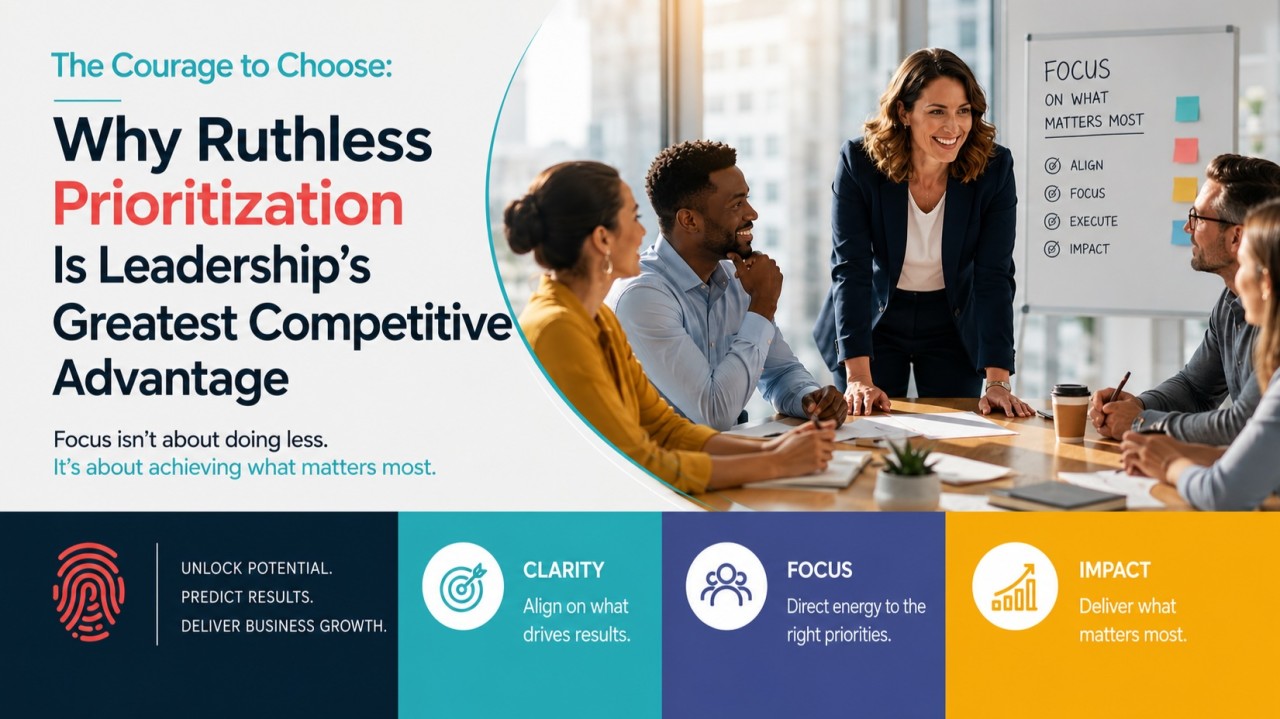
“What are the organization’s top priorities?”
Ask the CEO, and the answer is usually immediate. The executive team has aligned around a handful of strategic priorities designed to move the business forward. The strategy is clear, the direction has been agreed upon, and everyone leaves the annual planning session believing the organization knows exactly where it is heading.
Now ask a business unit leader.
Then ask a functional manager.
Then ask a project leader.
Finally, ask someone on the front line.
The answers begin to multiply.
What started as four enterprise priorities has quietly evolved into dozens of initiatives. Every function has added its own projects. Every department has introduced additional objectives. Managers have responded to customer requests, operational challenges, regulatory changes, and local business needs. None of these decisions is wrong in isolation. In fact, many are entirely justified. Collectively, however, they create something far more dangerous, an organization where almost everything has become a priority.
Only 15% of employees can identify their organization’s most important goals. Source: Franklin Covey
This is one of the greatest execution challenges facing organizations today. Leadership teams rarely fail because they lack a compelling strategy. More often, they struggle because priorities multiply as they cascade through the organization, diluting focus and stretching finite resources across too many competing demands. By the time the strategy reaches the people responsible for delivering it, clarity has given way to complexity.
The result is familiar. Employees are working harder than ever. Calendars are full. Meetings continue to multiply. New initiatives are regularly introduced while existing ones remain unfinished. Despite extraordinary effort, progress on the initiatives that matter most begins to slow.
The issue is not capability. It is focus.
Organizational focus is one of the most valuable yet least protected assets a business possesses. It determines where leaders invest their attention, where teams spend their energy, and ultimately whether strategy becomes reality or remains an aspiration. Yet unlike financial capital or talent, focus is rarely measured. It quietly erodes as priorities accumulate, leaving organizations busy but increasingly fragmented.
Nobel Prize-winning economist Herbert Simon recognized this challenge decades ago when he observed that “a wealth of information creates a poverty of attention.” Although he was referring to information, his insight applies equally to modern organizations. Today’s businesses are not constrained by a lack of ideas. They are constrained by a lack of collective attention.
Attention has become one of leadership’s scarcest resources.
How Good Intentions Create Organizational Complexity
Complexity rarely arrives through one poor decision. It accumulates through hundreds of good ones.
Every level of the organization makes rational choices based on the information available to it. Sales introduces a customer initiative to strengthen relationships. Operations identifies an opportunity to improve efficiency. HR launches a capability program to develop future leaders. Finance introduces new governance processes to improve risk management. Technology upgrades systems to improve productivity.
Each initiative has merit. The challenge is that very few organizations remove priorities with the same discipline that they add them. Or more importantly, align and plan these initiatives at the top of the organization.
As new initiatives accumulate, they begin competing for the same finite resources: leadership attention, employee capacity, specialist expertise, funding, meeting time, and decision-making bandwidth. Eventually, the organization reaches a tipping point where execution slows, not because people are working less, but because they are trying to accomplish too much at once.
Research from Bain & Company has consistently shown that increasing organizational complexity slows decision-making and reduces execution speed. Likewise, McKinsey’s work on organizational health has demonstrated that companies with a small number of clearly communicated priorities consistently outperform those attempting to pursue too many strategic objectives simultaneously.
This helps explain a paradox that many organizations experience. They become increasingly productive. But less effective.
People complete more tasks than ever before, yet fewer of those tasks move the organization meaningfully closer to its strategic objectives.
Activity has replaced impact.
The Hidden Cost of Too Many Priorities
The consequences of diluted focus extend well beyond delayed projects.
As priorities multiply, Bain found that leaders spend 40 to 50% of their time coordinating rather than leading. Meetings become longer because every initiative requires updates. Decision-making slows because resources must constantly be negotiated across competing projects. Teams switch continually between activities, making it difficult to sustain the deep thinking and collaboration required to solve complex problems.
Every additional initiative creates another context switch. Research suggests that frequent switching between tasks can reduce productive time by as much as 40%, not because people work less, but because the brain continually expends energy reorienting itself. Organizations experience the same phenomenon at scale.
Psychologists have long understood that frequent context switching reduces cognitive performance. Every interruption carries a hidden cost. The brain requires time to reorient itself each time attention shifts. At an organizational level, this translates into slower execution, reduced innovation, and lower-quality decisions.
Employees begin feeling overwhelmed, not because they lack capability, but because they are being asked to succeed across too many competing priorities simultaneously.
Eventually, everything feels urgent. Nothing feels important.
The irony is that organizations often respond by introducing even more governance, more reporting, and more meetings, all of which consume even more attention.
The solution is rarely adding more structure.
It is restoring focus.
The Power of Choosing Less
One of the most famous examples of ruthless prioritization came from Steve Jobs when he returned to Apple in 1997.
The company was struggling. Its product portfolio had expanded into dozens of overlapping offerings, creating confusion for customers and complexity for employees. Rather than introducing another wave of innovation, Jobs simplified the business. He reportedly reduced Apple’s product portfolio to four core categories.
At the time, many believed the decision was too risky. In hindsight, it became one of the defining moments in Apple’s turnaround.
The simplification did far more than reduce costs. It created clarity across the organization. Engineers understood where to focus their efforts. Marketing knew which products to champion. Sales knew what to sell. Investment flowed toward a small number of priorities instead of being dispersed across dozens of competing initiatives. Jobs understood something many organizations still struggle to embrace.
Simplicity is not the absence of ambition. It is the discipline that allows ambition to succeed.
Why Saying No Is So Difficult
If prioritization is so important, why is it so difficult?
The answer lies as much in human psychology as it does in business strategy.
Research by Daniel Kahneman demonstrated that people experience the pain of loss more strongly than the satisfaction of equivalent gains. This principle, known as loss aversion, influences countless leadership decisions.
Stopping an initiative often feels like admitting failure.
Canceling a program means disappointing stakeholders who have invested time, energy, and political capital. Leaders naturally worry about wasting previous investment or sending the wrong message to their teams.
There is also an emotional dimension. Projects become closely associated with the leaders who champion them. Over time, questioning the initiative can feel like questioning the individual. The result is that organizations become remarkably good at starting projects but far less disciplined about ending them.
Yet leadership has never been about saying yes to every opportunity. It has always been about making thoughtful trade-offs. Every decision creates consequences. Every investment redirects attention. Every new priority changes the organization’s ability to execute existing commitments. The most effective leaders understand a simple but often overlooked truth. Every “yes” is simultaneously a “no.”
We need to learn to say no to good ideas
Every time a leadership team approves another strategic initiative, it is also deciding what will receive less attention. That may be innovation. It may be customer relationships. It may be employee development. It may simply be the successful completion of initiatives already underway. The trade-offs exist whether leaders acknowledge them or not.
Great leadership makes them visible.
Protecting Organizational Focus
Many people think prioritization is an individual productivity skill. It is not. It is an organizational capability. The best organizations create systems that protect focus rather than constantly fragmenting it.
They communicate a small number of strategic priorities with relentless consistency. They ensure that departmental objectives clearly align with enterprise goals. They regularly review existing initiatives, asking not only what should begin but also what should end.
Most importantly, they create permission to stop work that no longer creates sufficient value. This requires courage. Many organizations celebrate launching initiatives. Far fewer celebrate ending them. Yet stopping the wrong work is often more valuable than starting the next piece of work. Leadership teams should therefore build a simple discipline into every significant investment decision by asking four questions.
- How is this strategically essential?
- What will we stop doing if we choose to do this?
- What is needed to genuinely create the capacity to execute this well?
Will this create meaningful value for our customers, our people, or our business?
These questions sound deceptively simple. In reality, they lead to some of the most difficult conversations executive teams can have because they force leaders to confront the trade-offs they would often rather avoid.
I remember working with one organization where the CHRO announced 11 strategic goals for the HR function. We challenged him, suggesting that the number of priorities was unrealistic and would make execution difficult. He simply smiled and told us to carry on. To him, the long list of goals was a badge of commitment and dedication to the business.
The outcome was predictable. By the end of the year, only four of the major goals had been fully achieved. The problem wasn’t a lack of effort or commitment. The team worked incredibly hard. The problem was that attention, resources, and decision-making had been spread too thin. When everything becomes a priority, very little receives the focus required to produce exceptional results.
Leadership Is the Guardian of Focus
One of the greatest misconceptions about leadership is that it is primarily about setting direction. Setting direction is important. Protecting it is even more important. Strategies rarely fail because they are poorly designed. They fail because organizational focus gradually erodes as priorities multiply throughout the business.
Every additional initiative appears reasonable. Every request feels important. Every function has legitimate business needs. Every leader wants to improve performance for their customers and their teams.
No one intentionally creates complexity. It simply accumulates.
The responsibility of leadership is not merely to create strategy. It is to continually protect the organization’s capacity to execute that strategy. That means making difficult trade-offs. It means resisting the temptation to pursue every attractive opportunity. It means having the courage to stop work that no longer creates sufficient value.
Most importantly, it means recognizing that organizational attention is one of the most valuable assets a business possesses. In the end, organizations rarely fail because they lack good ideas.
They fail because they lose focus.
The leaders who will create extraordinary organizations over the next decade will not necessarily be those with the boldest strategies or the greatest number of initiatives.
They will be the leaders who understand that execution begins with clarity, grows through disciplined choices, and succeeds because they have the courage to protect what matters most.
That is the true power of ruthless prioritization.
Four Disciplines of Ruthless Prioritization
1. Decide What You Will Stop Before You Decide What You Will Start
Every new initiative consumes finite organizational resources, time, talent, budget, and leadership attention. Before approving any new priority, ask one simple question: What will we stop doing to create the capacity for this? If the answer is “nothing,” then the organization is simply adding another layer of complexity. Great leaders create capacity through subtraction as much as addition.
2. Focus on the Vital Few, Not the Important Many
Not every worthwhile initiative deserves equal attention. Identify the two or three priorities that will create the greatest strategic impact over the next 12 months and commit to them relentlessly. The authors of The 4 Disciplines of Execution argue that every additional priority reduces an organization’s ability to execute exceptionally well. Success comes from concentrating effort, not distributing it.
3. Make Prioritization a Continuous Leadership Discipline
Priorities should not be set once a year and forgotten. Business conditions change, customer needs evolve, and new opportunities emerge. High-performing leadership teams regularly review their portfolio of initiatives and ask, “If we were starting today, would we still choose to invest in this?” If the answer is no, have the courage to stop it. Protecting focus is an ongoing leadership responsibility, not an annual planning exercise.
4. Align Every Team to the Same Few Priorities
One of the biggest reasons organizations struggle with execution is that priorities multiply as they cascade through the business. Every function adds its own objectives until employees are juggling dozens of competing demands. Leaders must continually connect departmental goals back to the enterprise priorities and eliminate work that doesn’t directly support them. When every team understands not only what matters most, but also what doesn’t, execution accelerates dramatically.
Human Edge is a global leader in human‑centric leadership assessment and development, empowering individuals, teams, and organizations to unlock their full potential. Guided by science and driven by empathy, Human Edge transforms behavioral insight into practical, personalized growth experiences that help leaders show up with authenticity, clarity, and purpose.
Founded in 2017, Human Edge brings together experts in psychometrics, psychology, instructional design, and leadership development to deliver evidence-based solutions that create measurable impact. Through innovative products like the suite of CORE assessments, experiential learning modules, and integrated coaching, Human Edge supports leaders and experts across life sciences, FMCG, industrial, and technology sectors, achieving a 94% client retention rate and transforming more than 10,000 leaders worldwide.
With over 25,000 assessments completed and a growing global partner ecosystem, Human Edge is pioneering a new standard for humanistic leadership in an era shaped by AI and constant change. Its mission is to elevate human potential through deeply personalized, science‑backed development that fuels sustainable growth, stronger teams, and meaningful performance outcomes.


