











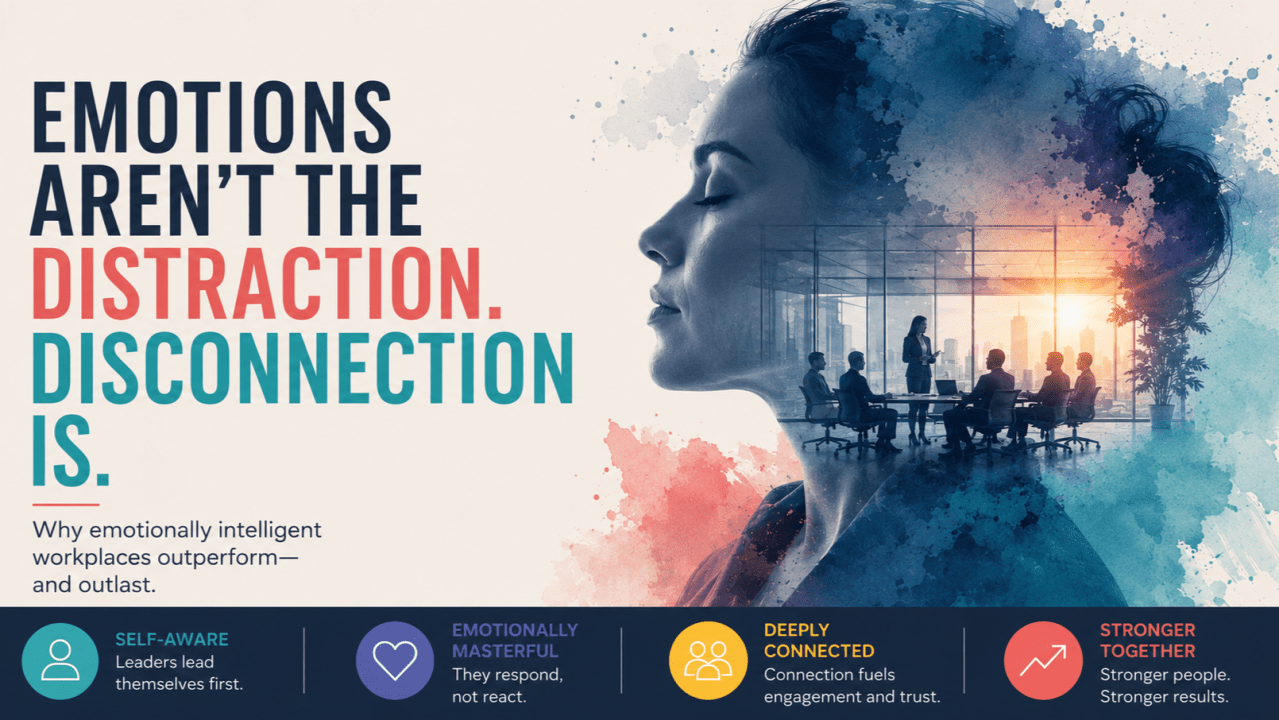
Why suppressing feelings is costing organizations more than they realize.
A question I find myself discussing more and more with leaders is this:
Do emotions belong at work?
For decades, many organizations operated under an unwritten rule: leave your emotions at the door. Be professional. Stay composed. Keep your feelings to yourself.
But let’s be honest. No one leaves their emotions at the door.
- The employee going through a divorce.
- An employee feel passed over for a promotion
- The manager worried about layoffs.
- The leader carrying the weight of impossible decisions.
- The team member celebrating the birth of a child.
- The colleague grieving the loss of a parent.
They all walk into work bringing their emotions with them. Because they are human. The real question isn’t whether emotions belong at work. The real question is whether we know how to process them.
𝗘𝗺𝗼𝘁𝗶𝗼𝗻𝘀 𝗮𝗿𝗲 𝗻𝗼𝘁 𝘁𝗵𝗲 𝗽𝗿𝗼𝗯𝗹𝗲𝗺. 𝗨𝗻𝗽𝗿𝗼𝗰𝗲𝘀𝘀𝗲𝗱 𝗲𝗺𝗼𝘁𝗶𝗼𝗻𝘀 𝗮𝗿𝗲.
When emotions are ignored, suppressed, or buried, they rarely disappear. Instead, they show up in other ways—frustration, withdrawal, defensiveness, burnout, conflict, poor decisions, or disengagement.
What many people don’t realize is that emotions serve an important purpose. They are information.
- Fear tells us something feels uncertain.
- Anger tells us a boundary may have been crossed.
- Sadness signals loss.
- Joy reminds us what matters.
- Excitement points us toward possibility.
𝗘𝗺𝗼𝘁𝗶𝗼𝗻𝘀 𝗮𝗿𝗲 𝗻𝗼𝘁 𝘀𝗶𝗴𝗻𝘀 𝗼𝗳 𝘄𝗲𝗮𝗸𝗻𝗲𝘀𝘀. 𝗧𝗵𝗲𝘆 𝗮𝗿𝗲 𝘀𝗶𝗴𝗻𝗮𝗹𝘀.
And when we learn to listen to those signals, we become more self-aware, more resilient, and ultimately more effective.
What Happens When We Don’t Express our Emotions at Work?
The research is surprisingly clear. When people feel they must suppress, hide, or fake their emotions at work, organizations pay a price.
Psychologists refer to this as emotional labor, he effort required to display emotions that may not match what we are genuinely feeling. While some degree of emotional regulation is necessary in professional settings, constantly suppressing emotions creates a hidden drain on our psychological resources.
Studies consistently show that emotional suppression is associated with higher levels of emotional exhaustion, burnout, stress, disengagement, and turnover intentions. Employees who regularly feel they cannot express concerns, frustrations, fears, or challenges are more likely to become detached from their work and from the people around them. (PMC)
The impact extends beyond individual wellbeing.
Organizations that lack psychological safety, where people fear speaking up, expressing concerns, admitting mistakes, or sharing difficult emotions, experience lower engagement, less collaboration, poorer decision-making, and greater burnout. Research shows that psychological safety acts as a protective factor, reducing burnout and helping people perform at their best, particularly during periods of uncertainty and change. (McKinsey & Company)
Think about what happens when employees don’t feel safe expressing what they are experiencing. Problems stay hidden. Risks go unspoken. Feedback disappears. Innovation slows. People stop asking for help.
Eventually, organizations lose access to something incredibly valuable: the truth.
And without truth, leaders cannot make good decisions. The healthiest organizations are not those where people never experience difficult emotions. They are the organizations where people can acknowledge those emotions, process them constructively, and use the insight they provide to move forward together.
We are wired for connection
But there is another reason emotions matter. Without emotions, we cannot truly connect. And without connection, work becomes transactional. Human beings are wired for connection. We want to feel seen. We want to feel understood. We want to know that our contributions matter and that the people around us care.
Connection is what feeds our souls.
- It is what creates trust within teams.
- It is what allows difficult conversations to happen.
- It is what helps people stay engaged during uncertainty.
- It is what transforms a group of individuals into a community.
The irony is that the more we try to remove emotion from the workplace, the more disconnected people become.
And disconnected people rarely do their best work. So how do we create a healthier relationship with emotions?
1. Name What You’re Feeling
Many people experience emotions without ever identifying them.
- “I’m stressed.”
- “I’m frustrated.”
- “I’m fine.”
These broad labels often hide what’s really happening underneath. Pause and ask yourself:
What am I actually feeling right now?
- Disappointed?
- Overwhelmed?
- Anxious?
- Hurt?
- Excited?
Research consistently shows that simply naming an emotion reduces its intensity and helps us regain perspective. Awareness is the first step toward choice.
2. Feel It Before You Fix It
Many leaders immediately move into problem-solving mode. We want to explain, justify, rationalize, or make the feeling go away. But emotions often need to be felt before they can be resolved. Give yourself permission to sit with the feeling for a moment.
- Notice where it shows up in your body.
- Take a breath.
- Observe it without judgment.
Emotions are like waves. When we resist them, they stay longer. When we allow them, they move through us.
3. Turn Emotion Into Insight
Every emotion carries a message. Instead of asking:
“How do I stop feeling this?”
Ask:
“What is this feeling trying to tell me?” “What need is behind the emotion?”
Perhaps your frustration is highlighting an unmet expectation. Perhaps your anxiety is revealing something important that requires preparation. Perhaps your sadness is reminding you of something you deeply value. Emotional intelligence is not about controlling emotions. It is about learning from them. As leaders, we don’t need less emotion at work. We need more emotional awareness.
At Human Edge, this belief sits at the heart of our work. We help leaders develop the self-awareness and emotional mastery needed to navigate complexity, build stronger relationships, and lead with greater intention. Through science-based assessments, coaching, and development experiences, we help people understand the patterns, triggers, beliefs, and emotions that shape how they show up under pressure. Because leadership is not just about what you know or what you do—it is about who you are when things get difficult. The most effective leaders are not those who suppress their emotions; they are those who understand them, learn from them, and channel them in ways that strengthen trust, connection, and performance. When leaders do the inner work, the ripple effect is felt across teams, cultures, and organizations. That’s where real transformation begins.


