









Much has been written about AI’s impact on productivity. It saves time, removes repetitive tasks, and helps us produce more, faster. Much of that is undoubtedly a good thing.
But I’ve found myself thinking about a different question.
Not how AI is changing work.
But how it might be changing the way we develop people.
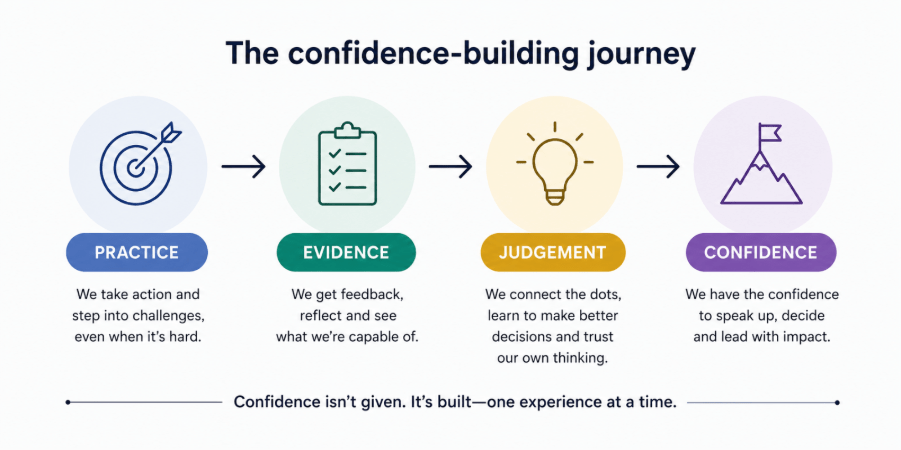
Confidence is built, not found
When I talk about confidence, I’m talking about the confidence to make a recommendation you stand behind. To challenge an idea respectfully. To navigate ambiguity. To make decisions when there isn’t an obvious answer.
In my experience, that kind of confidence isn’t built through encouragement alone.
It grows each time we step forward, get something wrong, listen to feedback, and try again. With every cycle, we accumulate evidence that we can learn, adapt and trust ourselves a little more.
Over time, that evidence develops judgement.
And judgement gives us the confidence to trust our own thinking.
That’s why genuine professional confidence is so difficult to fake.
It’s earned.
Work has always been our greatest teacher
When we think about talent development, we naturally think about graduate programmes, mentoring, coaching and leadership development.
And we should.
They’ve always played an important role.
But they’ve never been the whole story.
Day-to-day work has always been one of our greatest teachers.
Not every task is developmental. Some work genuinely adds little value, and I’m delighted AI can take it off our plates.
But some tasks that appear low value through a productivity lens have quietly been building something else: capability.
Think back to the early years of your career.
Drafting a proposal from scratch.
Trying to structure a presentation before seeing someone else’s version.
Working through messy data.
Receiving feedback on a recommendation.
At the time, it simply felt like work.
Looking back, you realise it was practice.
Those tasks weren’t valuable simply because they produced a proposal or presentation.
They were valuable because they developed the person producing them.
AI is changing what we practise
Today, many of those first drafts can be generated in minutes.
That’s an extraordinary gain in efficiency.
But it also changes what people practise.
For years, producing good work required us to analyse information, structure our thinking, make choices and defend our conclusions before arriving at an answer.
Today, the barrier to producing a polished output has fallen dramatically.
That doesn’t make human thinking less important.
If anything, it makes it more important.
AI can generate options, synthesise information and draft recommendations.
But it cannot decide which problem is worth solving, what trade-offs are acceptable, or which consequences an organisation should be willing to own.
That requires judgement.
More specifically, it requires critical thinking: questioning assumptions, evaluating evidence, considering alternatives and making decisions under uncertainty.
The World Economic Forum’s Future of Jobs Report 2025 found that analytical thinking remains the most important core skill identified by employers, with seven in ten employers considering it as essential.
A 2025 Microsoft Research and Carnegie Mellon University study, The Impact of Generative AI on Critical Thinking, found that higher confidence in AI was associated with less reported critical thinking, while greater confidence in one’s own ability was associated with more reported critical thinking. The researchers also observed that, when using AI, participants described their critical thinking as focusing more on verifying, integrating and overseeing AI-generated outputs than on generating ideas from scratch.
The risk is not simply that AI will do more of the thinking.
It’s that people may stop experiencing themselves as thinkers.
What does this mean for leaders?
I’m not suggesting we should return to writing every presentation from scratch.
Nor am I suggesting AI prevents people from becoming exceptional professionals.
Quite the opposite.
Used well, AI gives us access to more perspectives, surfaces alternative viewpoints, and frees us to spend more time on higher-value work.
But those benefits won’t happen automatically.
If AI changes what people practise, it also changes the evidence people accumulate about their own capability.
We can no longer assume that work will develop people simply because it always has.
The future of talent development isn’t simply about building AI capability. It’s about creating opportunities for people to think, question, decide, receive feedback, and build judgement.
Because AI can give us access to an extraordinary amount of knowledge.
The responsibility of leaders is to help people develop the judgement and confidence to use it wisely.


