










How Extraordinary Communicators Inspire Lasting Change.
Three Voices of Every Great Communicator
If communication were simply about transferring information, the smartest person in the room would always be the most influential.
We know that isn’t true.
We’ve all met brilliant people who struggle to inspire others. We’ve also met leaders who don’t always have the perfect words, yet somehow people trust them, follow them, and leave every conversation feeling more confident than when they arrived. The difference isn’t intelligence. It’s integration.
Great communicators know how to engage the whole person, not just the thinking mind. They understand that every conversation is an opportunity to create understanding, meaning, and resonance. Just as importantly, they understand that communication is never a one-way event.
Communication Is a Conversation, Not a Performance
One of the greatest myths about communication is that it is something we do to another person. We prepare our talking points, perfect our presentation, and focus on getting our message across. Yet communication isn’t a performance. It is a relationship.
The most memorable conversations in our lives rarely involve one person speaking brilliantly. They involve two people genuinely connecting.
Great communicators know that listening is just as important as speaking. They notice the hesitation before someone answers. They see the excitement in someone’s eyes. They recognize when crossed arms reveal uncertainty or when silence speaks louder than words.
Rather than pushing harder, they become more curious.
- They ask questions.
- They invite different perspectives.
- ·They adjust their message based on what they hear.
In other words, they don’t simply talk at people; they communicate with them. That shift changes everything. People don’t want to feel like an audience. They want to feel like a participant. When people contribute to the conversation, they become emotionally invested in the outcome. Understanding becomes ownership. Ownership becomes commitment.
The world’s greatest communicators don’t create followers. They create co-creators.
The Head: Creating Understanding
The Head is the voice of logic, clarity, and reason. It helps people understand what is happening, why it matters, and what needs to happen next. Every meaningful conversation begins here because our minds naturally seek certainty before they are willing to move forward. It engages our critical thinking and is based on facts, data and logical sequencing.
Imagine your CEO walks into a room and announces that the organization is restructuring. Immediately, your mind starts asking practical questions.
- What does this mean for my role?
- Why are we making this change?
- When will it happen?
- How will decisions be made?
The Head seeks clarity before commitment.
A Head-centered message might sound like this:
“Customer expectations have changed dramatically over the past five years. According to Salesforce, 88% of customers say the experience a company provides is as important as its products and services, while Gartner reports that 61% of organizations are redesigning their operating models because of AI. Yet our current structure creates unnecessary complexity and slows decision-making. To remain competitive, we need to simplify how we work, eliminate duplication, and empower teams to make faster decisions.”
The message is logical. Clear. Well structured. People understand exactly what is happening. But are they inspired? Not yet.
One of the biggest communication biases among Head communicators is the belief that more information leads to greater commitment. In reality, information creates understanding, but understanding alone rarely changes behavior.
I learned this lesson early in my career while presenting recommendations for redesigning a new performance management system. I had spent weeks reading research papers, benchmarking organizations, and analyzing data. By the time I finished, I was lost in a sea of data and wanted to present it all to the executive committee.
A trusted colleague smiled and asked me a question that changed the way I communicate forever.
“Lisa, if people remembered only three things from today, what would you want them to remember?”
In that moment, I realized I wasn’t creating clarity. I was creating cognitive overload. Sometimes the greatest act of communication isn’t adding more. It’s having the courage to say less.
The Heart: Creating Meaning
If the Head helps people understand, the Heart helps them care. The Heart reminds us that behind every strategy, every project, and every organizational change is a human being trying to make sense of their world.
Heart communication asks different questions.
- How are people feeling?
- What concerns haven’t been spoken aloud?
- What matters most to them?
Imagine the CEO continues speaking. Instead of moving immediately to the next slide, she pauses. She looks around the room and says,
“I know today’s announcement may create uncertainty. Some of you may be wondering what this means for your future, your team, and your career. If I were sitting where you are today, I would probably have the same questions.”
Nothing about the facts has changed. Everything about the experience has. The room softens. People stop protecting themselves and start listening. Why? Because they feel seen. Heart communication isn’t about becoming emotional.
It’s about becoming human. It is the ability to communicate in a way that quietly tells another person, “You matter.”
One of the most meaningful conversations I’ve ever had happened because I stopped trying to solve a problem. A close friend called me after learning she was pregnant with triplets through IVF. The doctors explained the significant risks, and she was overwhelmed by the impossible decision of having to abort one of the babies to bring the pregnancy to term.
- I didn’t offer advice.
- I didn’t search for the perfect words.
- I simply listened.
- I asked a few gentle questions.
- I held space for her uncertainty.
Several days later, she called to tell me that one of the pregnancies had ended naturally. She later gave birth to two beautiful, healthy children. I’ve reflected on that conversation many times. Not because of anything extraordinary I said.
But because sometimes the greatest gift we give another person isn’t our expertise. It’s our presence.
Listening may be the highest form of communication because it tells another person they are worthy of our complete attention.
The Gut: Creating Resonance
The Gut communicates differently. It doesn’t analyse. It doesn’t comfort. It awakens. Gut communication is where experience, intuition, wisdom, and courage come together.
It speaks in truths that people don’t simply understand.
They recognize. Think about some of the most memorable messages you’ve ever heard.
- “Just Do It.”
- “What got you here won’t get you there.”
- “If nothing changes, nothing grows.”
These messages don’t stay with us because they are clever. They stay with us because they resonate. They bypass endless analysis and connect with something deeper inside us. The Gut doesn’t seek agreement.
It seeks truth.
When a leader says,
“The future won’t be created by those who know the most. It will be created by those willing to learn the fastest.”
Long before the analytical mind has finished interpreting words, the brain is already responding at an intuitive level. While our conscious mind processes information relatively slowly, at just 40 to 50 bits per second, our unconscious mind processes millions of bits of information every second. It is detecting patterns, reading emotion, interpreting tone, sensing authenticity, and drawing on a lifetime of experience.
This is why we often know something before we can explain it.
When leaders communicate from the gut, they speak to this intuitive intelligence. They create a sense of certainty, possibility, or conviction before the audience has consciously analyzed the message. People don’t simply hear the words; they experience them. Only afterward does the analytical mind begin its work, organizing, interpreting, and validating what intuition has already recognized.
This is the power of resonance. It reaches people before logic does.
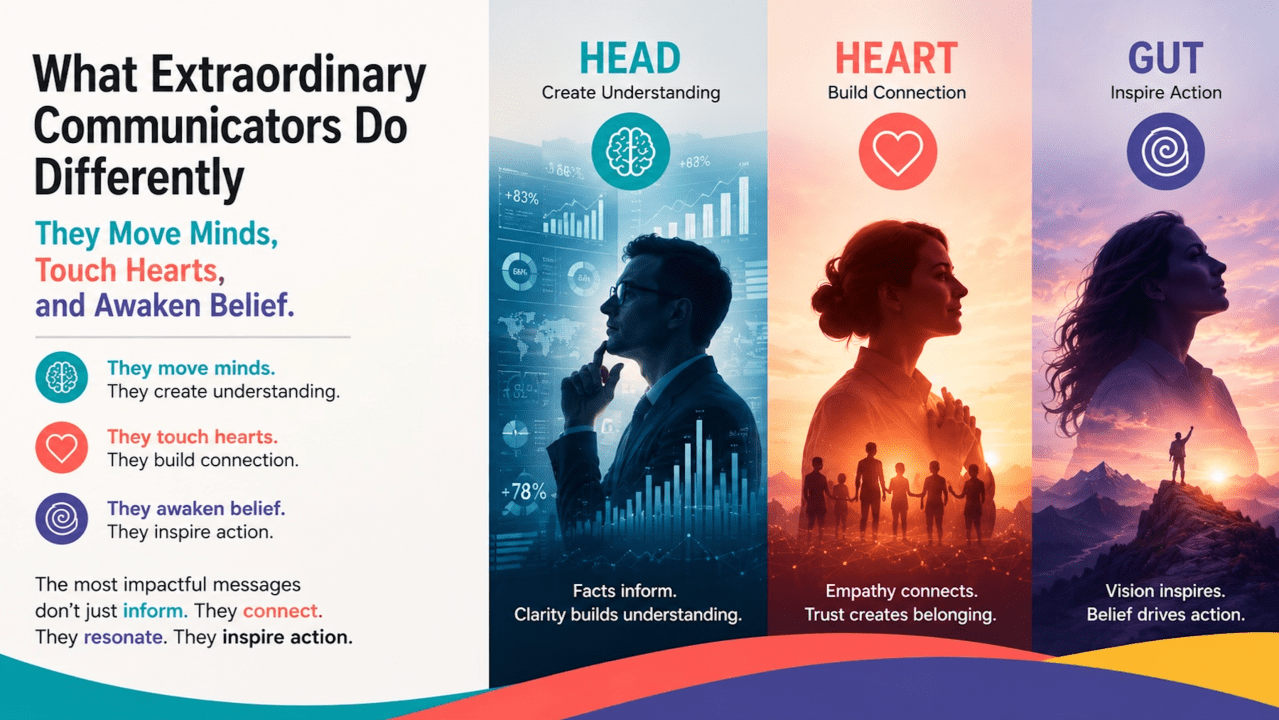
Each voice carries a unique kind of power, yet each has its limitations when used alone. The head informs. The heart connects. The gut inspires. But when these three voices come together, communication becomes something far greater than the exchange of information—it becomes transformation. People don’t just understand your message; they feel it, trust it, and are moved to act. The world’s most influential communicators don’t speak from just the head, the heart, or the gut. They weave all three together to create messages that resonate deeply and leave a lasting impact.
- They use the Head to create understanding.
- They use the Heart to create meaning.
- They use the Gut to unveil truth and create resonance.
Only then does communication become more than the exchange of information. It becomes a shared human experience. One that continues long after the conversation ends.
Speaking from the Head, Heart, and Gut
Understanding the three voices is one thing. Hearing them is another.
Imagine a CEO announcing a major organizational transformation. The message is the same, but the voice changes everything.
Speaking from the Head
“We’ve analyzed the market over the past three years and identified several structural challenges. Customer expectations have evolved, technology has accelerated, and our current operating model is slowing decision-making. To remain competitive, we will simplify our organizational structure, reduce duplication, and empower teams to make faster decisions.”
The message is logical, factual, and well-reasoned. It answers the question, “Why is this happening?” People understand the business case, but they may not feel personally connected to it.
Speaking from the Heart
“I know that change can be unsettling. Many of you have invested years building this organization, and it’s natural to feel uncertain about what comes next. I want you to know that we will navigate this together. We will support one another, communicate openly, and treat every person with dignity and respect throughout this journey.”
This message creates empathy and trust. It answers the question, “Do you understand how I feel?” People feel seen and valued, yet they may still wonder where the organization is heading.
Speaking from the Gut
“I believe we are standing at a defining moment in our history. We have a rare opportunity to build an organization that is faster, simpler, and capable of changing lives in ways we’ve only imagined. I can see what is possible, and I believe every one of us has a role in creating that future. This is our moment. Let’s build it together.”
This message creates resonance. It answers the question, “Does this feel true?” It inspires conviction before every detail has been explained. People begin to believe in the future before they fully understand how it will unfold.
Speaking from the Head, Heart, and Gut
Imagine you’re a Vice President leading a department through a new way of working. Your goal is to increase collaboration, reduce duplication, and improve customer responsiveness.
The message is the same. Only the voice changes.
Speaking from the Head
“Over the past 12 months, we’ve analyzed how work moves across our department. The data shows that nearly 28% of our projects involve duplicated effort, and teams spend an average of 7.5 hours each week searching for information or waiting for decisions. At the same time, customer response times have increased by 18%, while competitors are delivering projects significantly faster.
If we continue working this way, we risk falling behind. That’s why we’re introducing a new operating model that simplifies decision-making, improves cross-functional collaboration, and gives teams greater ownership. Based on our pilot, we expect to reduce project cycle times by 20% and significantly improve the customer experience.”
The head provides clarity. It uses evidence, facts, and logic to answer the question:
“Why does this change make sense?”
People understand the rationale, but understanding alone rarely changes behavior.
Speaking from the Heart
“I know this announcement may create mixed emotions. Some of you may feel excited, while others may be wondering what this means for your role or your team. Change often brings uncertainty, even when the intention is positive.
I want you to know that we won’t navigate this alone. We’ll communicate openly, listen carefully, and learn together as we move forward. Your experience, ideas, and concerns matter because this isn’t something we’re doing to you. It’s something we’re building with you.”
The heart creates connection. It acknowledges emotions, builds trust, and answers the question:
“Do you understand what I’m experiencing?”
People feel respected, heard, and included.
Speaking from the Gut
“I believe this is one of those moments we’ll look back on and recognize as a turning point. We have an opportunity to stop protecting yesterday’s ways of working and start building the organization we know is possible. What got us here does not guarantee success in the future.
Imagine a workplace where decisions happen quickly, ideas move freely across teams, and every person has the confidence to solve problems without waiting for permission. That’s the future we’re creating. I believe we’re capable of building it together, and I believe each of you will help shape what comes next.”
The gut creates resonance. It paints a compelling future and answers the question:
“Does this feel true?”
People begin to believe before every detail has been explained.
When All Three Voices Work Together
The most influential leaders don’t rely on one voice. They integrate all three.
“Over the past year, we’ve discovered that nearly 28% of our work is duplicated, and teams spend more than seven hours each week waiting for information or decisions. As customer expectations continue to rise, we need to become faster, simpler, and more connected. That’s why we’re introducing a new way of working that will reduce duplication, improve collaboration, and give teams greater ownership.
I also recognize that change creates uncertainty. You may be wondering how this will affect your role, your team, or the way you work. Those questions are completely understandable. We’ll communicate openly, involve you throughout the process, and make sure you have the support you need to succeed.
But this change is about far more than improving efficiency. It’s about creating an organization where talented people can do their best work, where ideas move without barriers, and where we make a greater difference for our customers. What got us here will not guarantee success in the future. I truly believe we’re building something better, not just for the business, but for every person who works here. Years from now, I hope we’ll look back and say this was the moment we chose progress over comfort and created a workplace we’re proud to be part of.”
When all three voices work together, communication becomes more than informative. It becomes transformational. People don’t simply understand the message. They feel connected to it, believe in it, and are inspired to make it happen.
Becoming Aware of Your Communication Style
Before you can become a more influential communicator, you first need to understand how you naturally communicate. Most of us have a dominant voice. Some instinctively lead with logic and facts. Others naturally connect through empathy and relationships. Still others inspire people with vision, conviction, and possibility. None of these approaches is better than the others. Each has unique strengths and blind spots.
The challenge is that we often communicate from habit rather than intention. Under pressure, we tend to rely even more heavily on our preferred style, sometimes without realizing the impact it has on others. A leader who communicates primarily from the head may be seen as knowledgeable but emotionally distant. Someone who leads with the heart may create deep trust but avoid difficult conversations. A person who naturally communicates from the gut may inspire others yet leave them wanting more clarity or direction. Awareness is the first step toward choice.
Use the self-assessment on the following page to discover which voice you rely on most often. As you answer each question, think about how you communicate when the stakes are high—not who you aspire to be, but how you typically show up in meetings, presentations, one-on-one conversations, or moments of conflict. Your first instinct is usually your most honest answer.
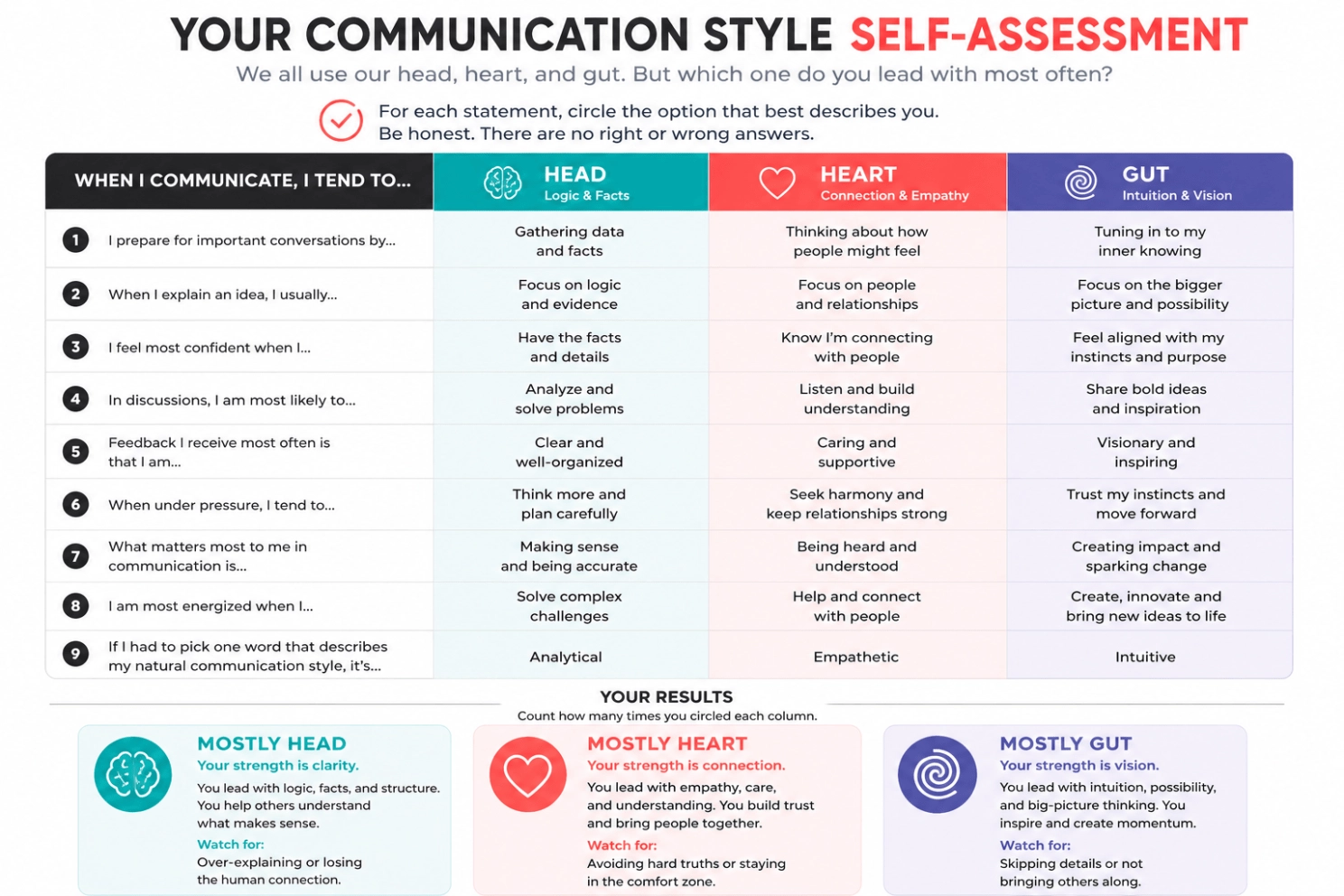
Your results are not a label or a limitation. They are a starting point for growth. The goal is not to become less analytical, less empathetic, or less intuitive. The goal is to expand your range. The most influential communicators know when to inform the mind, when to connect with the heart, and when to awaken the gut. They move fluidly between all three, choosing the voice their audience needs most in that moment.
Putting It Into Practice
Communication is not about choosing between the head, the heart, or the gut. It’s about knowing when each voice is needed and learning to weave them together into one compelling message.
Like any skill, this takes practice. The good news is that every conversation, meeting, presentation, or difficult discussion is an opportunity to strengthen your range.
Tips for Communicating from the Head
The head creates clarity. It helps people understand what is happening, why it matters, and what comes next. It has facts, data, and is backed up with intellectual rigor.
Before speaking, ask yourself:
- What are the three most important facts people need to know?
- What evidence or data will build credibility?
- Have I explained the “why” clearly?
- Is my message simple and easy to follow?
Remember: Information reduces uncertainty.
Tips for Communicating from the Heart
The heart creates connection. It reminds people they are seen, valued, and understood.
Before speaking, ask yourself:
- How might people be feeling right now?
- Have I acknowledged their perspective?
- Am I showing empathy without losing direction?
- Have I created psychological safety?
Remember: People don’t care how much you know until they know you care.
Tips for Communicating from the Gut
The gut unveils the truth and creates resonance. It brings to light what is self-evident and helps people believe in what is possible. It touches and ignites the soul.
Before speaking, ask yourself:
- What future am I inviting people to create?
- What do I deeply believe about this message?
- Am I communicating with conviction?
- Does my message inspire action rather than simply understanding?
- What phrases or words can I create that are memorable or sticky?
Remember: Conviction is contagious.
Bringing the Three Voices Together
Before every important conversation, take two minutes and ask yourself three simple questions.
Head: What do people need to understand?
Heart: What do people need to feel?
Gut: What do people need to believe?
When your message answers all three questions, something extraordinary happens. People don’t just understand your words. They feel connected to your message, believe in your vision, and are inspired to act.
The goal isn’t to become a different communicator. It’s to become more integrated. To speak with the clarity of the head, the compassion of the heart, and the conviction of the gut.
The greatest communicators don’t rely on charisma. They rely on wholeness.
When these three voices come together, your communication becomes more than persuasive—it becomes authentic. More than memorable—it is imbued with meaning. More than influential—it becomes transformational.
Because the most powerful messages don’t simply change minds. They touch hearts. They awaken knowing, and they inspire people to become part of something greater than themselves.
In a world where information is abundant and artificial intelligence can generate words in seconds, your greatest advantage is no longer what you know. It is how deeply you connect and communicate with authenticity.


